Mint tea and café culture in Tunisia
What makes Tunisian mint tea different, and how does café culture work?
Tunisian mint tea is green tea brewed strong and sweet with fresh mint, often topped with toasted pine nuts as a mark of hospitality or a small extra charge. Cafés themselves are mostly male-dominated, slow-paced spaces built for sitting for an hour over one glass, not a quick coffee-to-go — order at the table, expect a wait, and don't rush the ritual.
A glass of mint tea in Tunisia is rarely just a drink. It’s the thing a shopkeeper offers while you look at a carpet you have no intention of buying, the reason a two-hour lunch with Tunisian friends turns into a four-hour afternoon, and, in cafés from the Tunis medina to the seafront at La Marsa, the whole point of sitting down in the first place. This guide covers what’s actually in the glass, how a Tunisian café functions as a social space rather than a quick coffee stop, and where to experience it properly, from workaday neighbourhood spots to the postcard terraces of Sidi Bou Said.
| Where | Cafés across Tunis, the medina, La Marsa and Sidi Bou Said |
| Cost | A glass of tea typically 2–5 TND (about €0.60–€1.50); pine nuts sometimes a small extra |
| Time needed | No fixed limit — an hour is normal, longer is expected |
| Getting there | On foot in the medina; TGM train for La Marsa and Sidi Bou Said |
| Best time | Mid-afternoon, or after dinner in summer when terraces stay open late |
What’s actually in a glass of Tunisian mint tea
The base is green tea, usually a Chinese gunpowder-style leaf that’s been imported and drunk across the Maghreb for well over a century, brewed strong in a small metal pot with a generous handful of fresh spearmint pressed in while it steeps. Sugar goes in during brewing rather than being stirred in afterwards, and the result is sweeter than most first-time visitors expect — closer to a dessert drink than the lightly sweetened teas common in Europe. It’s poured from a height into small glasses, a flourish that aerates the tea and raises a thin layer of foam on top, considered a sign the tea has been made properly rather than just a bit of theatre.
The genuinely distinctive touch, and the one that surprises visitors most, is the handful of toasted pine nuts sometimes dropped into the glass before pouring. It began as a gesture reserved for guests or special occasions — pine nuts aren’t cheap, and adding them signalled that the host was making an effort — and in cafés today it’s often available on request for a small extra charge rather than included by default. Order “thé à la menthe aux pignons” if you want it and it isn’t offered; plain mint tea is the standard, everyday version, and there’s no shame in sticking with that if the extra cost doesn’t interest you.
How a Tunisian café actually works
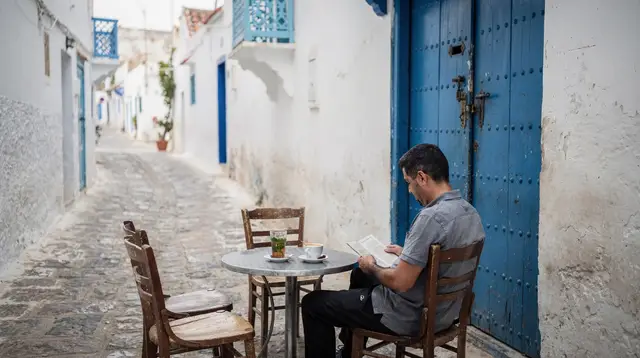
The first thing to adjust to is pace. A Tunisian café is not built around turnover the way a coffee chain is — a single glass of tea can reasonably occupy a table for an hour or more, and nobody working there will hurry you along. Waiters take orders at the table rather than over a counter, and payment usually happens when you’re ready to leave, not when the drink arrives. Cafés are also, in most neighbourhoods, still heavily male spaces in practice, particularly the older, plainer establishments filled with backgammon boards and clouds of shisha smoke.
Women are not barred and increasingly do sit in ordinary cafés, especially in central Tunis and the coastal suburbs, but a solo female traveller may notice she’s the only woman in the room at some of the more traditional spots — worth knowing rather than being surprised by, and covered in more detail in Tunisia for female travellers.
Shisha (water pipe) is a fixture at most cafés and often the reason a table is occupied for two hours rather than thirty minutes. You don’t need to smoke it to sit at a table where others are — plenty of people order tea or coffee and simply enjoy the surrounding atmosphere. If the smoke bothers you, look for a café with an open-air terrace or courtyard rather than an enclosed room, since ventilation varies enormously between venues.
Coffee versus tea: what people actually order
Mint tea gets most of the attention from visitors, but Tunisian café culture runs equally on coffee, and it’s worth knowing the basic vocabulary before you order. “Café direct” is a small, strong espresso-style shot; “café au lait” or “capucin” (a nod to the colour of a Capuchin friar’s robe) is a milkier version served in a small glass rather than a cup; “café turc” is Turkish-style coffee, sweet and unfiltered, served in tiny cups with the grounds left to settle at the bottom.
None of this is exotic to order — pointing at someone else’s glass and saying “comme ça” (like that) works perfectly well if the vocabulary doesn’t stick. For a broader introduction to Tunisian food and drink beyond the café table, see Tunisian food: a first-timer’s guide.
| Drink | What it is | Typical price |
|---|---|---|
| Thé à la menthe | Sweet green tea with fresh mint | 2–4 TND (~€0.60–€1.20) |
| Thé aux pignons | Mint tea topped with toasted pine nuts | 3–6 TND (~€1–€1.80) |
| Café direct | Small, strong espresso-style shot | 1.5–3 TND (~€0.45–€0.90) |
| Capucin | Coffee with milk, served in a small glass | 2–4 TND (~€0.60–€1.20) |
| Café turc | Sweet, unfiltered Turkish-style coffee | 2–4 TND (~€0.60–€1.20) |
Where to drink it in Tunis: from workaday to touristy
The medina has café culture at its most concentrated. Small, plain establishments tucked into side alleys off the main souk routes serve a mostly local, mostly male clientele, and prices stay noticeably lower than anywhere aimed at tourists. These aren’t destinations in themselves so much as a natural stop while walking the walking route through the medina of Tunis — sit for ten minutes with a glass of tea, watch the street, and move on.
Around Place de la Victoire and the newer Ville Nouvelle, café terraces along Avenue Habib Bourguiba lean more European in style — outdoor seating, a wider drinks menu, a more mixed clientele — while still serving the same mint tea as the medina spots at only slightly higher prices.
La Marsa, further out along the coast, has its own café scene built around the seafront corniche, popular with locals for an evening tea or coffee with a sea breeze rather than a specific historic pedigree. It pairs naturally with an afternoon at the Berges du Lac or a wider day exploring the northern suburbs.
The cafés of Sidi Bou Said, and why they’re different
Sidi Bou Said’s café scene is the one most visitors have actually seen a photograph of before arriving, even if they don’t know it by name. Café des Nattes, right at the top of the village’s main pedestrian street, is the most famous — a raised terrace of low woven-rush seating (nattes) that’s been a fixture since the early twentieth century and drew French and European writers and artists during the colonial period, part of what shaped the village’s reputation as an artists’ retreat in the first place. It’s touristy now, prices reflect that, and the tea itself is no better than what you’d get in the medina for a third of the price — but the view over the blue-and-white lanes and, on a clear afternoon, out towards the bay, is the reason people come.
Below the village, closer to the marina, a scatter of quieter café terraces look directly out over the water rather than the street, and they’re a reasonable alternative if Café des Nattes feels too crowded or too priced-up for what it delivers. The cafés of Sidi Bou Said covers the specific terraces, their views and their price differences in more detail, worth reading before you commit to sitting at the first table you see.
A cooking workshop in traditional dress in Hammamet is a reasonable way to get past the café table and actually learn how tea and Tunisian dishes are prepared at home, rather than only observing it from the outside as a visitor.
Tea as hospitality, not just a menu item
Outside cafés altogether, mint tea functions as a social obligation as much as a drink. In a carpet shop, a spice stall, or a private home, being offered tea is less a sales tactic (though it sometimes doubles as one) than a basic gesture of hospitality that it would be rude to refuse outright — accepting a small glass, even if you have no intention of buying anything, costs little and is generally read as good manners rather than naivety.
This is especially pronounced in the south and in Berber communities around the Sahara, where tea-making itself can become a small ceremony: three rounds poured from height, each slightly different in strength, traditionally described as “the first as bitter as life, the second as strong as love, the third as gentle as death.” A four-day Sahara desert and Berber culture tour is one of the more direct ways to see this tradition in a genuinely Berber context rather than a staged tourist version of it, alongside the wider caves and canyon landscapes of the south covered on a five-day Tunisia adventure through caves, nature and culture.
Tasting more than tea: a wider culinary starting point
If a café afternoon leaves you wanting to understand Tunisian food and drink more broadly rather than just the tea ritual, a private taste of Tunisia culinary adventure from Sousse works through several dishes and drinks in one guided outing, useful context for anyone whose only reference point so far has been a café terrace. For self-guided eating, street food in Tunis and couscous and brik, explained cover the food side of the equation that a tea-focused café visit doesn’t.
Ramadan and café hours
Café culture shifts noticeably during Ramadan. Daytime hours can be quieter, since many Tunisians observing the fast avoid sitting around food and drink they can’t consume until sunset, though plenty of cafés stay open for non-fasting visitors throughout the day.
The real activity happens after iftar, the sunset meal that breaks the fast, when cafés and streets fill with people well into the night in a way that doesn’t happen the rest of the year — mint tea and shisha sessions running past midnight are normal during this period. Eating in Tunis during Ramadan and travelling in Tunisia during Ramadan cover what changes for visitors in more detail.
Mistakes to avoid
Frequently asked questions about mint tea and café culture in Tunisia
Is Tunisian mint tea the same as Moroccan mint tea?
Similar in concept, both are sweet green tea with fresh mint, but Tunisian tea is typically brewed stronger and sweeter, and the pine nut topping is a distinctly Tunisian touch not commonly found in the Moroccan version.
Do I have to accept tea if it’s offered in a shop?
No, and a polite decline is perfectly acceptable, but a genuine hospitality gesture is generally worth accepting if you have the time, since refusing outright can occasionally come across as brusque rather than simply “no thank you.”
How much should a glass of tea cost?
Roughly 2 to 5 TND (about €0.60 to €1.50) for plain mint tea in an ordinary café, more with pine nuts added and noticeably more at tourist-facing spots like Café des Nattes in Sidi Bou Said.
Is it normal to sit in a café for hours over one drink?
Yes, entirely normal, and something visitors used to faster café cultures elsewhere often need to consciously adjust to rather than expect to be rushed along.
Can women sit alone in Tunisian cafés?
Yes, though comfort levels vary by venue; terrace cafés in central Tunis, La Marsa and Sidi Bou Said tend to have a more mixed clientele than older, plainer neighbourhood spots. See Tunisia for female travellers for more context.
What should I order if I don’t like mint or sugar?
Plain black tea without mint is usually available on request, and coffee (“café direct” for a small strong shot) is a reasonable alternative if the sweetness of mint tea isn’t to your taste.
Do cafés serve food as well as drinks?
Some do, usually pastries or a simple sandwich, but most Tunisian cafés are drink-focused rather than full food venues; for actual meals, see where to eat in the medina of Tunis.
Does café culture change much outside Tunis?
The basics stay similar across the country, though coastal resort towns like Hammamet lean more toward European-style café terraces aimed at tourists, while inland towns keep a more traditional, local pace closer to what you’d find in the Tunis medina.
Tunis food & drink tours on GetYourGuide
Verified deep-linked GetYourGuide tours. Book through these links and we earn a small commission at no cost to you.
These are our own photographs of Tunisia, not the operator's pictures of this tour — open the tour page to see those.