The cafés of Sidi Bou Said
Which café in Sidi Bou Said should I actually sit at?
Café des Nattes, on the main steps, is the famous one — worth ten minutes even if you don't sit, but crowded and pricier than it needs to be. Café Sidi Chabaane, lower down toward the port, has the better sea view and is a stronger choice for actually sitting down with tea and pastries for an hour.
Sidi Bou Said’s blue-and-white streets are built around cafés in a way most Tunisian towns aren’t, and sitting down at one for tea is close to the point of the visit rather than a detour from it. The village has a small handful of genuinely well-known cafés, several more that trade on proximity to them without quite matching the setting, and a couple of quieter options worth knowing about if you’d rather skip the queue. This page goes through the actual options, what each one gets right and wrong, and how to fit a proper café stop into a day that usually also includes Carthage.
| Where | Sidi Bou Said village, 20 km north-east of central Tunis |
| Cost | Mint tea with pine nuts runs roughly 6–12 TND (about €2–4); pastries a little more |
| Time needed | 45 minutes to an hour for a proper sit-down; longer at sunset |
| Getting there | TGM train from Tunis to the Sidi Bou Said stop, then a 10-minute uphill walk |
| Best time | Late afternoon into sunset; late morning to avoid both the heat and the tour-bus peak |
Café des Nattes: famous, central, and worth ten minutes
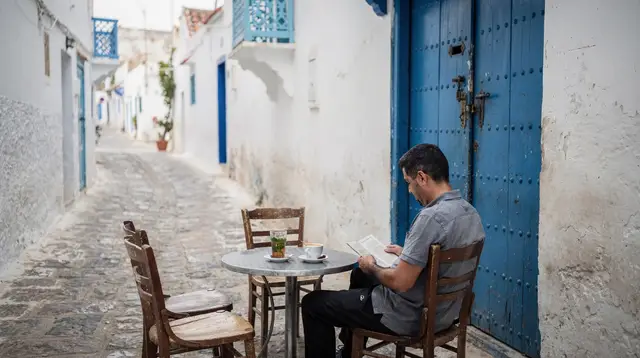
Café des Nattes sits directly on the main steps leading up into the village and is, by a wide margin, the café most photographed and most mentioned in anything written about Sidi Bou Said. Straw-mat seating, blue woodwork, and a location impossible to miss have made it a fixture for well over a century, and it genuinely was a gathering point for writers and artists in the early twentieth century rather than a manufactured claim.
The honest verdict, though, is that its fame now works against the experience of sitting there: prices run higher than anywhere else in the village, service is stretched thin at peak hours, and the seating directly on the steps means a constant stream of passers-by rather than a relaxed setting. It’s worth stopping at, even briefly, for what it represents — but treating it as the one café to sit at for an hour, rather than one stop among several, oversells it.
Café Sidi Chabaane: the view that’s worth the walk down
Lower in the village, closer to the small port, Café Sidi Chabaane trades the historic pedigree of Café des Nattes for a genuinely better physical setting: terraced seating built into the hillside with an open view over the Gulf of Tunis, especially striking as the light drops toward evening. It’s a longer walk from the main square than most visitors expect — down a steep, narrow lane rather than a short detour — which thins the crowd noticeably compared to the cafés clustered near the top of the village. Reaching it near sunset, order tea and a plate of something sweet, and settle in for the view rather than treating it as a quick photo stop; it rewards the extra time more than any other café in the village.
The smaller cafés along the main street
Between the two well-known names sits a run of smaller, less individually famous cafés along the main pedestrian street, most with similar menus — mint tea, Turkish coffee, a small selection of pastries — and similar blue-and-white terraces. Quality and price here vary more by which one happens to be quiet when you pass than by any consistent difference between them, and none carries quite the reputation of the two above. This is where locals more often actually sit, away from the two most tourist-heavy spots, and it’s a reasonable way to get a calmer version of the same experience without the crowd or the premium pricing.
If you want the village beyond its terraces, the complete guide to Sidi Bou Said covers the streets, the views and the practical details, and a winter afternoon in Sidi Bou Said shows how different a café stop feels when the tour groups are absent. The Café des Nattes question goes further into whether the famous name deserves its reputation.
Comparing the main café options
| Café | Setting | Crowd level | Price | Best for |
|---|---|---|---|---|
| Café des Nattes | On the main steps, historic | High, especially midday | Higher | A brief stop, the photo, the history |
| Café Sidi Chabaane | Terraced, sea view | Moderate, thins with the walk down | Moderate | An hour at sunset |
| Smaller street cafés | Along the main pedestrian street | Lower, more local | Lower | A calmer, cheaper sit-down |
Mint tea with pine nuts: what to actually order
The village’s signature order is mint tea served with a scattering of pine nuts floated on top, sweeter and more elaborate than the everyday glass of tea found elsewhere in Tunisia, and worth ordering specifically rather than a plain tea or coffee if this is your one café stop in Sidi Bou Said. It’s usually served in a small, ornate glass rather than a cup, and the sugar content is high by most travellers’ standards — if that’s a concern, it’s fine to ask for it less sweet, though the pine nuts are part of the dish either way.
For more on the wider role tea plays in Tunisian café culture beyond this one village, mint tea and café culture in Tunisia is worth a read, and if pastries are part of the plan, Tunisian pastries and sweets covers what’s typically on offer alongside the tea.
Timing your visit: when the cafés are actually pleasant
Sidi Bou Said draws heavy day-trip and tour-bus traffic, and the café terraces fill fastest between roughly 11am and 3pm, when group tours from Tunis, Hammamet and the cruise port at La Goulette tend to arrive together. Reaching the village by mid-morning, before that wave lands, or staying into late afternoon after it clears, makes a meaningful difference to how crowded any given café feels — the same table that’s a ten-minute wait at 1pm is often free at 4pm. Sunset is the busiest single window at Café Sidi Chabaane specifically, given its view, so arriving 30–45 minutes before sunset to secure a table is worth doing if that’s the plan.
Combining a café stop with Carthage
Almost nobody visits Sidi Bou Said in isolation — it sits a short distance from Carthage’s Roman and Punic sites, and most day trips from Tunis combine the two. A private tour taking in the Bardo museum, Carthage, Sidi Bou Said and the Tunis medina is a reasonable way to see all four in a single day if time is tight, with a driver handling the transfers between sites rather than relying on public transport.
A more focused Carthage and Sidi Bou Said tour covers just the two, leaving more unhurried time in the village itself, including a proper café stop rather than a quick photo pass. For those based in Hammamet rather than Tunis, a tour from Tunis covering the Bardo, Tunis medina, Carthage and Sidi Bou Said runs the same combination as a full-day excursion from the coast.
If you’d rather plan the visit yourself using public transport, the TGM light rail connects Tunis, Carthage and Sidi Bou Said along the same line, and the TGM: Tunis to La Marsa by train explains the route and timing. Carthage and Sidi Bou Said in a day lays out a full self-guided itinerary if a tour isn’t what you’re after, and Sidi Bou Said covers the village more broadly beyond just its cafés.
Choosing between Sidi Bou Said and its neighbours
A café afternoon in Sidi Bou Said is one way to spend time on this stretch of coast, and it helps to know the alternatives. Sidi Bou Said versus La Marsa compares the two villages if you can only pick one for a long sit-down, while medina rooftop views in Tunis offers a different kind of tea-with-a-view back in the city. If the day is built around the sea, the best hammams in Tunis make a good slow ending once the café hour is done, and Tunis in one day shows where a café stop sits in a tight schedule.
Beyond tea: an active stop before you sit down
Sidi Bou Said also sits right on the water, and a growing number of visitors pair a morning on the small bay with the café stop rather than treating the village purely as a place to walk and sit. A private paddleboarding and kayaking session in Sidi Bou Said runs from the village’s own stretch of coast, a genuinely different way to see the blue-and-white cliffs than from a café terrace above them, and works well as a first-half-of-the-day activity before settling in for tea once the sun starts dropping.
Prices and being overcharged
Menu prices at the village’s best-known cafés, Café des Nattes in particular, run noticeably above what the same tea and pastries would cost a few streets away or in central Tunis, and that’s a known, accepted premium for the setting rather than a scam — most menus display prices clearly, and it’s reasonable to check before ordering if that matters.
Occasional reports of inflated bills or added items happen more at smaller, unmarked stalls than at the established cafés, so sticking to a café with a visible printed menu is the simplest way to avoid a dispute over the final bill. For more on the wider food scene beyond tea and pastries, Tunisian food: a first-timer’s guide and the food and drink hub cover the rest of the table.
Mistakes to avoid
Frequently asked questions about the cafés of Sidi Bou Said
Is Café des Nattes worth visiting if it’s crowded and pricier?
Briefly, yes, for the history and the setting on the main steps. As a place to sit for a full hour, Café Sidi Chabaane or one of the smaller street cafés is generally the better choice.
Which café has the best sea view?
Café Sidi Chabaane, lower in the village toward the small port, has terraced seating with an open view over the Gulf of Tunis, especially good near sunset.
What should I order at a Sidi Bou Said café?
Mint tea with pine nuts is the village’s signature order, sweeter and more elaborate than an everyday glass of tea. Pastries from a nearby pâtisserie pair well with it.
When is the best time to visit for a quiet café stop?
Mid-morning before roughly 11am, or after 3pm once the main tour groups have thinned out. Sunset is calmer everywhere except at Café Sidi Chabaane, which gets busy specifically for the view.
Can I combine a café visit with Carthage in the same day?
Yes, and most visitors do — the two sit a short distance apart and are commonly combined on both guided tours and self-guided TGM train routes. See Carthage and Sidi Bou Said in a day.
Are the cafés in Sidi Bou Said expensive?
Somewhat, particularly the well-known ones, but prices are generally displayed clearly and the premium reflects the setting rather than being a scam.
Is there anything active to do in the village besides sitting at a café?
Yes — the village sits directly on a small bay, and a paddleboarding or kayaking session from the water gives a different view of the same blue-and-white cliffs before you sit down for tea.
Do I need a full day for Sidi Bou Said, or is a couple of hours enough?
A couple of hours covers the main streets and a proper café stop comfortably. Most visitors combine it with Carthage to fill a full day rather than spending the whole day in the village alone.
Tunis food & drink tours on GetYourGuide
Verified deep-linked GetYourGuide tours. Book through these links and we earn a small commission at no cost to you.
These are our own photographs of Tunisia, not the operator's pictures of this tour — open the tour page to see those.