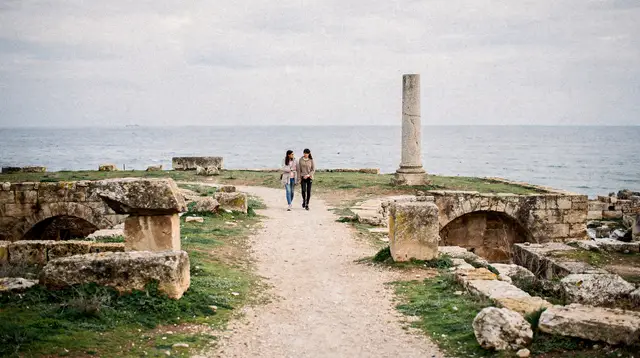
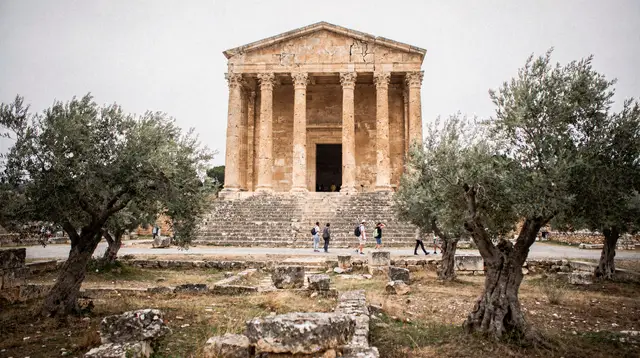
The medina of Sousse and its ribat
How much time do you need for the medina of Sousse?
Budget three to four hours to see the ribat, the courtyard of the Great Mosque, the kasbah's archaeological museum, and the main souks without rushing. Add another hour if you want to sit down for tea or lunch inside the walls, or if you're visiting on a Friday morning when the mosque area gets busy before prayers.
Sousse’s medina sits behind stone ramparts a short walk from the modern seafront, and it is one of the few old towns in Tunisia where the walls, the ribat, and the Great Mosque all survive close together and largely intact. Unlike some other historic quarters, this one is still a working town: haberdashers, spice sellers, and tailors trade a few metres from stalls selling leather bags and keyrings to day-trippers off the coach.
The old town was inscribed as a UNESCO World Heritage Site in 1988, largely on the strength of this cluster of ninth-century Aghlabid buildings sitting almost untouched in the middle of a modern city. A visit works best as a half day rather than a rushed hour between excursions, because the ribat, the mosque, and the kasbah museum each reward fifteen to forty minutes on their own terms, not five.
| Where | The old town of Sousse, behind the ramparts, a short walk from the port and Boulevard Habib Bourguiba |
| Cost | The ribat and the kasbah museum are ticketed separately, each around 8-11 TND (roughly €2.50-3.50) for foreign visitors; walking through the mosque courtyard and the souks themselves costs nothing |
| Time needed | Three to four hours to see the ribat, the mosque courtyard, the kasbah museum, and the main souks without rushing |
| Getting there | A 10-15 minute walk from Sousse’s Bab Jedid train station, or a short taxi ride from hotels in Port El Kantaoui or along Boulevard Habib Bourguiba |
| Best time | Weekday mornings before 10:00, avoiding Friday prayer times and the flat heat of a midsummer afternoon |
A medina that still earns its living
What sets Sousse apart from some of the more polished old towns further north is that this one hasn’t been entirely handed over to tourism. Walk two streets back from the ribat entrance and you’re in a working souk where tailors alter trousers, hardware stalls sell mismatched screws by the handful, and nobody is trying to sell you a carpet.
The touristy stretch is real and it’s concentrated: the lanes closest to the ribat and the port gate are lined with leather goods, spice cones dyed for photographs rather than cooking, and the occasional tout offering a “free” rooftop view that ends in a sales pitch. Neither version cancels the other out. Most visitors end up walking through both without quite noticing the seam, and that’s fine, but it helps to know it’s there so the pushier stretch near the entrance doesn’t sour the rest of the visit.
Sousse’s medina is smaller and flatter than the medina of Tunis, easier to cover on foot in a morning, though also less to discover if you’ve already spent a day getting lost in the capital’s old town. See the walking route through the medina of Tunis for that bigger, denser comparison; Sousse is the more compact, more legible half-day version.
Finding your way in: the gates and the layout
The medina is walled on all sides, and most visitors enter through Bab el Bhar or one of the gates nearest the port, close to where the ribat and the Great Mosque stand side by side. From there, the main commercial spine runs roughly north-south through the souk area, with the kasbah and its tower rising on the higher ground toward the southern end of the walls. It isn’t a difficult layout to hold in your head: aim for the ribat first since it’s the tallest landmark and everything else radiates from around it, then let the souk streets pull you south and slightly uphill toward the kasbah once you’ve had enough of postcards and spice photographs.
Street signs are inconsistent and phone signal in the thicker-walled lanes can be patchy, so fix a couple of reference points before setting off: the ribat’s watchtower, the minaret of the Great Mosque, and the kasbah’s Khalef tower are all visible from various points inside the walls and make reasonable landmarks to walk back toward. None of this requires a guide, though a guided half day removes the guesswork if you’d rather not think about navigation at all.
Sousse & Monastir: Full-Day Tour with Ribat & Medina covers the ribat, the medina, and a run down the coast to Monastir in one outing, which is a reasonable way to see both towns without arranging your own transport between them.
The ribat of Sousse: a fortress built for monks and soldiers
The ribat is the medina’s single most recognisable building, and it earns that status. Started in the early ninth century under the Aghlabids, it was built as a fortified monastery for soldier-monks who combined military watch duty on the coast with religious devotion, part of a chain of similar structures along the Sahel that also included the ribat at Monastir. The building is plain and thick-walled from the outside, almost defensive in a way that reads as unglamorous until you’re inside and realise how deliberately it was designed: small cells around a central courtyard, a prayer room, and a narrow staircase that climbs the watchtower.
The climb to the top of the tower is the part most people remember. The stairs are steep, uneven in places, and genuinely narrow — this is not a wheelchair-accessible or claustrophobia-friendly climb — but the view from the top takes in the whole medina roofscape, the port, and the sea beyond the ramparts, and it’s a much better vantage point than any of the “free rooftop view” offers you’ll get pitched near the entrance.
Expect twenty to thirty minutes for the ribat if you climb the tower, less if you stick to the ground floor. For more on how this building fits into the wider network of coastal fortifications, the ribats and fortresses of the Sahel covers the pattern across several towns, including Monastir’s better-known example.
The Great Mosque of Sousse
A short walk from the ribat, the Great Mosque of Sousse dates from 851 and is one of the oldest surviving mosques in Tunisia, built without a minaret in its original form — the current one is a later addition. As with most working mosques in Tunisia, the prayer hall itself is not open to non-Muslim visitors; what you can see is the large open courtyard, which is usually accessible outside prayer times for a small entry fee, and which gives a good sense of the mosque’s scale and its castle-like crenellated walls, a detail it shares with the ribat next door.
Dress modestly for this stop specifically: shoulders and knees covered, and a scarf on hand for women, even though you won’t be entering the prayer hall itself. Staff at the entrance do turn away visitors in shorts or vest tops, and there usually isn’t a wrap-around-you-can-borrow the way there sometimes is at more visited mosques elsewhere. If you only have time for one mosque interior-adjacent stop in the region, this courtyard and the ribat next to it together give a more complete picture of Aghlabid-era Sousse than either does alone. Mosque etiquette in Tunisia has the fuller rundown on what’s expected at working mosques generally, including why the courtyard-only rule exists.
The kasbah, the Khalef tower, and the archaeological museum
At the highest point of the medina, the kasbah complex houses Sousse’s archaeological museum, and the ticket also gets you access to the grounds around the Khalef tower, a watchtower-lighthouse that predates most of what’s now built around it. The museum itself is modest by the standards of the Bardo in Tunis, but it holds a genuinely good collection of Roman-era mosaics recovered from sites across the region, displayed in a manageable handful of rooms rather than the sprawling wings of the capital’s museum.
Expect thirty to forty minutes here if mosaics interest you, closer to fifteen if they don’t — it’s honestly a site some visitors find skippable if they’ve already been to the Bardo, and one that others rate as the best single stop in the medina. Both reactions are fair depending on what you’ve already seen.
The following table gives a rough sense of what to budget for the main paid sights inside the walls, in TND with an approximate euro equivalent — treat these as an order of magnitude rather than an exact quote, since ticket prices for foreign visitors do get revised.
| Site | Approx. cost | Time needed |
|---|---|---|
| Ribat (with tower climb) | 8-11 TND (roughly €2.50-3.50) | 20-30 minutes |
| Great Mosque courtyard | 3-5 TND (roughly €1-1.50) | 10-15 minutes |
| Kasbah & archaeological museum | 8-11 TND (roughly €2.50-3.50) | 15-40 minutes |
| Souks (browsing, no purchase) | Free | 45-90 minutes |
None of these sites are free, and it’s worth planning for that rather than assuming the archaeological ones will be, since that assumption is a common source of frustration at the ticket booth. For a deeper look at the museum’s holdings specifically, see the archaeological museum of Sousse.
The souks: what’s genuinely local and what’s for the coach parties
Sousse’s souks fan out from the area between the ribat and the mosque, and they split fairly cleanly into two characters. The stretch nearest the ribat entrance — Souk el Caïd and the lanes immediately around it — is where cruise groups and coach tours get funnelled, and the stock reflects that: leather bags, ceramic plates painted for display rather than use, shisha pipes, and a fair amount of pressure to step inside “just to look.” Prices here start high and bargaining is expected as a matter of course, not an insult.
Walk a few streets further in, particularly toward the perfume souk and the areas selling everyday fabric and household goods, and the tone changes. These are stalls serving Sousse residents rather than visitors, prices are fixed or close to it, and nobody minds if you walk past without buying anything. It’s a less photogenic slice of the town, but it’s the part that makes the difference between a tick-box stop and somewhere worth the detour. If bargaining makes you uneasy, bargaining in a Tunisian souk without getting it wrong covers the etiquette, and buying a Tunisian carpet or kilim helps if a carpet seller corners you, which near the ribat they will.
The Sublime Medina of Sousse with its Great Mosque, Ribat, and Souks is built around exactly this route — ribat, mosque courtyard, and both faces of the souk — with a guide who can point out which stalls are aimed at locals, which is genuinely useful the first time round.
Kalaa Kebira, Hergla, and the medina’s quieter neighbours
If the crowds near the ribat entrance start to grate, Sousse’s medina isn’t an isolated attraction — it sits within a stretch of the Sahel coast with smaller, quieter towns a short drive away. Kalaa Kebira, a few kilometres inland, has its own modest old quarter and a reputation for weaving, without a fraction of the visitor traffic. Hergla, a fishing town between Sousse and Hammamet, has a small whitewashed old centre and a working harbour that gives a sense of what Sousse’s own waterfront probably looked like before tourism took over the seafront strip. Neither is a must-do on a first trip, but both work as half-day add-ons for a longer stay.
Port El Kantaoui, by contrast, is the marina resort just north of Sousse, and it is not a historic medina — it’s a purpose-built holiday complex from the 1970s and 80s styled to look vaguely traditional, with its own shops and a small mock-medina arcade. It’s pleasant for an evening walk along the marina, but visitors expecting an old town there are usually disappointed; the real one is in Sousse itself. See Port El Kantaoui for what the resort area actually offers.
Sousse: Private Trip to Kantaoui, Sousse Medina, and Hergla strings these three together with a private driver, which suits travellers based in Port El Kantaoui hotels who don’t want to arrange separate taxis for each stop.
Dress, prayer times, and what you can’t go into
A few practical points are worth settling before you set off rather than discovering them at the door. Shoulders and knees covered is the baseline for the mosque courtyard and generally sensible for the ribat too, even though the ribat itself has no religious function today. Fridays bring extra foot traffic and a period around midday prayers when the mosque courtyard may close to visitors entirely; if Friday is your only day in Sousse, plan the mosque stop for the morning and save the souks and kasbah for the afternoon.
As with mosques across Tunisia, the prayer hall of the Great Mosque is closed to non-Muslim visitors — only the courtyard is open, and this is the standard arrangement nationwide, not something specific to Sousse. Bring cash in small denominations for the ticketed sites, since card machines are inconsistent at the smaller entrances, and expect to be asked to store bags before the tower climb.
How much time to set aside, and when to come
Three to four hours covers the core route comfortably: ribat, mosque courtyard, kasbah museum, and a proper walk through both faces of the souk. Add an hour if you want to stop for tea or a plate of brik inside the walls, which is a reasonable way to break up the walking and watch the medina’s daily rhythm rather than just its monuments. Cruise ship days bring a noticeable spike in the streets closest to the ribat entrance, typically mid-morning through early afternoon; if your schedule allows it, an early start before 9:30 or a later visit after 15:00 avoids the worst of it.
Season matters more here than at inland sites, since the medina offers very little shade and the stone streets hold heat. Spring and autumn are the most comfortable seasons for walking the full route; midsummer is manageable if you go early. The best time to visit Tunis covers seasonal patterns that broadly apply to the Sahel coast too, with slightly milder winters on the coast than inland.
Where the medina disappoints, and where it earns the detour
Honestly, the stretch of souk immediately inside the port-side gates is the weakest part of a Sousse visit: it’s the most crowded, the most aggressively sold, and the least representative of the town beyond it. Visitors who only walk that one lane, buy a keyring, and leave with the impression that Sousse’s medina is a tourist trap aren’t wrong about what they saw — they’ve just seen the smallest and least interesting slice of it. The ribat, the mosque courtyard, and the kasbah museum are all genuinely worthwhile monuments on their own merits, and the quieter souk lanes further in are a far more honest look at how the old town actually functions.
Where it falls short of the medina of Tunis is scale — there’s simply less of it, and a determined visitor can see the whole thing in half a day, which some will read as underwhelming after bigger old towns elsewhere. Deciding between Sousse and Hammamet’s smaller, more resort-adjacent old town? Hammamet or Sousse? lays out the trade-offs, and the medina of Hammamet covers the alternative in full. Against the medina of Kairouan — inland, more purely religious, less geared toward day-trippers — Sousse is the easier, more coastal-holiday-friendly option, but Kairouan edges it on historical weight.
Getting to Sousse and back
Sousse sits on Tunisia’s main coastal rail line, and the train from Tunis is the most straightforward option for a day trip, arriving at a station a short walk from the medina walls. Louages and long-distance taxis cover the same route more quickly but with less predictable comfort, and if you’re staying in Hammamet or Port El Kantaoui, a taxi or an organised tour is usually simpler than working out local transport connections yourself.
| From | Journey time | Typical option |
|---|---|---|
| Tunis | Around 2-2.5 hours | Train from Tunis to Sousse, or a shared louage |
| Hammamet | Around 45-60 minutes | Taxi, louage, or an organised day tour |
| Port El Kantaoui | 15-20 minutes | Taxi or the TGM-style local shuttle where available |
| Monastir | 20-30 minutes | Taxi, louage, or combined with a ribat-and-medina tour |
If you’re combining Sousse with Monastir in the same day, Sousse and Monastir in a day lays out a route that works whether you’re driving yourself or booking transport. For general orientation on the town beyond the medina walls, see Sousse and the broader things to do in Sousse hub, or the wider medina and souks category for comparable old towns elsewhere in the country.
Frequently asked questions about visiting the ribat and medina of Sousse
Is the ribat of Sousse worth climbing for the view?
Yes, for most visitors it’s the highlight of the site. The staircase is steep, narrow, and unlit in places, but the top of the tower gives a clear view over the medina’s rooftops, the port, and the sea — a better vantage point than the informal “free view” offers touted by shopkeepers near the entrance.
Can non-Muslims enter the Great Mosque of Sousse?
Only the courtyard is open to non-Muslim visitors, not the prayer hall. This is the standard arrangement at working mosques across Tunisia, not a Sousse-specific restriction, and the courtyard alone gives a good sense of the mosque’s ninth-century scale and fortress-like walls.
Is there a combined ticket for the ribat, kasbah, and museum?
Ticketing is generally separate rather than bundled, so budget for the ribat and the kasbah museum as two distinct entry fees. Combined regional passes exist for some archaeological sites in Tunisia, but check current availability at the ticket booth rather than assuming one applies here.
Do I need a guide to visit the ribat and kasbah?
No, both sites are straightforward to visit independently, with signage in French and some English. A guide adds historical context and can steer you toward the less touristy souk lanes more efficiently, which is the main advantage of booking an organised half day.
Is the medina of Sousse safe to walk around after dark?
The medina is generally calm in the evening, though souk stalls close earlier than seafront restaurants, so the atmosphere inside the walls thins out after dinner. Sticking to the main lanes near the ribat and mosque, which stay reasonably lit and populated, is the sensible approach after dark.
How does the medina of Sousse compare to the medina of Kairouan?
Kairouan’s medina is inland, built around a much larger and more significant mosque complex, and carries more religious weight as one of Islam’s holy cities. Sousse’s medina is smaller, coastal, and easier to combine with a beach trip, but doesn’t match Kairouan’s depth for religious architecture.
What should I wear to visit the ribat and the Great Mosque?
Modest dress works for both: shoulders and knees covered, with a scarf on hand for women even though the mosque’s prayer hall stays closed to non-Muslim visitors. Comfortable, closed shoes are worth it for the ribat’s uneven tower staircase.
Is the medina of Sousse walkable from the cruise port?
Yes, when a ship docks in Sousse, the medina’s port-side gates are within easy walking distance, which is exactly why the lanes closest to that entrance see the heaviest tourist traffic and the pushiest selling. Walking a few streets further in quickly thins the crowds.
Medina & souk tours on GetYourGuide
Verified deep-linked GetYourGuide tours. Book through these links and we earn a small commission at no cost to you.
These are our own photographs of Tunisia, not the operator's pictures of this tour — open the tour page to see those.