The fishermen of Ghar el Melh
I got to Ghar el Melh at half past six in the morning, mostly by accident — a bus timetable I’d misread meant arriving two hours before I’d planned, and I ended up on the lagoon shore watching the small wooden boats come in rather than sitting in a café waiting for the village to open. It turned out to be the best possible mistake. Ghar el Melh doesn’t have much of a tourist infrastructure to open in the first place, and the hour I spent watching nets get hauled and sorted, unbothered by anyone since I clearly wasn’t there to buy anything, told me more about the place than any amount of daytime wandering would have.
| Where | A lagoon fishing village roughly 55km north of Tunis, near Bizerte |
| Cost | A day trip costs little beyond transport — a few TND for a shared taxi or louage from Tunis or Bizerte |
| Time needed | Half a day is enough; there’s little to fill a full day beyond the harbour and the beach |
| Getting there | Louage or shared taxi from Bizerte is simplest; a private day trip removes the guesswork |
| Best time | Early morning, when the fleet returns, or late afternoon for the light on the lagoon |
A lagoon village that never became a resort
Ghar el Melh sits on a shallow lagoon separated from the open Mediterranean by a narrow spit, and that geography is most of the explanation for why it never developed the way Hammamet or Sousse did further along the coast — there’s no proper beach right at the village, the water is too shallow and reedy for swimming, and the harbour exists purely for the fishing fleet rather than for tourism.
Ottoman-era forts sit on the hills above the lagoon, half-ruined and rarely visited, a reminder that this was once a defended corsair port rather than the quiet backwater it is today. Our guide to Ghar el Melh and Sidi Ali El Mekki covers the fuller history and the beach nearby in more depth than this account needs to.
Watching the boats come in
The boats are small, mostly wooden, painted in the faded blues and greens common along this stretch of coast, and they came in over about ninety minutes rather than all at once — a staggered return that meant the harbour stayed busy without ever feeling crowded. Nets came off in tangled piles that two or three men would sort together, working fast and talking constantly, occasionally calling something across to a boat still coming in. Nobody paid me any real attention beyond a couple of nods; this clearly wasn’t a scene arranged for visitors; it was simply the morning’s work, and I happened to be standing nearby.
The catch itself was smaller and more varied than I expected — no single dominant species, just a mix that seemed to reflect whatever the lagoon and the nearby open water had given up that morning. A few buyers, mostly local rather than restaurant staff from further afield, were already negotiating prices dockside before the boats had fully unloaded, in Arabic too fast for me to follow beyond the numbers. Our broader beaches and coast hub and guide to boat trips from Tunis are useful if this kind of low-key coastal morning is what you’re after elsewhere in the region too.
What the village looks like once the fleet’s in
By mid-morning, once the boats had settled and the nets were drying on racks along the shore, Ghar el Melh itself turned out to be a small, sleepy collection of streets with almost nothing aimed at visitors — a couple of cafés, no souvenir stalls, no one selling anything beyond what the village itself needed. I found this more restful than the medina in Tunis or the tourist strip in Hammamet, precisely because nobody was trying to sell me anything at all. It’s not a place with much to actively do, and I’d be lying if I said there was a full day’s worth of sights here; it’s a place to sit with a coffee, watch the lagoon, and appreciate a working fishing village that has stayed exactly that.
a boat trip along the coast to Sidi Ali El Mekki beach extends the morning into something closer to a full day out, combining the lagoon village with a proper stretch of open-water coastline a short distance away — useful if, like me, half a day in the village itself feels like enough and you want the second half of the day to include actual swimming.
The drying nets and the smell of the place
I want to be honest that Ghar el Melh smells strongly of fish and tar in the mornings, close to the harbour especially, in a way some visitors find charming and others find genuinely off-putting. It faded within twenty minutes of walking away from the water, but it’s worth knowing about before you go rather than being surprised by it on arrival. The nets themselves, laid out to dry on wooden racks along a stretch of the shore, made for the single best photograph of the morning — repeating diagonal lines against the flat lagoon water, nothing staged about it.
How it compares to Sidi Ali El Mekki, just up the coast
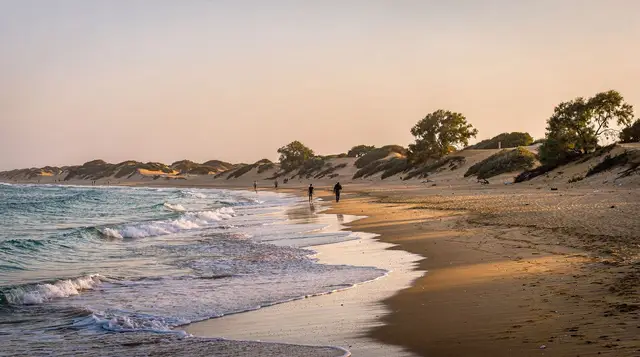
Sidi Ali El Mekki, a short drive or boat trip from Ghar el Melh, is the actual beach most day-trippers are aiming for when they come this way — proper sand, open Mediterranean water, and considerably more visitors than the fishing village itself sees. Combining both in one day works well: the working harbour in the morning, the beach in the afternoon once the light has flattened out and swimming is more appealing than photography.
Our combined guide covers the practical split between the two more thoroughly, and our wider guide to the best beaches near Tunis puts Sidi Ali El Mekki in context against the more developed options at Gammarth and La Marsa.
| Ghar el Melh | Sidi Ali El Mekki | |
|---|---|---|
| What it is | Working lagoon fishing harbour | Open-water sand beach |
| Swimming | Not really — shallow, reedy lagoon | Yes, proper Mediterranean swimming |
| Crowds | Very few, mostly local | Moderate, more day-trippers |
| Best time | Early morning, for the returning fleet | Afternoon, once the light flattens |
| Food | Very limited, plan to eat elsewhere | A few simple beachside options |
an interactive walking tour of Sidi Bou Said makes a reasonable pairing for the same trip if you’re based in Tunis and want to bookend a quiet lagoon morning with a livelier, more polished coastal town on the way back — the contrast between the two is part of what makes the day interesting rather than repetitive.
Getting there without a car
I got out to Ghar el Melh via a louage from Bizerte, which involved waiting roughly twenty minutes for the shared taxi to fill before it left — standard louage practice, and cheap once it did. Coming directly from Tunis without a car is possible but involves more connections; most independent visitors either base themselves in Bizerte first, covered in our Bizerte destination guide, or treat Ghar el Melh as part of a longer coastal drive from Tunis to Bizerte if a rental car is part of the plan.
Utica, the ancient Phoenician site a little further along the same stretch, is a reasonable add-on for the same day if Roman and Punic ruins interest you, and our Utica destination guide covers what’s actually left to see there, which is more modest than Carthage but worthwhile for the detour.
a private half-day excursion around Monastir is a reasonable substitute for travellers based further south along the coast who won’t make it up to Ghar el Melh at all but still want a comparable slower, less-touristed coastal morning — Monastir’s own harbour has a similar unhurried, working character, even if the geography and history differ considerably.
Why I’d send someone here, and why I wouldn’t oversell it
Ghar el Melh isn’t a destination that rewards someone chasing a checklist of sights, and I want to be upfront about that rather than talk it up into something it isn’t. What it offers is a genuinely unpolished working fishing village within reasonable striking distance of Tunis, at a point in most itineraries — day three or four, typically — when the medina, Carthage, and Sidi Bou Said have started to feel like a well-worn tourist circuit rather than a discovery. It resets that feeling more effectively than most other single day trips near the capital.
Food, or the lack of it, in the village itself
I’ll be honest that lunch options directly in Ghar el Melh were thin — a couple of very basic places rather than anything resembling a proper restaurant scene, which surprised me given how central fishing is to the village’s identity. Most visitors, myself included in the end, ate either in Bizerte on the way back or brought something simple with them. Our Tunisian food guide and seafood in La Goulette and La Marsa are both better bets if fresh seafood specifically is the goal, since the catch landed at Ghar el Melh mostly leaves the village rather than getting cooked there.
Mistakes to avoid
Frequently asked questions about visiting Ghar el Melh
Is Ghar el Melh worth visiting as a day trip from Tunis?
Yes, if you go in with modest expectations and ideally combine it with Sidi Ali El Mekki beach. As a standalone destination for a full day it’s thin; as a half-day contrast to busier coastal towns, it’s genuinely worthwhile.
What time should I arrive to see the fishing fleet?
Early morning, roughly six to eight, is when most boats return and the harbour is at its most active. By late morning the nets are drying and the activity has largely moved on for the day.
Can I swim at Ghar el Melh itself?
Not really — the lagoon is shallow and reedy rather than suited to swimming. Sidi Ali El Mekki, a short distance away, has the proper open-water beach most visitors are actually looking for.
Is there anywhere good to eat in the village?
Options are limited to a couple of very basic places. Most visitors eat either before arriving or in Bizerte afterward rather than counting on a meal in Ghar el Melh itself.
How do I get to Ghar el Melh without a rental car?
A louage or shared taxi from Bizerte is the most reliable route. Going directly from Tunis without a car involves more connections and isn’t the easiest option for a first visit.
Is Ghar el Melh touristy?
No, and that’s a large part of its appeal. There’s minimal tourist infrastructure — no souvenir stalls, very few visitors — which makes it feel distinctly different from Sidi Bou Said or the Hammamet coast.
Are the Ottoman forts above the village worth visiting?
Only if fortifications specifically interest you. They’re genuinely half-ruined, under-signposted, and a fairly minor addition compared to the harbour itself.
Beach & coast tours on GetYourGuide
Verified deep-linked GetYourGuide tours. Book through these links and we earn a small commission at no cost to you.
These are our own photographs of Tunisia, not the operator's pictures of this tour — open the tour page to see those.