The long road to Douz
Nobody warns you properly about how long the drive to Douz actually takes, or how much the landscape changes along the way. It isn’t a transfer you sit through with headphones in and eyes closed — somewhere past Kairouan the scenery starts shifting fast enough that closing your eyes feels like a mistake. This is a record of that drive, roughly as it happened, from the outskirts of Tunis to the edge of the erg.
| Where | Douz, around 470 km south of Tunis |
| Cost | Shared minibus or organised transport from roughly 60-120 TND one way; private car hire more |
| Time needed | 6 to 7 hours by road, depending on stops |
| Getting there | Road via Kairouan and Gabes, or a domestic flight to Tozeur-Nefta as a shortcut |
| Best time | October to April, when the drive and the destination are both far more comfortable |
Kairouan to Gabes, and the country changing under you
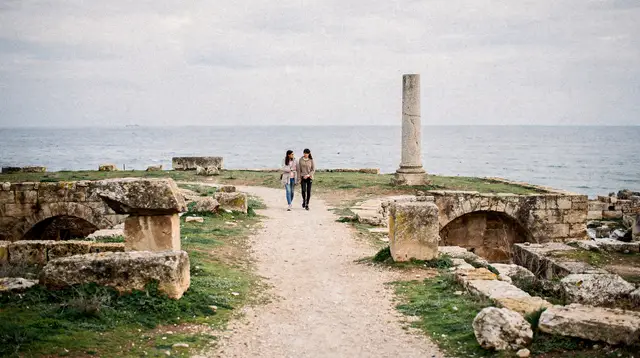
The first stretch out of Tunis is unremarkable — motorway, then a slower road through olive groves that could be almost anywhere in the Mediterranean. That changes near Kairouan, where the land starts to dry out and flatten, and it keeps changing for the next three hours. Trees thin out, then disappear except around irrigated patches. By the time you pass Gabes, the vegetation has mostly given way to stony plain, and you understand, without anyone explaining it, that you’ve crossed some kind of line.
Gabes itself is worth a mental note rather than a stop on this particular trip — it’s a coastal town with an unusual oasis running almost to the sea, but the drive south doesn’t linger there. From Gabes, the road turns properly inland, and the last hour and a half into Douz is where the desert stops being a rumour and starts being the view out the window.
What the landscape actually does, hour by hour
| Stretch | Approximate distance | What changes |
|---|---|---|
| Tunis to Kairouan | 160 km | Olive groves give way to open farmland |
| Kairouan to Gabes | 200 km | Vegetation thins, the land flattens and dries |
| Gabes to Douz | 110 km | Stony plain shifts to visible dunes near the town |
By the time Douz appears — low buildings, palm groves, a sudden run of hotels built for exactly this kind of arrival — the change from where you started feels larger than the number of kilometres suggests. This is the gateway to the Tunisian Sahara in the most literal sense: it’s the last proper town before the erg takes over, and it’s built almost entirely around that fact.
Why the road matters more than the flight
A domestic flight to Tozeur-Nefta cuts the journey down to under an hour in the air, and plenty of travellers take it, particularly on a tighter schedule. But the road trip does something the flight can’t: it shows you the transition rather than skipping past it. Watching farmland become desert over four or five hours changes how the desert itself registers when you arrive, in a way that landing directly at an airport surrounded by sand simply doesn’t replicate. If your time is limited, flying and driving are both legitimate choices, and the trade-offs are laid out properly in the comparison of Sahara tours from Tunis.
For anyone deciding how much of the south to see and in what order, Tozeur and the mountain oases sit close enough to Douz to combine into one loop, and Matmata’s troglodyte villages are a reasonable detour if you’re not in a hurry. The Star Wars filming locations scattered through this same stretch of desert are another reason several routes converge on Douz rather than treating it as an isolated stop.
What Douz is actually for
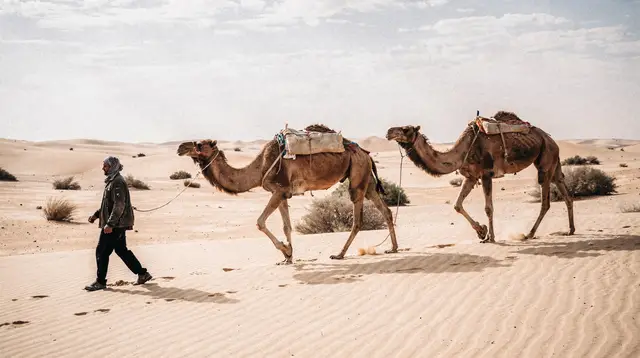
Douz exists, in its current tourist-facing form, almost entirely to put people on camels and into the dunes beyond town. That’s not a criticism — the Grand Erg Oriental starts within walking distance of the last hotels, and the camel trek is genuinely the point of coming this far south rather than an add-on. A short camel ride into the Sahara with hotel transfers covers the basics in an afternoon if that’s all the time you have.
For anyone who wants to actually sleep out under it, a 2-day Sahara desert camel trek from Douz adds a night in the dunes, which changes the experience considerably — the temperature drop after dark and the total absence of light pollution are things a day trip can’t offer. The most committed option, a 3-day camel trek with nomads in the Sahara, goes further out and spends more time with people who actually live semi-nomadically in this landscape rather than only working the tourist circuit.
Packing for any of these matters more than it sounds like it should — nights in the desert get cold even when days are hot, and the guide to what to pack for the Sahara is worth reading before you commit to an overnight option. The practical side of a night out there, from tents to toilets, is covered honestly in the guide to desert camps and bivouacs.
The stretch most people underestimate
The hour before Douz is the part nobody prepares you for properly. The road narrows, sand starts drifting across the tarmac in thin ribbons that the wind rearranges daily, and the first dunes appear close enough to the road that you could walk to them from a rest stop. It’s also, on a clear day, when the light starts doing something unusual — flatter and whiter than anywhere further north, with none of the haze that softens the Mediterranean coast. Photographs from this stretch consistently undersell how it actually looks in person, which is one of the few honest things I can say about a landscape people usually oversell.
Frequently asked questions about the road to Douz
How long does it take to drive from Tunis to Douz?
Around 6 to 7 hours covering roughly 470 km, depending on stops in Kairouan or Gabes along the way.
Is it better to fly or drive to the Douz area?
Flying to Tozeur-Nefta is faster and suits a tight schedule, but driving shows the gradual shift from farmland to desert that a flight skips entirely.
What’s the best time of year to make this drive?
October to April, when temperatures are manageable both on the road and once you arrive in Douz itself.
Is the road safe and well maintained?
Yes, the main route via Kairouan and Gabes is a well-used, sealed road. The final stretch near Douz can have drifting sand in windy conditions.
Can I do a Douz camel trek as a day trip from Tunis?
Not realistically given the drive time. Most visitors base themselves in Douz, Tozeur or elsewhere in the south for at least one night.
What should I pack for a night in the desert near Douz?
Warm layers for after dark, a hat and sun protection for the day, and comfortable closed shoes for walking on sand. The packing guide for the Sahara covers this in full.
Is Douz worth visiting if I only have a few days in Tunisia?
It’s a significant commitment of travel time, so it suits a longer trip better than a short city break. If time is tight, closer desert experiences exist further north.
Sahara desert tours on GetYourGuide
Verified deep-linked GetYourGuide tours. Book through these links and we earn a small commission at no cost to you.
These are our own photographs of Tunisia, not the operator's pictures of this tour — open the tour page to see those.