What to pack for a night in the Sahara
What should I actually pack for an overnight Sahara excursion from Tunis?
Bring warm layers even in summer (desert nights drop sharply after dark), a scarf or wrap for sand and sun, closed shoes rather than sandals, a headtorch, cash in small dinar notes, and a power bank since bivouac camps rarely have plug sockets. Skip hard-shell suitcases and anything you'd be devastated to get sand in.
Most people who get an overnight Sahara trip wrong get it wrong on temperature, not on the desert itself. They picture heat, pack accordingly, and then shiver through a January night near Ksar Ghilane wearing a t-shirt and a light jumper because nobody told them the mercury can drop close to freezing once the sun goes down. This guide is built around what actually happens on the ground on the road out of Tunis through Kairouan and Kebili towards Douz and the dunes, not a generic desert packing list copied from the Atacama or the Empty Quarter. It covers clothing by season, footwear, sun and sand protection, power and money, and the real differences between a camel-trek night and a 4x4-based bivouac.
Why the desert catches people off guard
The Sahara does two things that surprise first-time visitors: it swings temperature far more than the coast, and it gets into everything. A day that hits 38°C in Douz in July can still cool to the low twenties after midnight, which feels almost cold after the heat of the afternoon. In winter the swing is more dramatic — a mild 20°C afternoon can fall to 2-5°C by 3am, occasionally lower on a clear, windless night. Add fine sand that finds its way into camera gear, phone ports and shoe seams, and you have a packing problem that’s less about volume and more about the right handful of items.
| What to know | Detail |
|---|---|
| Best season for comfort | October–April (cooler days, cold nights) |
| Typical night temperature | 2–12°C in winter, 18–25°C in summer |
| Typical day temperature | 20–25°C in winter, 35–42°C in summer |
| What the camp usually provides | Blankets, mattress or mat, tent or open-air bivouac |
| Getting there from Tunis | Road trip via Kairouan and Kebili, or a organised tour |
| Cash needed | Yes — bring dinar, cards are rarely usable in the south |
Seasonal packing: winter nights versus summer nights
Winter (November to March) is when the cold really bites. Daytime is pleasant, even mild, but as soon as the sun drops the temperature falls fast because there’s no cloud cover or humidity to hold heat in. Pack as if you were going hiking in the mountains in early spring: thermal base layer, fleece or wool mid-layer, a windproof outer layer, and a hat that covers your ears. Many first-timers assume “desert” means “warm” and pack a single hoodie; that’s the single most common regret reported after a winter bivouac.
Summer (June to September) flips the problem. Days are genuinely dangerous if you’re not careful — 40°C-plus with strong sun and dry air that dehydrates you faster than you notice. Nights are still noticeably cooler than the day but rarely uncomfortable, so a light long-sleeve layer for the evening is usually enough. The bigger packing priority in summer is sun protection and hydration rather than warmth. If you’re planning a summer trip, it’s worth reading through a dedicated guide to the Sahara in summer before you commit to dates, since some operators quietly reduce midday activity in the hottest weeks.
A seasonal packing list at a glance
| Item | Winter (Nov–Mar) | Summer (Jun–Sep) |
|---|---|---|
| Base layer | Thermal top and leggings | Light breathable shirt |
| Mid layer | Fleece or wool jumper | Optional light layer for evening |
| Outer layer | Windproof jacket, ideally down or synthetic fill | Not usually needed |
| Legwear | Trousers, thermal leggings under them at night | Light trousers, loose fit |
| Headwear | Beanie plus scarf or wrap | Wide-brim hat plus scarf or wrap |
| Sleepwear | Thermal layer even inside a tent | Light layer, camp blankets are enough |
| Footwear | Closed boots or trainers, thick socks | Closed trainers, breathable socks |
Layering for cold desert nights
The trick with desert cold isn’t one big coat, it’s layers you can add and remove as the temperature swings across a single evening. Start with a thermal base layer against the skin, add a fleece or wool mid-layer for insulation, and finish with a windproof or lightly water-resistant outer shell — desert wind at night can be sharper than the temperature alone suggests. Trousers over thermal leggings work better than one thick pair of jeans, which get cold and stiff once the sun is gone and don’t dry out easily if they pick up any damp from morning dew on the tent canvas.
Bring gloves and a warm hat for winter trips even if you never wear them in Tunis itself — a thin pair of gloves takes almost no space and makes a real difference sitting around a fire at 4am waiting for sunrise over the dunes. If you’re combining the desert leg with a stop in Tozeur or the mountain oases, pack the same layers for early mornings there too, since those inland towns also cool sharply overnight even though they sit lower than the open dunes near Douz.
Footwear and clothing for sand and dust
Sandals are the wrong shoe for the Sahara despite what the heat suggests. Loose sand gets between your foot and the strap within minutes, dunes hold surprisingly sharp grass and thorny scrub near the edges of the erg, and a closed shoe protects you from both. A pair of trainers or light hiking shoes you don’t mind getting sandy is the standard choice; boots are only worth the extra weight if you’re doing a longer trek rather than a single overnight stop. Bring an extra pair of socks — wet or sweaty socks combined with fine sand causes blisters faster than almost any other single packing mistake.
For clothing generally, loose and light-coloured cotton or linen works better than tight synthetic fabrics, which trap heat during the day and don’t breathe as well. A long-sleeve shirt and full-length trousers, even in summer, protect against sunburn and against the sand itself when the wind picks up, which it regularly does in the late afternoon. Bring one set of clothes you’re happy to retire afterwards — fine desert sand does not fully wash out of light-coloured fabric, and camp showers, where they exist at all, are basic.
Headwear, scarves and sun protection
A scarf, shesh or keffiyeh-style wrap is not a costume prop, it’s functional kit, and most operators either provide one or sell one cheaply at the edge of the dunes. Wrapped around the head and lower face, it blocks blowing sand during a windy stretch of a camel trek or 4x4 ride and doubles as extra warmth at night. Pair it with a wide-brim hat or cap for daytime sun and, in winter, a beanie for after dark.
Sunglasses with good UV protection matter more here than almost anywhere else in Tunisia — sand reflects glare upward as well as down, which is harder on the eyes than coastal sun. High-factor sunscreen (SPF 50 is standard advice) and a lip balm with SPF are worth packing specifically for this leg of the trip even if you didn’t bother much in Hammamet or along the coast, since dry desert air dehydrates skin faster than humid coastal heat does.
Hydration and food on the trip
Bring more water than feels necessary and expect the camp or tour operator to supply bottled water as part of the package on most organised excursions, including the Mahdia Sahara Desert Adventure 2-Day/1-Night excursion. As a rule of thumb, plan on at least two to three litres per person per day in summer and slightly less, though still meaningful, in winter, when it’s easy to underestimate how much you’re losing to dry air even without feeling obviously hot. A refillable bottle you top up from larger supply bottles at camp cuts down on plastic waste and is easier to carry on a camel than several small bottles rattling in a daypack.
Food on most overnight packages is included — usually a simple grilled dinner and mint tea around the fire, plus breakfast before you head back. If you have specific dietary needs, mention them when booking rather than assuming the camp kitchen can improvise on the spot; camps in the Sabria and Ksar Ghilane area are basic by design and don’t stock a wide pantry.
Electronics and power at a bivouac camp
This is the detail most trip reports skip and most travellers get wrong: bivouac camps in the open desert usually have no mains power at all, and even the more established fixed camps near Douz or Ksar Ghilane may only run a generator for a few hours in the evening, if that. Pack a fully charged power bank, ideally one with enough capacity for at least one full phone charge plus your camera or GoPro. If you’re relying on your phone for photos, download offline maps and anything else you need before you leave signal range, since coverage becomes patchy or disappears entirely once you’re well past Douz.
A headtorch is worth more than a phone torch here — camps have no street lighting, the ground is uneven sand, and you’ll want both hands free walking between the fire, the tents and the makeshift toilet area after dark. For camera gear, dust is the real enemy rather than heat: a simple dry bag or a sealed pouch for lenses and memory cards, changed away from open wind, prevents the fine grit that otherwise works its way into zoom mechanisms and hinges within a single trip.
Money, medication and toiletries
Cash is essential once you’re south of Kairouan. Card machines are unreliable to non-existent in Douz, Ksar Ghilane and along the desert routes, and camps operate on cash only for tips, extra drinks or souvenirs bought from local sellers at rest stops. Bring dinar in small notes — a 50 TND note (roughly €15) is often hard to break at a small desert stall. Budget in the region of 20-40 TND (about €6-12) per day for tips, snacks and incidentals beyond whatever your tour already includes, and check current guidance in the money and payments guide before you travel, since ATM access thins out fast once you leave the main towns.
Pack a small personal first-aid kit: basic pain relief, anything for an upset stomach, plasters for blisters, and any prescription medication you take, since pharmacies are scarce beyond Douz and Tozeur. Toiletries should be minimal and practical — wet wipes and hand sanitiser matter more than a full wash bag, since camp facilities are usually a shared basic toilet block or, on the more remote bivouac trips, nothing beyond a spade and privacy behind a dune.
Camel trek versus 4x4 tour: what changes
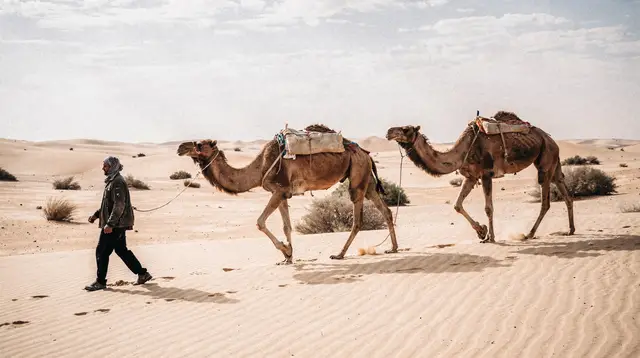
The two common ways to reach an overnight camp change what you should carry on your body versus what can travel in the vehicle. On a camel trek, whatever you carry with you needs to survive being strapped to a saddle for one to three hours each way, so a soft daypack beats a rigid bag, and you want your scarf, sunglasses, water and camera accessible without digging through a full pack mid-ride. A trip like the Sahara two-night camp and bivouac adventure typically includes a camel segment, so pack light for that leg specifically and leave the rest in the support vehicle if one is provided.
On a 4x4-based tour, luggage space is more forgiving and you can bring a slightly larger bag, but the vehicles themselves kick up dust on unpaved tracks, so anything electronic or optical should still travel in a sealed bag rather than an open side pocket. Multi-day 4x4 circuits, such as the three-day Sahara desert tour from Tunis, also cover more ground and more overnight stops, so pack one full change of clothes per night rather than relying on a single outfit for the whole trip.
If you’re comparing the two structures before booking, the two-day versus three-day Sahara tour comparison and the camel trekking guide both go into the practical differences in more depth.
What the camp provides versus what you bring
Camps vary, but the pattern across most bivouac and fixed desert camps near Douz, Sabria and Ksar Ghilane is broadly consistent. Confirm specifics with your operator, since a package like the Sahara desert two-day tour with meals and a night in a tent spells out inclusions clearly at booking, but the general split looks like this.
| Usually provided by the camp | Usually your responsibility |
|---|---|
| Tent or covered sleeping area | Personal medication and first-aid basics |
| Blankets and a mattress or foam mat | Warm layers for winter nights |
| Dinner and breakfast, plus mint tea | Snacks for the road and any dietary extras |
| Bottled drinking water (most packages) | A refillable bottle and extra water for hiking |
| A fire in the evening | Headtorch and power bank |
| Basic toilet facilities | Toilet paper, wet wipes, hand sanitiser |
What not to bring
Leave a hard-shell suitcase at your hotel in Tunis or the coast — it doesn’t fit on a camel, takes up disproportionate space in a 4x4, and its wheels are useless on sand. A soft duffel or holdall packs down better and survives being lifted on and off vehicles repeatedly. Leave anything genuinely precious behind too: fine jewellery, a laptop you’d hate to damage, or shoes you care about keeping pristine. Sand, dust and the occasional bump in an unpaved 4x4 track are part of the experience, not a rare mishap.
Don’t overpack electronics you won’t actually use. One camera or one phone for photos is plenty; a second body or extra lenses mostly just multiply the amount of gear exposed to dust for a single night’s shooting. If a proper packing checklist tool would help you plan the rest of your trip beyond this one leg, the site’s packing list tool covers the wider Tunisia trip, not just the desert night.
Travelling with kids or older relatives
Families doing an overnight Sahara trip should pack slightly differently. Bring extra layers for children specifically, since kids feel the cold night-to-day swing more than adults and are more likely to complain rather than quietly add a jumper. A familiar snack or two helps if camp food doesn’t suit fussy eaters, and a spare set of clothes matters more with children who inevitably end up sitting in sand at some point during the evening.
For older travellers, ask the operator in advance about the camel-trek segment specifically, since sitting on a moving camel for over an hour can be uncomfortable for anyone with back or hip issues, and most tours can swap that leg for a 4x4 transfer instead. There’s more detail on this in the dedicated guide to the Sahara with kids.
Frequently asked questions about packing for an overnight Sahara stay
How cold does it really get in the Sahara at night?
In winter (roughly November to March), overnight temperatures near Douz and Ksar Ghilane commonly fall to 2-8°C and can occasionally approach freezing on a clear, windless night. In summer, nights stay much milder, typically 18-25°C, which feels comfortable after a 38-40°C day.
Do I need a sleeping bag, or does the camp provide bedding?
Most camps provide blankets and a mattress or foam mat as part of the package, so a full sleeping bag isn’t essential. If you feel the cold easily or you’re travelling in the coldest winter months, packing a lightweight liner or an extra layer to sleep in is a reasonable precaution rather than relying purely on camp blankets.
Can I charge my phone or camera overnight at the camp?
Rarely, and not reliably. Open bivouac camps generally have no mains power at all, and even fixed camps near Douz or Ksar Ghilane may only run a generator for part of the evening. A fully charged power bank is the practical solution rather than assuming you’ll find an outlet.
Is it safe to drink the water provided at the camp?
Most organised tours supply sealed bottled water as part of the package, which is the safest option and what’s generally recommended throughout Tunisia rather than tap or well water in remote areas. Confirm this is included when booking and bring your own refillable bottle to top up from the supplied bottles.
What should I wear on a camel trek specifically?
Loose, full-length trousers rather than shorts, since bare skin against the saddle and rope for over an hour gets uncomfortable, plus closed shoes, a scarf for dust, and sun protection for your face and forearms since you’re exposed the whole ride with no shade.
Do I need to bring my own toilet paper and wet wipes?
Yes. Camp toilet facilities are basic, ranging from a simple shared block at fixed camps to nothing at all on remote bivouac stays, so wet wipes, tissues and hand sanitiser are worth packing regardless of which type of trip you book.
How much cash should I bring for a two-day Sahara trip?
Budget roughly 20-40 TND (about €6-12) per day for tips, snacks, tea or souvenirs beyond whatever your tour already includes, and bring it in smaller notes, since a 50 TND note can be hard for small desert stalls to change.
Is it worth bringing a proper camera, or is a phone enough?
A phone is enough for most people and is easier to protect from dust with a simple sealed pouch. If you do bring a camera, avoid changing lenses in the open near the dunes, since airborne sand during a change is what actually causes the long-term damage, more than heat or a single day’s exposure.
Should I pack differently for a two-day trip versus a three-day trip?
Mainly in volume rather than kind — a three-day circuit such as the one from Tunis to the desert and back covers more overnight stops, so pack one change of clothes per night instead of a single outfit, and bring slightly more medication and toiletries than you would for a single overnight stay. See the comparison of Sahara tours from Tunis for how the different lengths and routes affect what you’ll actually need.
Sahara desert tours on GetYourGuide
Verified deep-linked GetYourGuide tours. Book through these links and we earn a small commission at no cost to you.
These are our own photographs of Tunisia, not the operator's pictures of this tour — open the tour page to see those.