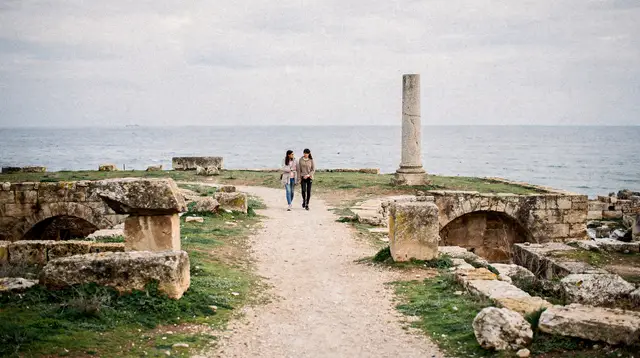
Douz, the gateway to the Tunisian Sahara
What makes Douz worth visiting on a Tunisia trip?
Douz sits right at the edge of the Grand Erg Oriental, so it's the closest most travellers get to genuine Sahara dunes rather than flat desert scrubland. It's the usual starting point for camel treks, quad tours and overnight camps into the sand, and it hosts a well-known desert festival most years in December. On its own the town is small and quiet, so most people treat it as a base for a day or two rather than a destination in itself.
Douz sits at the southern edge of the Nefzaoua region, on the last strip of irrigated palm ground before the sand of the Grand Erg Oriental takes over completely. For years it has marketed itself as “the gateway to the Sahara,” and unlike a lot of tourist-board slogans, this one holds up: paved streets stop a short drive from the centre and proper dunes begin almost immediately, not forty minutes further on as in some towns that borrow the same claim. Most travellers arrive here as the last stop before a camel trek, a desert camp or a quad excursion, and the town itself gets an afternoon of anyone’s attention at most before the sand takes over. That’s roughly the right amount of time to give it.
| Where | Nefzaoua region, southern Tunisia, on the edge of the Grand Erg Oriental |
| Cost | Free to walk around town; short camel rides from around 40 TND (about €12), multi-day treks several hundred TND |
| Time needed | Half a day for the town itself; one to three days if you’re trekking or camping in the dunes |
| Getting there | Around 470 km from Tunis, roughly six to seven hours by car, tour, or a mix of train and louage |
| Best time | November to March; June to August is extreme heat |
The dunes start where the road ends
“Sahara” gets used loosely across southern Tunisia — Tozeur, Matmata and even Kebili all trade on the word to some degree — but Douz is the one town where you can walk fifteen minutes from a hotel and be standing on genuine erg dunes, the tall, wind-shaped sand formations most people picture when they hear the word desert. The Grand Erg Oriental, the “great eastern erg,” stretches from here well into Algeria, and the section nearest Douz around the village of Zaafrane is where almost every short excursion starts. Further out, past Zaafrane and the smaller settlement of Sabria, the dunes get higher and the tour groups thin out.
This matters because a lot of what gets sold elsewhere in the region as a desert experience is actually flat, stony hammada rather than sand dunes. If seeing and climbing an actual dune is the point of the detour south, /destinations/douz/ is the more honest choice of base than towns further north that use the same marketing language without quite the same landscape on their doorstep.
If the south is new to you, it helps to read about the wider Douz destination page first, then come back here to plan the details. The camel trekking guide explains how the animals, guides and pace work, and the broader Tunis trip planning guide shows where a southern detour fits into a full Tunisia trip.
Getting to Douz from Tunis
There’s no way to make Douz a short trip from Tunis — it’s around 470 km by road, and even with good traffic that’s six to seven hours of driving, mostly on the motorway south to Gabès and then west through Kebili on secondary roads. Most independent travellers either hire a car (see our guide to /guides/car-hire-in-tunisia/) and split the drive with a stop in Kairouan or El Djem, or take the overnight train from Tunis to Gabès and finish the last stretch by louage, which trades some travel time for a night spent moving rather than sitting behind a wheel.
The simplest option for most visitors is an organised multi-day tour that bundles the run south, the nights in the desert and the drive back into one booking. A three-day Sahara desert camel trek from Douz typically includes transport from the Tunis area, so you’re not also driving yourself on top of an already long few days. It’s worth weighing that against shorter options before booking — our rundown of /guides/sahara-tours-from-tunis-compared/ goes through how the different lengths and operators stack up against each other.
Other travel modes are covered separately: driving in Tunisia deals with road conditions and habits behind the wheel, trains in Tunisia explains the rail side of the journey, and louages explained shows how the shared taxis work for the final stretch. If you would rather skip the logistics, private vs group tours in Tunisia helps you choose a format. A stop at Kairouan or El Djem breaks the trip up well, and the Tunis and the Sahara in one week itinerary shows one way to string those stops together.
Camel treks: from an hour to three days
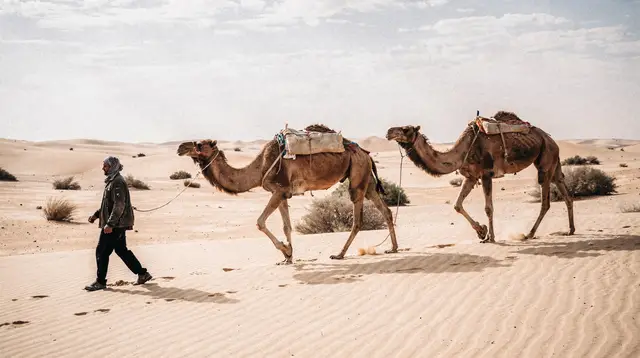
Camel treks are the reason most people come to Douz in the first place, and they range from a fairly touristy hour on a camel near the car park at Zaafrane to genuine multi-day expeditions that put real distance between you and the last paved road. A short sunset ride, generally an hour to ninety minutes, costs somewhere around 40 to 70 TND (roughly €12 to €21) per person and gives you the photograph everyone wants without much physical commitment — fine as an add-on to a day trip, not much of a Sahara experience on its own.
For something closer to what “camel trek” actually implies, the multi-day options matter more. A two-day Sahara desert camel trek from Douz gets you one night camping in the dunes with a guide and a support crew, generally covering a modest distance each day since the pace is set by the animals rather than by a mileage target. The three-day version pushes further into the erg and adds a second night, which matters if genuine silence and a horizon with no vehicle tracks in it is the point — something the two-day trip doesn’t always deliver, since its single camp can still be within earshot of the piste.
| Trip | Duration | Nights in the dunes | Roughly |
|---|---|---|---|
| Sunset ride from Zaafrane | 1 hour | None | 40–70 TND (about €12–21) |
| Short overnight trek | 1–2 days | 1 | from around 300 TND (about €90) |
| Two-day Sahara trek | 2 days | 1 | from around 450 TND (about €135) |
| Three-day Sahara trek | 3 days | 2 | from around 650 TND (about €195) |
Treat those figures as an order of magnitude rather than a quote — prices move with season, group size and what’s included, and it’s worth checking exactly what a listed price covers before comparing two operators against each other.
Choosing between the lengths comes down to how much time you have and how much silence you want. The two-day vs three-day Sahara tour guide weighs exactly that, and the Berber heritage in Tunisia guide gives useful context for the people and guides you will meet along the way. Whatever you book, read the what to pack for the Sahara list a few days before leaving, since the right layers make the difference between a good night and a miserable one.
A night in a Bedouin camp
Most of the families who once lived as full-time nomads in this part of the Nefzaoua settled in or around Douz decades ago, so a “Bedouin camp” near the dunes today is a recreation built for visitors rather than somewhere anyone actually lives year-round — worth knowing going in, since the marketing sometimes implies otherwise. That doesn’t make the experience worthless, but it’s closer to a cultural performance than a documentary, and it’s more honest to treat it that way.
A Bedouin dinner in a Tunisian Sahara camp, based out near Sabria, is the shorter version: transport out after sunset, a traditional meal cooked over a fire, sometimes music, and a return to Douz the same night rather than sleeping out. For anyone short on time or unsure about a full night on a mat in the sand, it’s a reasonable way to get the atmosphere — the fire, the dark sky, the food — without committing to the longer camel treks that build an overnight stay into the itinerary.
If you do want to compare that against a full overnight bivouac, our guide to /guides/desert-camps-and-bivouacs-tunisia/ covers what a night really looks like — the bedding, the temperature drop after dark, the toilet situation — in more detail than any tour listing will.
Quad biking and other short desert trips
Not everyone wants the pace of a camel, and Douz has a reasonable quad biking scene built around exactly that. A one-hour Sahara desert quad biking tour from Douz covers a loop through the nearer dunes at the edge of the erg, with a guide leading the group and a stop for photos at a high point along the way. It’s noisier and faster than a camel ride and covers noticeably more ground in the same hour, which suits travellers with limited time who still want to get up close to real dunes rather than watch them go by from a car window.
Four-by-four dune-bashing trips and informal sandboarding also turn up on offer from operators and camps around town, generally sold as add-ons rather than standalone bookings, and quality varies more with the individual driver or guide than with the vehicle itself. If noise and speed aren’t really the point for you, the camel treks or a slower walk into the dunes near Zaafrane make more sense than the motorised options.
Whichever vehicle or animal you choose, the desert rewards a slow start and a little preparation. Reading the Sahara in summer is worthwhile if your dates fall in the hot months, and Sahara with kids is the place to look if the group includes children. Film fans may also like the Star Wars filming locations in Tunisia, which cover other corners of the south.
The town, the palmeraie and market day
Douz itself is a modest, low-rise town built for exactly the tourism it now depends on: a scattering of hotels, tour offices and camel-trek outfitters clustered near the edge of the dunes, with an ordinary Tunisian provincial centre — a market, a mosque, small cafés — a short walk inland. The palmeraie that surrounds the town on its northern side is often quoted as holding somewhere in the region of several hundred thousand date palms, mostly the deglet nour variety Tunisia exports, and a walk or a donkey-cart ride through the shaded paths between the trees is a pleasant, cooler contrast to the open dunes.
A small museum near the town centre, sometimes signed as the Sahara museum, covers Bedouin material culture — tents, jewellery, tools — and is worth twenty minutes rather than a dedicated stop; don’t build a special trip around it. Market day, usually a Thursday, brings in traders from across the Nefzaoua region selling livestock, dates, wool and household goods, and it’s a more interesting slice of ordinary life than anything aimed specifically at tourists, though it’s worth going early before the midday heat empties the square.
The International Festival of the Sahara
Douz’s best-known event is the International Festival of the Sahara, usually held over several days in December, when the town’s population swells with visitors from across Tunisia and beyond. The programme typically includes camel races and camel fights, races for sloughis — the slim North African hunting dogs sometimes called Arabian greyhounds — poetry recitals in Arabic, and a reconstructed traditional Bedouin wedding ceremony performed for the crowd.
If your trip lines up with it, it’s worth timing a visit around, but book accommodation well ahead: the town’s hotel capacity is limited at the best of times, and it fills up fast for festival week. Outside festival dates, Douz is a quiet, unhurried place, which some travellers prefer since it means camel treks and camp bookings run without any of the crowding the festival brings.
Douz, Tozeur and Ksar Ghilane: choosing between them
Travellers planning one Sahara stop rather than several often ask whether Douz, Tozeur or Ksar Ghilane is the better choice, and the honest answer depends on what you actually want to do once you’re there. /destinations/douz/ has the most direct access to real erg dunes and the widest choice of camel-trek operators, which makes it the strongest pick if trekking or camping in the sand is the main goal.
Our comparison at /guides/douz-vs-tozeur/ goes through the trade-offs in more detail, but broadly, /destinations/tozeur/ is a larger, more comfortable town with better hotels and restaurants, sits closer to the mountain oases and the salt flats, and works better as a base if you want a mix of oasis towns and short desert trips rather than a dedicated dune expedition — see our guide to /guides/tozeur-and-the-mountain-oases/ for what that side of the region offers.
/destinations/ksar-ghilane/ is the third option, further south still, and it has one thing neither Douz nor Tozeur can offer: a natural hot spring right at the edge of the erg, where you can sit in warm water with dunes on the horizon. It’s a more remote, more expensive detour, and not a sensible add-on unless you already have several days to spend in the south. For most first-time visitors with a week or less in Tunisia, Douz remains the more practical base, and our /guides/two-day-vs-three-day-sahara-tour/ guide can help decide how long to spend here once you’ve settled on it.
Before you commit to the south at all, the Chott el Jerid salt lake guide is worth a look, since the road to and from the region often passes it, and Matmata’s troglodyte houses make another memorable stop on the way. For a sense of the journey itself, see the long road to Douz on the blog.
Where to stay in Douz
Accommodation in Douz runs from simple guesthouses near the market to a handful of three- and four-star hotels built specifically for desert tourism, several with pools that feel slightly surreal a few hundred metres from open dunes. The Mehari group, which also runs hotels in Tozeur and Matmata, has a long-standing property here and is a reasonably safe default if you’d rather not gamble on somewhere smaller. Budget travellers tend to do well with the family-run guesthouses closer to the centre, which are cheaper and often better placed for an early start on a camel trek than the resort-style hotels set slightly outside town.
Whichever category you’re in, book ahead if your visit overlaps with the Sahara festival in December, and expect noticeably lower rates and more room to negotiate outside the peak winter season from roughly November to February, when most northern European visitors head south for the mild daytime temperatures.
Douz earns its “gateway to the Sahara” label more than most towns that use the phrase, and if a camel trek, a quad tour or a night under genuinely dark skies is what you came south for, it delivers on that specifically.
Mistakes to avoid
Frequently asked questions about visiting Douz and the Tunisian Sahara
How many days do you need in Douz?
A single night is enough to combine the town with a short camel ride or a quad tour, but two to three days lets you add an overnight or multi-day trek into the dunes, which is where most of the actual appeal of the Nefzaoua sits. Anyone treating Douz as a rushed stop on the way to somewhere else will see the palmeraie and not much of the desert that gives the town its reputation.
Is Douz safe to visit?
Douz is a small, tourism-dependent town with low visible crime, and the areas visitors spend time in — the centre, the palmeraie, the organised excursions into the dunes — are well trodden by tour operators who have a direct interest in nothing going wrong. The more relevant safety consideration is heat and dehydration on desert excursions rather than personal security, so sun protection and enough water matter more than anything else.
What is the best time of year to visit Douz?
November through March gives the most comfortable daytime temperatures for camel treks and time outdoors, with December through February bringing genuinely cold desert nights that catch underprepared travellers out. June to August is extreme, often well above 40°C in the shade, and multi-day treks in that window are a serious physical undertaking rather than a relaxed holiday activity; see our guide on /guides/what-to-pack-for-the-sahara/ for what a shoulder-season or winter trip actually requires.
Can you visit Douz without joining an organised tour?
Yes — independent travellers with a rental car, or willing to combine train and louage, can reach Douz on their own, and short camel or quad excursions can generally be booked directly with local operators once you’re there. The multi-day treks are harder to arrange informally since they need a guide, a support camel or vehicle, and camping equipment, so most independent travellers still book those in advance even if they’ve handled the journey south themselves.
What should you pack for a night in the desert near Douz?
Layers matter more than any single item: a warm layer for after dark, a hat and sun protection for the day, closed shoes rather than sandals for walking on dunes, and a head torch, since camps rarely have much ambient light once the fire dies down. Our full packing rundown at /guides/what-to-pack-for-the-sahara/ goes through what operators typically provide against what you should bring yourself.
Are camel treks from Douz suitable for children?
Short rides of an hour or so are generally fine for children old enough to sit securely and follow basic instructions, but multi-day treks are a harder sell — long hours on a camel, cold nights and no proper toilets test most kids’ patience faster than adults’. Families set on an overnight desert experience are often better off with a single night rather than the two- or three-day versions; our guide to /guides/sahara-with-kids-tunisia/ covers what tends to work and what doesn’t.
How much does a Sahara camp stay near Douz actually cost?
Costs vary a lot by operator, group size and how many nights are included, but as a rough order of magnitude, a single overnight camel trek with a camp dinner tends to fall somewhere in the low hundreds of TND per person, with multi-day treks scaling up from there. Prices quoted by tour operators usually include food, guiding and basic bedding, but it’s worth checking what’s covered before booking rather than assuming.
Is a Douz-based Sahara trip better planned as part of a longer itinerary?
For most visitors, yes — the six-to-seven-hour drive each way makes Douz a poor fit for a rushed one- or two-night dash from Tunis, and it pairs more sensibly with a longer loop through the south that also takes in Tozeur or Kairouan on the way down. Our /itineraries/tunis-and-the-sahara-one-week/ itinerary is built around exactly that kind of pacing, and it’s worth reading even if you end up adjusting the days once you’re on the ground; the account in /blog/the-long-road-to-douz/ also gives a more personal sense of what the journey south actually feels like.
Sahara desert tours on GetYourGuide
Verified deep-linked GetYourGuide tours. Book through these links and we earn a small commission at no cost to you.
These are our own photographs of Tunisia, not the operator's pictures of this tour — open the tour page to see those.