The Antonine baths of Carthage
What are the Antonine baths of Carthage?
They're the ruins of a vast second-century Roman bath complex on the seafront at Carthage, once among the largest such buildings in the Roman world outside Italy. Almost nothing stands above a single storey today, so the site is mostly enormous column bases and foundation walls rather than intact rooms. What it offers instead is scale, a genuine sea view toward Sidi Bou Said, and a sense of how seriously Rome invested in this coastline.
On the seafront at Carthage, a short walk from where the Punic ports once stood, a stretch of coastal parkland holds the footprint of what was once one of the largest Roman bath complexes outside Italy. Built under Antoninus Pius in the mid-second century AD, the Antonine baths served a city Rome had rebuilt from scratch after razing the Punic capital in 146 BC, and it did so on a scale meant to say something about the empire’s confidence in this province.
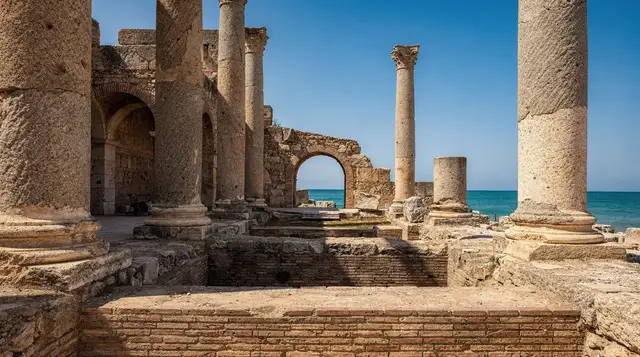
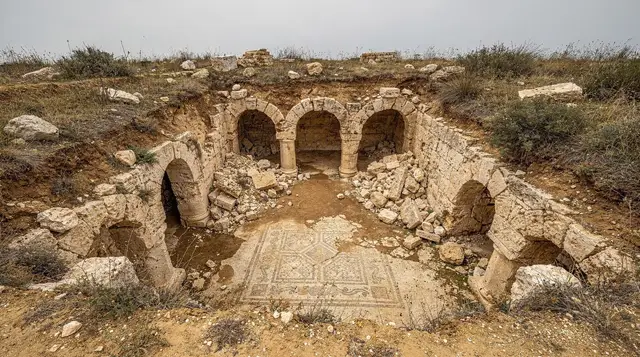
Very little of the structure still stands at head height. What remains is mostly a field of massive column bases, cavernous substructure walls and a handful of re-erected columns, spread across a genuinely large footprint above a viewing terrace over the Gulf of Tunis. This guide covers what’s actually there, how the bathing sequence worked, what it costs to visit, and how to set expectations before you go.
| Where | Carthage seafront, within the archaeological park near the Punic ports |
| Cost | Included in the Carthage multi-site ticket, roughly 12 TND (about €3.50) |
| Time needed | 45 minutes to an hour |
| Getting there | TGM train to Carthage-Salammbô, then a short walk downhill |
| Best time | Morning, before the exposed terraces get hot |
Why so little of the baths is still standing
The short answer is that Roman bath complexes were built on a scale that didn’t survive well once they went out of use. The Antonine baths functioned for roughly three centuries before falling into disrepair after the Vandal conquest of Carthage in the fifth century AD, and what followed was the usual cycle for a large ancient structure near a living city: stone robbed for later building projects, upper floors collapsing once maintenance stopped, and centuries of erosion doing the rest. Because the baths were built partly into a slope, with service galleries and cisterns sunk below the main bathing halls, it’s largely that lower substructure that has survived intact enough to excavate, while the soaring vaulted rooms above it are long gone.
That’s worth knowing before you arrive, because the site photographs less dramatically than it reads on paper. There’s no equivalent here to the amphitheatre at El Djem, where a single recognisable structure still rises complete. Instead you’re looking at the plan of a huge building traced out in column bases and wall stubs, a handful of columns re-erected to suggest scale, and a small on-site display that reconstructs what the missing upper floors would have looked like. Visitors who arrive expecting standing walls are often disappointed; visitors who arrive understanding they’re reading a footprint tend to find the scale genuinely striking.
How a Roman bath complex like this actually worked
Roman public baths followed a fairly standard bathing sequence, and knowing it makes the Antonine baths’ ruined layout much easier to read. Visitors typically began in the frigidarium, a cold-water room used partly for a bracing plunge and partly as a social space where people lingered, since Roman bathing was as much about conversation and business as hygiene. From there the sequence moved through the tepidarium, a warm intermediate room that eased the body toward higher heat, and finally into the caldarium, the hottest room, heated from below by a hypocaust system of raised floors and wall cavities that channelled hot air from furnaces tended by slaves and paid staff.
At Carthage, the caldarium sat closest to the sea, its vast heated pools requiring a scale of furnace operation that gives some sense of the labour and fuel a complex like this consumed daily. The massive piers still visible on site once supported the floor of this room, raised well above ground level to let hot air circulate underneath. Beyond the core bathing sequence, a complex this size would also have included exercise courts, changing rooms, latrines and probably a library or lecture space, since Roman baths functioned as something closer to a leisure centre than a simple washing facility. Reading the ground plan with this sequence in mind turns an otherwise abstract field of foundations into a legible building.
How big the baths actually were
Scale is the one thing the Antonine baths still communicate clearly, even in ruin. The bathing block alone covered several hectares, and the main hall’s vaulted ceiling is estimated to have risen roughly to the height of a modern ten-storey building, supported by columns whose surviving bases give a sense of their original girth. Ancient sources and modern surveys generally rank it among the largest bath complexes built outside Rome itself, a genuine statement of imperial investment in a provincial capital rather than a routine civic amenity.
The most useful comparison for most visitors is the Baths of Caracalla in Rome, which many will have seen or heard of even without visiting Tunisia. The two complexes were built within a few decades of each other and are often discussed together by archaeologists studying Roman bathing architecture at its largest scale.
| Antonine baths, Carthage | Baths of Caracalla, Rome | |
|---|---|---|
| Built | c. 145–162 AD | c. 212–216 AD |
| What survives | Mostly foundations and substructure | Substantial standing walls and vaults |
| Relative size | Among the largest outside Italy | Larger overall complex |
| Setting | Open seafront site with sea view | Enclosed within the city of Rome |
Caracalla’s baths in Rome retain far more standing masonry, which is why they read as more immediately impressive to a first-time visitor. Carthage’s baths were arguably comparable in ambition when new, but centuries closer to abandonment and further from continuous urban reuse, which left less standing today. Knowing that context changes how the Carthage site reads: not a lesser building, but a similarly grand one that simply had a rougher few centuries.
The archaeological park and the view toward Sidi Bou Said
The baths sit within a landscaped strip of coastal parkland that also borders the site of the Punic ports, and the two are easy to combine on the same short visit. Paths wind between the excavated sections, with information panels in French, Arabic and English explaining what each fragment represents, and enough open grass and shade to make it a comfortable spot to pause partway through a longer Carthage circuit. It’s one of the few Carthage sites where you’re as likely to see local families out for a walk as visiting tour groups.
The real draw beyond the ruins themselves is the view. From the raised terrace above the caldarium’s foundations, the ground drops toward the Gulf of Tunis, with the white hillside town of Sidi Bou Said visible along the coast to the north. It’s a genuinely good vantage point, arguably better than anything else at Carthage’s Roman sites, and worth allowing a few extra minutes just to take in rather than rushing straight to the next stop. Details on the Punic ports next door, and on Byrsa hill’s Punic quarter and museum a short taxi ride away, cover the rest of what a fuller Carthage visit involves.
Tickets and what they cost
The Antonine baths aren’t sold as a standalone ticket. They’re one of the sites covered by Carthage’s combined multi-site pass, priced at roughly 12 TND (around €3.50), which also covers Byrsa hill’s museum and the Punic ports on the same ticket. You buy this pass at whichever site you reach first rather than at a dedicated booth here, so if the baths are your starting point, expect a small ticket kiosk near the entrance rather than the busier booths at Byrsa hill. Full detail on exactly which sites the pass includes and where it’s actually sold is in the Carthage multi-site ticket guide.
There’s no reliable online booking for this pass, and prices are revised periodically, so it’s worth treating the figure above as an order of magnitude rather than an exact quote. If you’re travelling with a guided tour, entry is normally arranged as part of the package, which removes the ticket-queue question entirely. For the wider archaeological site and how the baths fit into a half-day covering Byrsa hill and the Punic ports too, see the Carthage archaeological sites guide.
Getting to the Antonine baths from Tunis
The TGM light rail line from central Tunis to La Marsa is the simplest way in, with Carthage-Salammbô the closest stop to both the baths and the Punic ports, a five-to-ten-minute walk from the platform. Trains run frequently through the day and the fare is minimal. For anyone unfamiliar with the wider transport picture around the city, the getting around Tunis guide covers how the TGM fits alongside taxis and buses.
Driving or taking a taxi from central Tunis takes twenty to thirty minutes depending on traffic, and parking near the site is informal rather than organised. That’s one reason many visitors either combine the baths into a walking loop with the Punic ports after arriving by train, or book a guided day trip that handles the logistics.
From Hammamet: Medina, Bardo, Carthage & Sidi Bou Said Tour is a practical option for anyone based on the coast near Hammamet who doesn’t want to arrange Tunis transport independently, since it covers Carthage’s Roman sites alongside the Bardo museum and Sidi Bou Said in a single day. Anyone arriving via the airport can check the Tunis-Carthage airport guide for the first leg into the city.
How much time to spend, and when to go
Forty-five minutes to an hour is enough to see the baths properly, including a slow circuit of the main terrace and a read of the on-site interpretation panels. That’s shorter than the time worth setting aside for Byrsa hill’s museum, but similar to the Punic ports next door, which makes the two a natural pairing for a combined visit of roughly ninety minutes. Morning is the better time to come: the site is almost entirely exposed with little shade, and the terrace can get uncomfortably hot by early afternoon in the warmer months. The best time to visit Tunis tool has a fuller seasonal breakdown if you’re still choosing when to travel.
Cruise-ship groups tend to arrive at Carthage’s sites from mid-morning onward, and the baths are one of the stops that can feel crowded around a tour bus’s fixed schedule even though the site itself is large enough to absorb the numbers reasonably well. An early start, ideally soon after the sites open, gives the best combination of light, temperature and relative quiet.
Combining the baths with the rest of Carthage
Few visitors come to the Antonine baths as a single destination; it’s normally one stop in a wider Carthage circuit that also takes in Byrsa hill, the Punic ports, and often Sidi Bou Said afterwards. Geography makes the baths and the Punic ports a natural pair, both sitting near the coast within a short walk of each other, while Byrsa hill sits on higher ground a fifteen-minute walk or short taxi ride away. From Tunis: Half-Day Tour to Carthage and Sidi Bou Said follows roughly this sequence, moving from the Roman and Punic sites down to Sidi Bou Said’s cafés and viewpoints in the same half-day.
Travellers with more time, or those combining Carthage with the Bardo museum’s mosaic collection and the Tunis medina, are better served by a fuller day tour. Tunis: Carthage, Bardo, Sidi Bou Said and medina with lunch and Hammamet: Old Medina, Bardo, Carthage & Sidi Bou Said Tour both build the baths into a longer circuit with transport and a guide, which suits anyone who’d rather not sequence the sites and the TGM line independently.
For a rougher sense of how a Roman-focused day compares to Carthage’s other angles, the Carthage versus Dougga guide and the roman Tunisia itinerary both cover where the baths sit within a wider Roman-sites trip.
Practical tips for visiting
Shade is minimal across the site, so a hat and water matter more here than at an indoor museum stop; there’s no reliable vendor directly on site, though small cafés cluster a short walk away near Byrsa hill and toward Sidi Bou Said. Underfoot conditions are a mix of gravel paths and uneven stone footings around the excavated sections, so flat, closed shoes are worth it even for a short visit. A little imagination goes further here than a guidebook description can; picturing the missing upper floors from the surviving column bases is most of what makes the site rewarding.
If you’re combining the baths with the Punic ports and Byrsa hill in one morning, budget transport time between the coastal cluster and the higher ground rather than assuming everything is walkable in sequence. The Carthage archaeological sites guide sets out a fuller half-day sequence, and the Tunis budget guide has a wider sense of typical daily costs if you’re planning several site visits alongside meals and transport.
Frequently asked questions about visiting the Antonine baths
How much of the Antonine baths is actually still standing?
Almost nothing rises above a single storey. What survives is mostly massive foundation walls, column bases and a handful of re-erected columns, giving a sense of the building’s footprint and scale rather than its original vaulted rooms.
How long does a visit to the Antonine baths take?
Forty-five minutes to an hour covers the site properly, including the interpretation panels and the terrace view. Most visitors pair it with the nearby Punic ports, extending the combined stop to around ninety minutes.
Do I need a separate ticket for the Antonine baths?
No. Entry is included in Carthage’s combined multi-site pass, priced at roughly 12 TND (about €3.50), which also covers Byrsa hill’s museum and the Punic ports. There’s no standalone ticket sold at the baths themselves.
Why were the Antonine baths built at Carthage?
They were commissioned under the emperor Antoninus Pius in the mid-second century AD as a statement of imperial investment in Carthage, by then a major Roman provincial capital rebuilt on the site of the Punic city Rome had destroyed three centuries earlier.
Is the site suitable for visitors with limited mobility?
Partially. The main terraces are relatively flat, but paths include gravel sections and uneven stone footings around the excavated areas, and there’s no step-free route through every part of the site.
How does the site compare to the Baths of Caracalla in Rome?
The two were built within a few decades of each other and are comparable in original scale, but Caracalla’s baths retain substantially more standing masonry thanks to different patterns of later reuse and repair. Carthage’s baths are best understood as similarly ambitious rather than smaller.
What’s the best way to combine the baths with other Carthage sites?
Pair them with the nearby Punic ports first, since both sit close to the coast, then continue to Byrsa hill on higher ground either on foot or by short taxi. Many day tours build this same sequence in with transport included.
Is there shade or anywhere to sit at the Antonine baths?
Very little. The excavated terraces are largely open to the sun, though the surrounding parkland has some grass and trees to pause under, and small cafés are a short walk away rather than on site.
Roman & Punic site tours on GetYourGuide
Verified deep-linked GetYourGuide tours. Book through these links and we earn a small commission at no cost to you.
These are our own photographs of Tunisia, not the operator's pictures of this tour — open the tour page to see those.