The Carthage multi-site ticket, and how to use it well
What does the Carthage multi-site ticket actually include?
One ticket, bought at whichever site you reach first, gives entry to Byrsa hill and the Carthage national museum, the Antonine baths, the Roman villas and theatre area, and the Punic ports. It does not include the Bardo museum, which is a separate national collection with its own entry fee and is not physically inside the Carthage archaeological zone.
Carthage is not one ruin, it’s a scattered archaeological zone spread across a modern suburb of Tunis, and the way Tunisia’s heritage authority handles entry reflects that: rather than paying separately at each excavated area, you buy a single combined ticket that covers most of the sites within the ancient city’s footprint. That’s convenient in principle, but it also means the ticket’s coverage, its price and its logic aren’t always obvious to a first-time visitor standing at a gate with no signage explaining what’s included. This guide sets out exactly what the multi-site ticket gets you, what it leaves out, roughly what it costs, and how to sequence a visit so you’re not doubling back across Carthage on foot in the heat.
| Where | Across Carthage’s archaeological zone, north-east of Tunis |
| Cost | Around 12 TND (roughly €3.50), single ticket for all included sites |
| Time needed | Half a day for all sites; 2–3 hours for the highlights |
| Getting there | TGM train from Tunis to Carthage-Hannibal or Carthage-Salammbô |
| Best time | Morning, before the exposed ruins get hot and crowded |
What the ticket covers, and what it deliberately leaves out
The Carthage multi-site ticket is issued by Tunisia’s Institut National du Patrimoine and is designed around the fact that Carthage’s ruins are not concentrated in one enclosure the way, say, Dougga’s are. Buy it at the first site you visit and it’s valid for entry to the others the same day, without having to queue and pay again at each gate. In practice that means Byrsa hill and the Carthage national museum, the Antonine baths, the Roman theatre and villas quarter, and the Punic ports are all reachable on the one pass.
What it doesn’t cover trips people up more often than what it does. The Bardo museum, which holds Carthage’s most significant Roman mosaics, is a separate national museum in a different part of greater Tunis and needs its own ticket. Damous El Karita, the ruined basilica north of the site, and the Tophet sanctuary are sometimes accessible with the same pass and sometimes gated separately depending on staffing that day — treat them as a bonus rather than a guarantee.
If you’d rather not work out ticket logic at each gate yourself, Private tour: Medina, Sidi Bou Said, Carthage & Bardo Museum bundles entry and transport across Carthage’s sites and the Bardo in a single guided day, which sidesteps the whole question.
The sites included, and what you’ll actually see
Four stops make up the core of the ticket, and they’re spread across roughly two kilometres of the modern suburb, not clustered together. Knowing what each one actually offers before you set off saves you from either rushing past something worthwhile or lingering somewhere with less to see than the name suggests.
| Carthage site | What you’ll see | Time to allow |
|---|---|---|
| Byrsa hill & museum | Excavated Punic quarter, site museum, hilltop view over the gulf | 1.5 hours |
| Antonine baths | Roman bath complex, among the largest outside Rome | 1 hour |
| Roman theatre & villas | Restored working theatre, one reconstructed Roman villa | 45 minutes |
| Punic ports | Circular former military harbour, remains of ancient docks | 30–45 minutes |
Byrsa hill and the Carthage national museum
Byrsa is the hilltop where Punic Carthage began, and where the visible evidence of that Punic city is most concentrated: an excavated street plan, house foundations sealed by the fire that ended the city in 146 BC, and a small museum built into a former seminary that holds the stelae, sarcophagi and ceramics recovered from the hill and surrounding site. It’s also the best single vantage point over Carthage as a whole, with the gulf, La Goulette’s port and, on a clear day, Sidi Bou Said visible from the terrace. The full breakdown of what’s inside the museum and how the hill’s history unfolded is in the Byrsa hill and Carthage museum guide.
The Antonine baths
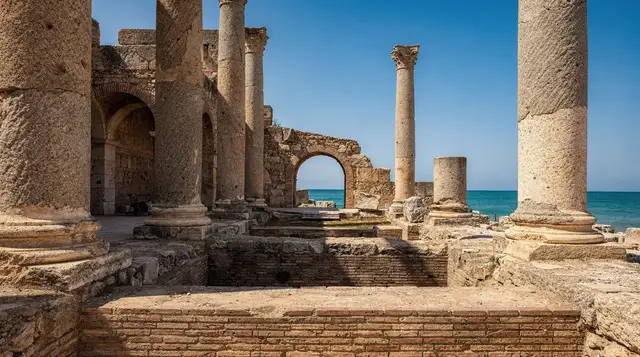
Down near the coast, the Antonine baths were once the third-largest bath complex in the Roman world, and although only the substructure and a handful of towering columns survive above ground, the scale is still legible in a way few of Carthage’s other Roman remains manage. It’s a stop that photographs better than it reads on paper — the sheer footprint of the vaulted service tunnels beneath the bathing halls tends to surprise people more than the standing ruins do. The Antonine baths guide covers the layout in more depth, including which sections are safe and permitted to walk into.
The Roman theatre and the villas quarter
This part of the ticket covers two distinct things close together: a restored Roman theatre that still hosts performances during the Carthage international festival most summers, and a separate area of excavated and partly reconstructed Roman villas that give a sense of domestic life in the rebuilt colonial city. Neither is as visually dramatic as the baths or Byrsa’s museum, and it’s fair to say this is the section of the ticket most visitors move through fastest. The Roman theatre and villas guide goes into which villa is worth the short detour and which parts are essentially grassed-over foundations.
The Punic ports and Damous El Karita basilica
The Punic ports — a circular inner harbour once used by Carthage’s navy, connected to a rectangular outer commercial port — are among the oldest visible structures at Carthage and among the hardest to appreciate without some imagination, since what remains today is mostly a quiet lagoon rather than dramatic stonework. It’s genuinely useful before visiting to read the Punic ports guide, which explains what you’re actually looking at and why the site mattered strategically. Damous El Karita, a large ruined Christian basilica a short walk north, is sometimes bundled into the same ticket zone and sometimes not; ask at whichever gate you buy your pass from rather than assuming either way.
Where and how to buy the ticket
You buy the multi-site ticket at the entrance booth of whichever Carthage site you arrive at first — there is no separate ticket office elsewhere in Tunis, and it cannot be booked online through the heritage authority. Byrsa hill and the Antonine baths are the two most commonly used starting points, mainly because they’re the easiest to reach directly from the TGM stations, and either is a sensible place to buy in. Bring cash in Tunisian dinars; card payment at these gates is unreliable at best, and there’s no ATM at any of the individual sites themselves, only in Carthage’s town centre near the Hannibal station.
Pricing has crept up gradually over recent years and is periodically revised by the ministry, so treat any figure as an order of magnitude rather than a fixed number: expect to pay somewhere in the region of 12 TND, which works out to roughly €3.50 at typical exchange rates. Reduced rates for students and Tunisian residents usually apply with valid ID, and children under a certain age are often admitted free, though the exact cut-off has varied between seasons. None of this is published in a way that travellers can check reliably in advance, so the honest advice is to have a bit more cash on hand than you expect to need and treat the printed price as approximate on the day.
How much time to set aside, and in what order to see things
Trying to see all four sites in under two hours is the single most common mistake people make with this ticket, mostly because the sites look close together on a map and are not close together on the ground — walking between them along Carthage’s residential streets takes longer than the straight-line distance suggests, and there’s minimal shade on most of the routes. A realistic half-day covers all four comfortably: start early at Byrsa hill while the terrace and Punic quarter are still cool, move down to the Antonine baths mid-morning, then finish at the theatre, villas and Punic ports before the early-afternoon heat sets in.
If you only have two to three hours, Byrsa hill and the Antonine baths give the strongest sense of Carthage’s two main eras — Punic and Roman — and are the pair most people would keep if forced to cut the list down. The theatre, villas and Punic ports are worth including if you have the time and energy, but they’re reasonably skippable without feeling you’ve missed the point of Carthage. For a longer view of how Carthage fits against a full Tunis itinerary, how many days in Tunis and Tunis in two days both sequence a Carthage half-day against the rest of the city.
Getting to Carthage from Tunis
The TGM light rail line running from Tunis Marine station out to La Marsa is the simplest way to reach Carthage, with several stops — Carthage-Hannibal, Carthage-Byrsa, Carthage-Dermech and Carthage-Salammbô among them — spread along the site, so which station you get off at depends on which site you’re starting with. Full timetables and fare information are in the TGM train guide; trains run frequently enough during the day that timing your visit around the schedule isn’t really necessary.
Taxis from central Tunis take 20 to 30 minutes depending on traffic and route around the sites more flexibly than the train does, useful if you’re trying to minimise walking between stops. General orientation on moving around the wider city, including when taxis make more sense than public transport, is covered in the getting around Tunis guide.
If you’re arriving as part of a cruise call at La Goulette, logistics tighten considerably given fixed return times, and that’s a scenario where a fixed-itinerary option removes the guesswork: Shore excursion: medina of Tunis, Carthage, Sidi Bou Said is built specifically around getting cruise passengers to Carthage’s key sites and back to the port within a defined window, without needing to work out ticket purchase or TGM connections under time pressure.
Guided tours versus buying the ticket and going alone
Doing Carthage independently with the multi-site ticket is entirely manageable — the sites are signposted, the TGM makes the logistics straightforward, and none of the four locations requires specialist access. What you lose without a guide is context: Carthage’s ruins are fragmentary enough that a knowledgeable guide filling in what you’re actually looking at, particularly at the Punic ports and the villas quarter, changes the experience more than it does at a site like the Antonine baths, where the scale mostly speaks for itself. Labelling on site is inconsistent, stronger in French and Arabic than in English at several stops.
For travellers who want that context without assembling it from guidebooks between sites, Tunis VIP: Carthage, Sidi Bou Said, medina and Bardo with pickup covers the same ground as a self-guided day but with a driver and guide handling both the transport and the historical narration, plus a stop at the Bardo, which as noted isn’t part of the multi-site ticket at all.
A simpler, less structured option that still takes the ticket logistics off your hands is Visit Tunis: Sidi Bou Said, Carthage and the medina, which pairs a Carthage visit with the medina and Sidi Bou Said without the private-tour price point of a dedicated vehicle.
Is the multi-site ticket worth it
Mistakes to avoid with the Carthage ticket
Frequently asked questions about the Carthage multi-site ticket
Can I buy the Carthage multi-site ticket online in advance?
No, it’s only sold at the entrance booths of the individual sites, not through an official online booking system. If you’d rather arrange everything ahead of time, booking a guided tour that includes entry is the only way to pre-purchase access.
Which Carthage site should I buy the ticket at first?
Byrsa hill or the Antonine baths are the most practical starting points, since both are close to TGM stations and tend to have staffed ticket booths reliably open. Either works equally well as a first stop.
Is the ticket valid for more than one day?
No, it’s a single-day pass covering entry to the included sites on the day of purchase only. If you’re planning to spread a Carthage visit across two days, you’ll need to buy a fresh ticket on the second day.
Does the multi-site ticket include Sidi Bou Said?
No. Sidi Bou Said is a separate town along the coast from Carthage with no admission ticket of its own — it’s free to walk around, though some individual sights within it may charge separately. It’s commonly combined with a Carthage visit on the same day, but it isn’t part of this ticket.
Are there discounts for students or children?
Reduced rates are generally available for students with valid ID and often for children under a certain age, though the exact thresholds and proof required have varied between seasons and aren’t published in a way visitors can verify in advance. It’s worth asking at the ticket booth directly.
Is it worth visiting Carthage on a Friday?
Friday is the main day of prayer in Tunisia, and while the archaeological sites themselves generally stay open, some have shortened afternoon hours or lighter staffing. It’s not a reason to avoid Carthage entirely, but it’s worth checking opening times for that specific day rather than assuming standard hours apply.
How does the Carthage ticket compare to visiting Dougga?
They’re not directly comparable — Dougga is a single, self-contained site with its own separate entry fee roughly an hour and a half outside Tunis, while the Carthage ticket covers several smaller, more scattered sites within the city’s outskirts. The Carthage vs Dougga comparison sets out which suits a shorter trip better.
Do I need modest dress to visit Carthage’s archaeological sites?
Not in the way you would for a mosque — these are outdoor ruins rather than active religious sites, so there’s no formal dress requirement. Comfortable shoes and sun protection matter far more than clothing modesty here, given the uneven ground and lack of shade at most stops.
What happens if I lose my ticket between sites?
Hold onto it for the whole day, since staff at each subsequent gate check it rather than reissuing automatically. If you do lose it, you’ll likely need to buy a new one at the next site, as there’s no central record linking your visit across locations.
Roman & Punic site tours on GetYourGuide
Verified deep-linked GetYourGuide tours. Book through these links and we earn a small commission at no cost to you.
These are our own photographs of Tunisia, not the operator's pictures of this tour — open the tour page to see those.