Carthage archaeological sites: a complete visitor guide
What are the main archaeological sites to visit at Carthage?
The core sites are Byrsa hill and the national museum, the Antonine baths, the Punic ports, and the Roman villas and theatre, all covered by a single multi-site ticket. Most visitors see three or four of these in half a day. A full day allows a slower pace with time for Sidi Bou Said afterwards.
Carthage is not one ruin — it’s a scattered set of excavated pockets spread across a modern suburb of Tunis, connected by ordinary streets, roundabouts and the occasional villa garden. That surprises people who arrive expecting something more like a walled archaeological park. Between the Punic city Rome destroyed in 146 BC and the Roman colony rebuilt on top of it centuries later, the surviving fragments are genuinely significant, but they need a bit of planning to see well, since no single entrance ties them together. This guide covers what’s actually there, what it costs, and how to move between the pieces without wasting a morning on transport.
| Where | Carthage suburb, 15km north-east of central Tunis |
| Cost | Multi-site ticket, roughly 12 TND (about €3.50), covers most sites |
| Time needed | Half a day for the main sites; a full day at a slower pace |
| Getting there | TGM train from Tunis to Carthage-Hannibal or Carthage-Salammbô |
| Best time | Morning, before the exposed sites get hot and crowded |
Why Carthage’s ruins are spread across a whole suburb
Modern Carthage is a wealthy residential district of greater Tunis, with villas, embassies and a presidential palace occupying much of the ground the ancient city once covered. Archaeological zones survive as fenced pockets between and around these, a legacy of how excavation happened here: piecemeal, over more than a century, often only where new construction or research made a specific plot available. There was never a moment when the whole ancient city was cleared and turned into a single park, the way you might expect from sites like Dougga or El Djem further from the capital.
That has practical consequences. You cannot walk from one Carthage site to the next along a continuous path the way you can wander a self-contained ruin. Distances between the main pockets — Byrsa hill, the Antonine baths, the Punic ports, the Roman villas — run from a ten-minute walk to a fifteen-minute drive, and there’s no shuttle system linking them.
Most visitors either walk a loop covering the closer sites and take taxis for the rest, or join a tour that handles the sequencing for them. Carthage: Walking tour of the archaeological sites and ruins is built specifically around this problem, moving on foot between the main excavated areas with a guide who fills in what the fragmentary walls don’t explain on their own.
Byrsa hill: where Punic Carthage is best preserved
Byrsa was the fortified acropolis of the Punic city, the high point Phoenician settlers built on from around the ninth century BC. What survives here today is unusual among Carthage’s sites: an excavated street plan of Punic houses, sealed and preserved by the fire that destroyed them in 146 BC rather than erased by later rebuilding. Narrow lanes, stone house footings and cisterns cut into rock are laid out below the terrace of the Carthage national museum, which occupies a former nineteenth-century seminary next to the cathedral of Saint-Louis.
The museum itself is compact — Punic funerary stelae, sarcophagi and ceramics in one wing, a smaller Roman-period collection in another — and rarely takes more than an hour to see properly. The real draw for many visitors is the terrace view over the excavated quarter to the Gulf of Tunis, one of the few spots that gives a real sense of how the ancient city’s different districts related to each other. The full detail on hours, the museum’s collection and how it compares to the Bardo lives in the Byrsa hill and Carthage museum guide.
The Antonine baths: Carthage’s largest Roman structure
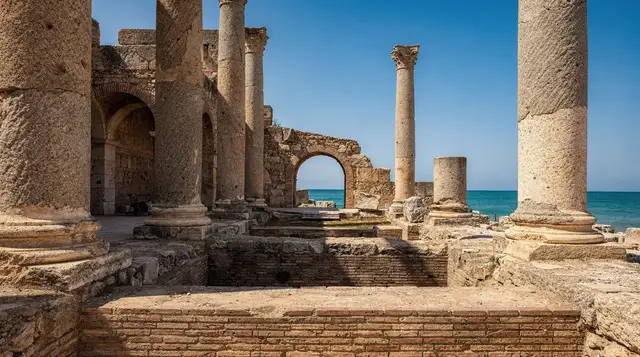
Down near the coast, the Antonine baths are the single most physically impressive thing left standing at Carthage — or rather, lying in scattered fragments, since almost nothing rises above a single storey today. What was once among the largest bath complexes in the Roman world, built in the second century AD under Antoninus Pius, now survives mostly as massive column bases, foundation walls and a handful of re-erected columns near the seafront. The scale is what registers, not the completeness; a small on-site model helps visitors picture the vaulted halls that once stood three storeys high above the fragments now visible at ground level.
Coming here directly after Byrsa hill or the Punic ports, some visitors are underwhelmed by how little actually stands. That reaction is common enough to say plainly: the baths reward reading the interpretation panels and using your imagination on the layout more than they reward simply looking at what remains. A guide narrating the missing upper floors adds real value here in a way it doesn’t at every Carthage stop. The site sits within the same landscaped park as the Punic ports, so the two are easy to combine on foot.
The Punic ports: circular harbour, easy to misread
The Punic ports — a rectangular commercial harbour and a circular military harbour with a central island — were the naval and trading heart of pre-Roman Carthage, and by some estimates could house over 200 warships at once. What’s visible today is subtler than that description suggests: a shallow lagoon roughly tracing the ancient harbour’s shape, with a small on-site museum on the central island explaining the excavated ship sheds that once ringed the water. Without that context, it’s easy to walk past and see only an ordinary body of water surrounded by modern apartment blocks.
It’s a quick stop — thirty to forty-five minutes covers the museum and a walk around the island comfortably — and works best paired with the nearby Antonine baths rather than visited alone. The full picture, including exactly what the small on-site exhibition covers, is in the punic ports of Carthage guide.
Roman villas and the amphitheatre
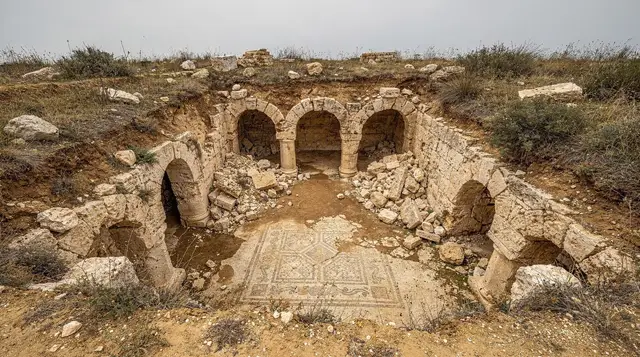
Away from the coast, a smaller cluster of Roman remains includes a partially restored villa — the so-called Villa of the Aviary, notable for its surviving mosaic floors and reconstructed peristyle garden — and the outline of Carthage’s Roman theatre, still occasionally used for performances during the city’s summer festival. Neither matches the scale of El Djem’s amphitheatre or Dougga’s far better preserved Roman townscape, and this is the part of a Carthage visit most likely to feel optional if you’re already pressed for time. Forty-five minutes covers both comfortably.
That said, the villa’s mosaic fragments and garden layout give a rare sense of how a wealthy Roman household in Carthage actually lived, which the more monumental sites — baths, ports, theatre shells — don’t really convey. Details on both are in the Carthage roman theatre and villas guide.
Sequencing the sites: what a realistic visit looks like
There’s no single correct order, but geography does impose some logic. Byrsa hill and the Carthage national museum sit on the highest ground, roughly central to the wider site. The Antonine baths and Punic ports are close together nearer the coast, a fifteen-minute walk or short taxi ride from Byrsa. The Roman villas and theatre sit slightly apart again, usually reached by taxi rather than on foot from the other clusters.
A realistic half-day covers Byrsa hill, the Antonine baths and the Punic ports, in roughly that order working downhill toward the sea, finishing in time for lunch in nearby Sidi Bou Said. Adding the villas and theatre extends that to a fuller day. Tunis: Carthage, Sidi Bou Said & Medina private day tour covers this exact sequencing with private transport between stops, which removes the taxi-hailing that otherwise eats into the middle of the day.
| Site | Distance from Byrsa hill | Time needed | Standing remains |
|---|---|---|---|
| Byrsa hill & museum | — | 1.5 hours | Punic street plan, museum collection |
| Antonine baths | 15-min walk | 1 hour | Massive foundations, few upper walls |
| Punic ports | 15-min walk (near baths) | 30–45 minutes | Harbour outline, island museum |
| Roman villas & theatre | Short taxi ride | 45 minutes | Restored villa, theatre shell |
Tickets: the multi-site pass and what it covers
Carthage’s core sites are covered by a single combined ticket rather than separate entry fees at each gate, priced at roughly 12 TND (around €3.50), though prices are periodically revised and worth checking on the day. You typically buy this pass at whichever site you reach first — Byrsa hill and the Antonine baths are the most common starting points — and it remains valid across the sites for that visit. It’s rarely possible to buy single-site tickets, so factor the combined price in even if you only plan to see one or two stops. Full detail on which sites are and aren’t included, and where ticket booths are actually staffed, is in the Carthage multi-site ticket guide.
Hours generally run from mid-morning into late afternoon, with shorter winter hours and earlier closing on Fridays at some sites during parts of the year. There’s no reliable online booking for the standard multi-site pass — you buy it in person — so building in a little slack for the first ticket queue is sensible, particularly if you’re visiting during a peak cruise-ship morning.
Getting to Carthage from Tunis
The TGM light rail line running from central Tunis to La Marsa is the standard way in, with stops at Carthage-Hannibal (closest to Byrsa hill) and Carthage-Salammbô (closest to the Antonine baths and Punic ports). Trains run frequently through the day, and the fare is minimal — a few hundred millimes each way. The full timetable, fare structure and which station suits which site is covered in the TGM train guide.
Driving or taking a taxi from central Tunis takes twenty to thirty minutes depending on traffic, and can make sense if you’re travelling with a group or combining Carthage with an early or late stop elsewhere. Parking directly at each site is limited and informal rather than organised, which is one reason many visitors either walk between the closer sites on foot after arriving by train, or book a tour with transport already arranged. Tunis: Medina, Carthage and Sidi Bou Said private day trip with lunch is a fuller option for anyone who’d rather not manage the TGM-versus-taxi decision at all and wants a sit-down lunch built into the day.
Carthage versus Dougga: which ruins are worth more of your time
This comparison comes up often, and the honest answer depends on what you’re after. Dougga, a couple of hours from Tunis, is widely regarded as North Africa’s best-preserved Roman small town — a coherent, walkable site with a genuinely dramatic theatre, temples and streets still legible as a town rather than as isolated fragments. Carthage’s Roman-era remains, by contrast, are scattered and mostly reduced to foundations; what Carthage offers that Dougga doesn’t is the Punic layer at Byrsa hill and the historical weight of the city’s name, plus far easier access from central Tunis without a half-day excursion.
If your time is genuinely limited and you can only manage one Roman site trip, Carthage vs Dougga walks through the trade-offs in more depth. As a rough rule: choose Carthage if you have a morning or afternoon and want proximity, choose Dougga if you have a full day and want the more complete Roman townscape.
Combining Carthage with Sidi Bou Said
Sidi Bou Said, the white-and-blue hillside town a short ride from Carthage’s coastal sites, is the natural add-on for an afternoon after the ruins — different in character entirely, with cafés, craft shops and views over the bay rather than excavated foundations. Most half-day and full-day Carthage tours build this pairing in by default, and independent travellers following the TGM line can simply continue two stops further to Sidi Bou Said station after finishing at Carthage-Salammbô or Carthage-Hannibal. The Carthage and Sidi Bou Said day trip guide sets out a full itinerary for pairing the two.
Practical tips: what to bring and when to avoid
Most of Carthage’s outdoor sites offer little to no shade, so a hat, sun protection and water matter more than they might at an indoor museum — there’s rarely a reliable vendor at each individual site, though small cafés cluster near Byrsa hill and Sidi Bou Said. Comfortable, closed shoes are worth it even for a half-day of largely flat walking, since several of the excavated areas have uneven stone footings and loose gravel.
During Ramadan, some site cafés and nearby food options operate on reduced hours, though the archaeological sites themselves generally stay open on their usual schedule; check the mosque etiquette in Tunisia guide for wider context on visiting during the fasting month. Modest dress is sensible near the cathedral of Saint-Louis on Byrsa hill, though it functions as a cultural venue rather than an active place of worship today.
Frequently asked questions about visiting Carthage’s ruins
How many Carthage sites should I realistically try to see?
Three sites — Byrsa hill, the Antonine baths and the Punic ports — make a comfortable half-day covering the highlights without rushing. Adding the Roman villas and theatre is reasonable if you have a full day or are particularly interested in Roman domestic architecture.
Is one ticket enough for all the Carthage sites?
The standard multi-site pass covers most of the core locations, including Byrsa hill’s museum, the Antonine baths and the Punic ports. It’s worth confirming at the first ticket booth exactly which sites are included that day, since coverage has occasionally varied.
Can I walk between all the Carthage archaeological sites?
Some, not all. Byrsa hill to the Antonine baths and Punic ports is a manageable fifteen-minute walk. The Roman villas and theatre sit further out and are usually reached by taxi rather than on foot.
Do I need a guide to appreciate Carthage’s ruins?
Not strictly, but the sites reward it more than most — the Antonine baths especially are hard to picture at full scale from foundations alone, and Byrsa hill’s Punic layer benefits from someone explaining the sequence of destruction and rebuilding rather than reading scattered panels.
Is Carthage worth visiting if I’ve already been to Dougga?
Yes, though for different reasons — Carthage’s Punic history and easy access from Tunis make it worthwhile even after seeing Dougga’s more complete Roman townscape. Visit Carthage for the story and proximity, not expecting to top Dougga’s scale.
What’s the best time of day to visit Carthage’s sites?
Morning, ideally starting soon after opening. Most sites are exposed with little shade, and cruise-ship groups tend to arrive by mid-morning, making early visits both cooler and quieter.
Are the Carthage sites suitable for visitors with limited mobility?
Partially. Byrsa hill involves a genuine uphill walk with uneven ground near the excavations, while the Antonine baths and Punic ports are flatter but still have loose gravel and stone sections. None of the sites are fully step-free.
How does a Carthage half-day fit with visiting Tunis itself?
Comfortably — Carthage is close enough to central Tunis that a half-day here leaves the rest of the day free for the medina or Sidi Bou Said. See how many days in Tunis for how this fits into a wider trip.
Roman & Punic site tours on GetYourGuide
Verified deep-linked GetYourGuide tours. Book through these links and we earn a small commission at no cost to you.
These are our own photographs of Tunisia, not the operator's pictures of this tour — open the tour page to see those.