Byrsa hill and the Carthage national museum
How much time do I need for Byrsa hill and the Carthage national museum?
The museum itself is compact and rarely takes more than 45 minutes to an hour. Add another 30 to 45 minutes for the excavated Punic quarter outside and the terrace view beside the cathedral. Most visitors overestimate the time needed; 1.5 hours covers it comfortably unless you're combining it with Carthage's other sites the same day.
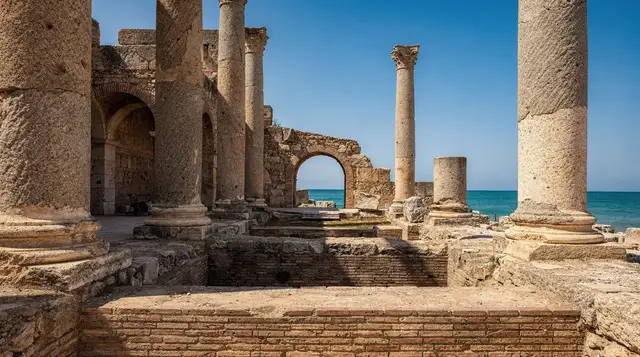
Byrsa hill is the one point in Carthage where you can stand on the same ground the Punic city stood on, look down at the excavated foundations of the houses that burned when Rome destroyed it, and then walk into a nineteenth-century cathedral built on top of the ruins by people who had no idea what lay beneath their feet until decades later. The Carthage national museum, housed in the former seminary next to that cathedral, is where most of what came out of the ground on this hill ended up. It is a smaller, plainer stop than people expect, and that is worth saying plainly before you plan around it.
| Where | Byrsa hill, Carthage, above Rue Père Delattre |
| Cost | Included in the Carthage multi-site ticket, roughly 12 TND (about €3.50) |
| Time needed | 45 minutes for the museum; 1.5 hours with the Punic quarter and viewpoint |
| Getting there | TGM train to Carthage-Hannibal, then a 15-minute uphill walk |
| Best time | Morning, before the hill’s exposed terraces get hot |
The hilltop where Carthage was born — and fell
Byrsa was the acropolis of Punic Carthage, the fortified high point of a city that Phoenician settlers established here in the ninth century BC, according to tradition led by Elissa, a queen later known to Romans as Dido. The name itself comes from a Greek folk story about a hide cut into thin strips to claim more land than a straightforward purchase would allow — a legend rather than history, but one that has stuck to the hill for over two thousand years.
What is not legend is what happened here in 146 BC: after the Third Punic War, Rome levelled Carthage and burned Byrsa’s residential quarter to the ground. That destruction, oddly, is what preserved it. The fire sealed a layer of Punic daily life that would otherwise have been built over and lost.
The Romans did eventually build over most of it anyway, terracing the hilltop for a new forum when they refounded the city as Colonia Julia Carthago a century later. Byrsa functioned as elevated, civic high ground for centuries after that, through the Roman, Vandal and Byzantine periods, before falling into relative obscurity. Its next major structure did not arrive until the French colonial era, when the cathedral of Saint-Louis and the adjoining seminary went up in the 1890s — and it was work connected to that seminary, and later organised excavation campaigns, that brought the Punic layer back to light.
What’s actually inside the Carthage national museum
The museum occupies the former seminary of the White Fathers, the missionary order founded by Cardinal Charles Lavigerie, whose collection of finds from Carthage’s excavations grew into a formal museum in the late nineteenth century and was reorganised after Tunisian independence. It is not large, and it does not try to compete with the Bardo museum for scale — this is a site museum built around what was found on this specific hill and around Carthage more broadly, not a national survey collection.
The Punic rooms are the most distinctive part. Funerary stelae recovered from the tophet sanctuary sit alongside sarcophagi carved with reclining figures, including the well-known priestess and priest sarcophagi with their long robes and finely worked faces. There are ceramics, jewellery, amphorae used in the wine and oil trade that made Punic Carthage wealthy, and small votive objects that give a more domestic sense of the city than the grand civic ruins elsewhere. A second set of rooms covers the Roman period: mosaic fragments, statuary, glassware and everyday objects from the rebuilt city, thinner in scale than what the Bardo holds but useful for filling in the sequence if you’re visiting Carthage’s sites in order.
Labelling is inconsistent — some rooms have detailed French and Arabic panels, others very little in English — which is one reason a guide who can talk through the Punic collection specifically adds more here than at some of Carthage’s outdoor sites. Private tour: Medina, Sidi Bou Said, Carthage & Bardo Museum covers Byrsa hill as part of a fuller day that also reaches the Bardo, useful if you want the Punic and Roman collections explained side by side rather than pieced together from two separate visits.
The Punic quarter: Carthage’s oldest visible remains
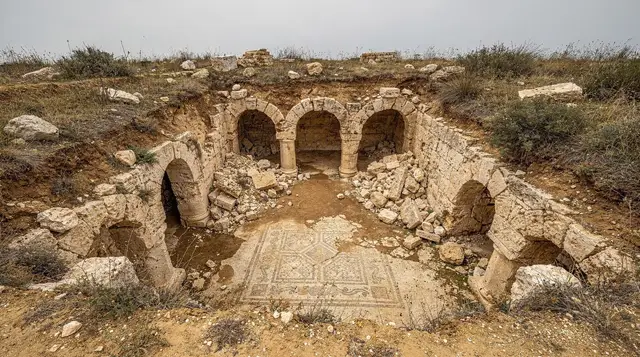
Below the museum terrace, a fenced excavation area shows the actual street plan of Punic Byrsa: narrow paved lanes, the stone footings of multi-storey houses, and cisterns cut into the rock for water storage. This section was uncovered during the UNESCO “Save Carthage” campaign of the 1970s, an international effort to record and protect the site’s Punic and Roman layers before further development on the hill made that impossible.
Because the destruction that ended the Punic city also sealed it under a layer of ash and rubble, this is the most complete visible evidence of ordinary Punic domestic life anywhere in Carthage — more informative for that specific period than the Punic ports further down the hill, which show infrastructure rather than housing.
It is a modest area to walk — fifteen minutes covers the whole excavated footprint at a slow pace — and it rewards reading the panels rather than just glancing at low stone walls, which is what most of it looks like without context. If Punic-era Carthage specifically interests you more than the Roman rebuild, the Carthage archaeological sites guide sequences Byrsa against the other Punic-linked locations across the wider site.
| Carthage site | What you’ll see | Time needed |
|---|---|---|
| Byrsa hill & museum | Punic quarter, museum collection, hilltop views | 1.5 hours |
| Antonine baths | Roman bath complex, largest outside Rome | 1 hour |
| Punic ports | Circular military harbour, ancient docks | 30–45 minutes |
| Roman villas & theatre | Restored villa, working amphitheatre | 45 minutes |
Byrsa hill’s other landmark: the cathedral of Saint-Louis
The cathedral sharing the hilltop with the museum is dedicated to Louis IX of France, who died of illness near Tunis in 1270 while leading the Eighth Crusade — a fact that gives the building’s presence here more historical logic than its colonial-era construction date might suggest at first. Completed in 1890, it is no longer used for regular Catholic worship and today functions mainly as a cultural venue, occasionally hosting concerts.
The interior is plain compared to European cathedrals of a similar scale, but the building’s silhouette, visible from much of Carthage and even from parts of Tunis on a clear day, is one of the more recognisable landmarks in the area. Visiting the exterior and the terrace beside it does not usually require a separate ticket from the museum entry.
The view that makes the climb worth it
Whatever you think of the museum’s modest scale, the terrace outside it earns the walk uphill on its own. From here you look down over the excavated Punic quarter to the Gulf of Tunis, with La Goulette’s port visible to one side and, on clear days, the white outline of Sidi Bou Said further along the coast. It is the clearest single vantage point over the shape of ancient Carthage — you can trace roughly where the ports, the residential districts and the Roman villas sat in relation to each other, which is genuinely difficult to do at ground level among the separate fenced sites.
Go in the morning if you can. The hilltop has almost no shade, and by early afternoon in the warmer months both the terrace and the museum’s outdoor sections get uncomfortably hot with nowhere to retreat except back indoors.
How long you actually need here
People visiting Carthage for the first time tend to allocate roughly the same amount of time to Byrsa hill as to the Antonine baths, assuming a “museum plus ruins” stop takes longer than a standalone ruin does. In practice it’s the other way round: the museum’s rooms are few enough to cover properly in under an hour even reading most of the panels, and the Punic quarter outside is compact.
Ninety minutes total, including the view, is realistic for most visitors, and rushing it to under 45 minutes only really makes sense if you’re combining four or five Carthage sites in a single half-day and have already seen Punic-era material elsewhere. For the full site’s pacing, see how many days in Tunis and roman sites near Tunis, ranked for where Byrsa sits against Dougga and the rest.
Getting to Byrsa hill and the museum
The TGM light rail line from central Tunis to La Marsa stops at Carthage-Hannibal, the most convenient station for Byrsa hill; from there it’s a fifteen-minute walk uphill along Rue Père Delattre, with a steady but not steep climb. The TGM train from Tunis to La Marsa guide covers timetables and fares if you’re combining this with other Carthage-area stops or continuing on to Sidi Bou Said afterwards. A taxi from central Tunis takes 20 to 30 minutes depending on traffic and is a reasonable option if you’re visiting early or combining the trip with other Carthage sites that are awkward to reach on foot from the station.
There is no dedicated car park at the hilltop itself, and street parking on the narrow approach roads is limited, so taxis or the TGM are generally more straightforward than driving.
Carthage, Bardo Museum, Sidi Bou Said and Tunis Medina tour handles the transport question for you across a full day covering Carthage’s main sites, which removes the TGM-versus-taxi decision entirely if you’d rather not plan the logistics yourself.
Byrsa hill vs the Bardo: which museum matters more
This comparison comes up constantly, and the honest answer depends on what you actually came to Tunisia to see. The Bardo museum holds one of the finest mosaic collections in the world, housed in a former beylical palace that is itself worth the visit independent of the exhibits. The Carthage national museum on Byrsa hill is smaller, more site-specific, and stronger on Punic material — stelae, sarcophagi, everyday objects — than on the large-scale Roman mosaics the Bardo is known for.
If you can only visit one museum in the Tunis area, most visitors get more from the Bardo. Byrsa hill’s museum earns its place as part of a Carthage day rather than as a standalone destination — the site itself, the Punic quarter and the view are the primary draw, with the museum as a useful but secondary stop. The Bardo versus Carthage museum comparison breaks this down room by room if you’re trying to decide how to split limited time.
Practical details: tickets, hours, what to bring
The Carthage sites, including Byrsa hill and its museum, are covered by a single multi-site ticket costing roughly 12 TND (about €3.50), rather than separate entry fees per location — buying individual tickets at each gate is rarely an option, so plan to purchase the combined pass at whichever site you reach first. The Carthage multi-site ticket guide covers exactly which sites it includes and where to buy it before you arrive at Byrsa specifically. Opening hours generally run from mid-morning to late afternoon, with slightly shorter hours in winter months, and the site closes earlier on Fridays in some seasons.
Bring water — there is no reliable vendor at the hilltop itself — and sun protection, since both the terrace and the Punic quarter offer almost no shade. Comfortable shoes matter more than you’d expect for what looks like a short, flat walk; the excavated area has uneven stone footings and loose gravel sections. Photography is generally permitted throughout the museum, though flash is discouraged near the more fragile stelae.
Carthage and Sidi Bou Said tour pairs Byrsa hill with an afternoon in Sidi Bou Said, a natural combination given how close the two are and how different the pace of each stop is.
Frequently asked questions about visiting Byrsa hill and its museum
Is Byrsa hill the same thing as the Carthage national museum?
No. Byrsa hill is the location — the ancient acropolis, including the excavated Punic quarter, the cathedral of Saint-Louis and the surrounding terraces. The Carthage national museum is the specific building on top of the hill, housed in the former seminary next to the cathedral, that holds finds from the site.
Do I need a separate ticket for the museum and the Punic quarter?
No, both are covered by the same entry as part of Carthage’s combined multi-site ticket. You do not pay separately for the excavated quarter outside and the museum building itself.
Is the cathedral of Saint-Louis still an active church?
Not for regular worship. It occasionally hosts cultural events and concerts, and the building and its terrace are generally accessible alongside a Byrsa hill visit without a separate arrangement.
What period does the museum’s collection mostly cover?
Primarily Punic-era material — stelae, sarcophagi, ceramics and jewellery — alongside a smaller Roman-period collection of mosaics, statuary and everyday objects from the rebuilt city.
Can I visit Byrsa hill without visiting the rest of Carthage’s sites?
Yes, though it’s an inefficient use of the combined ticket if you only see one site. Most visitors pair it with at least the Antonine baths or the Punic ports on the same day, since the multi-site ticket already covers them.
Is the walk up Byrsa hill difficult?
It’s a steady uphill walk of about fifteen minutes from the Carthage-Hannibal TGM station, manageable for most fitness levels but genuinely uphill rather than a gentle slope, and with no shade for most of the climb.
How does Byrsa hill compare to Dougga for someone short on time?
They’re not really comparable trips — Dougga is a half-day excursion outside Tunis with a much larger Roman site, while Byrsa hill is a stop within Carthage itself, reachable by train in under half an hour. See Carthage vs Dougga if you’re deciding how to split limited days between the two.
Is there anywhere to eat near Byrsa hill?
Options directly on the hilltop are limited to a small café near the site entrance in some seasons; more reliable choices are down in Carthage’s lower streets or in nearby Sidi Bou Said, a short taxi or train ride away.
Roman & Punic site tours on GetYourGuide
Verified deep-linked GetYourGuide tours. Book through these links and we earn a small commission at no cost to you.
These are our own photographs of Tunisia, not the operator's pictures of this tour — open the tour page to see those.