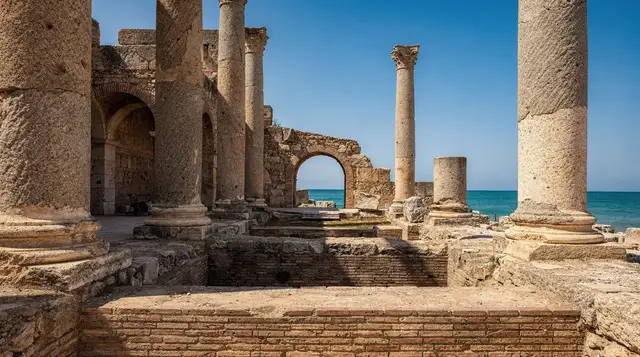
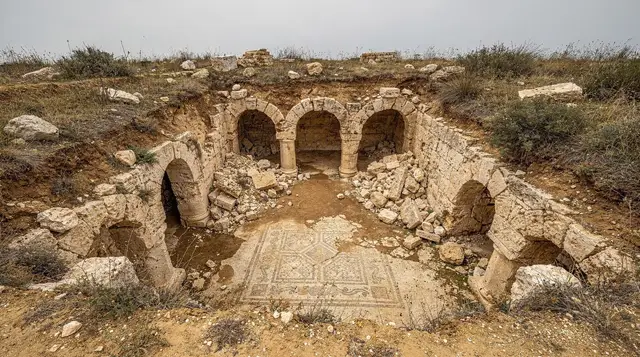
Carthage or Dougga?
Should I visit Carthage or Dougga if I only have time for one?
If you're short on time or don't have a strong specific interest in Roman archaeology, Carthage: it's twenty to thirty minutes from Tunis and carries far greater historical weight as the Punic capital. If you have a full day to spare and genuinely want to see the best-preserved Roman town in North Africa, standing capitol and all, Dougga is worth the two-hour drive. Many travellers with enough time do both rather than choosing.
Carthage and Dougga are the two Roman sites travellers most often weigh against each other when time near Tunis is limited, and the comparison isn’t as simple as “which ruins are better.” They offer genuinely different things: Carthage is historically the more significant site, the capital of a Punic empire that rivalled Rome before Rome erased it, but what survives on the ground today is scattered and fragmentary.
Dougga is a smaller regional Roman town by comparison, but it’s the best-preserved one left standing in North Africa, with a capitol, theatre and forum that read as an actual town rather than isolated fragments. This page sets out the real trade-offs, distance, what you’ll actually see, and how much time each demands, so the choice reflects what you actually want from a Roman-site visit rather than which name is more familiar.
| Where | Carthage: within Tunis, 20-30 min. Dougga: near Teboursouk, about 105 km, 2 hours |
| Cost | Both around 12 TND (roughly €3.50) entry |
| Time needed | Carthage: half a day. Dougga: a full day including travel |
| Getting there | Carthage: TGM train. Dougga: car hire or organised tour |
| Best time | Morning for both, before the heat; spring and autumn most comfortable |
Historical significance: Carthage wins clearly
If the question is which site mattered more in the ancient world, Carthage isn’t close. It was the capital of a Punic maritime empire that controlled trade across the western Mediterranean for centuries and fought Rome to a near-standstill across three wars, before Rome finally razed the city in 146 BC and rebuilt it as a major Roman colonial capital in its own right. Dougga, by contrast, was a regional Numidian and later Roman town, never a capital, never the seat of an empire, significant locally but not on the same historical stage as Carthage.
For anyone whose primary interest is the sweep of ancient Mediterranean history rather than the physical completeness of what’s still standing, Carthage’s story is the more consequential one, covered in depth in the Tunisian history timeline and the Carthage archaeological sites guide.
What’s actually standing: Dougga wins clearly
Flip the question to what you can physically see on the ground, and the result reverses. Carthage’s Punic-era city was destroyed so thoroughly by Rome, and its Roman-era rebuild subsequently swallowed by a modern Tunis suburb, that what survives is scattered across roughly two kilometres of residential streets: the Antonine baths’ substructure, Byrsa hill’s excavated quarter, a rebuilt theatre, a quiet lagoon that was once the Punic naval ports.
It’s genuinely worthwhile, but it demands real imagination to reconstruct the ancient city from what remains. Dougga, gradually abandoned rather than destroyed and never built over by a later city, preserves an entire legible town plan: a capitol still standing near its original height, a working Roman theatre, a forum, a market and residential streets that relate to each other spatially in a way nothing at Carthage does. The complete guide to Dougga covers what’s actually still standing in detail.
Distance and time commitment: Carthage wins clearly
This is the most practical difference and often the deciding one. Carthage sits within Tunis’s own suburbs, twenty to thirty minutes from the centre by TGM train or taxi, making it realistic as a half-day trip that still leaves time for other sightseeing the same day. Dougga is roughly 105 km west of Tunis, near the town of Teboursouk, a two-hour drive each way that turns a Dougga visit into a genuine full-day commitment, four hours of driving alone before accounting for time on site. Travellers with only one or two days in the Tunis area, or a packed itinerary that doesn’t have a full day to spare, will find Carthage the far more practical choice on time grounds alone, regardless of the other trade-offs.
Side-by-side comparison
| Carthage | Dougga | |
|---|---|---|
| Historical significance | Punic imperial capital; major Roman colony | Regional Numidian and Roman town |
| Completeness of ruins | Scattered, fragmentary across a modern suburb | Best-preserved standing Roman town in North Africa |
| Distance from Tunis | 20-30 minutes | About 105 km, 2 hours each way |
| Time needed | Half a day | A full day including travel |
| Entry cost | Around 12 TND, multi-site ticket | Around 12 TND, single site |
| Terrain | Mostly flat, spread across suburb streets | Sloping hillside, uneven unpaved paths |
| Best suited to | Short trips, first-time visitors, tight schedules | Travellers with a full day and a genuine interest in Roman archaeology |
Terrain and physical demands
Carthage’s sites are spread across flat, paved suburban streets, genuinely walkable even for visitors who’d rather not tackle uneven ground, though the distances between individual sites, Byrsa hill, the Antonine baths, the theatre and villas, the Punic ports, are longer on foot than a map suggests. Dougga is built across a genuinely sloping hillside, with paths that are uneven, unpaved in places, and demand solid closed footwear rather than sandals. Families with young children or anyone with mobility concerns will generally find Carthage the more manageable of the two, while Dougga’s terrain, while not extreme, is a real factor to weigh against the long drive required just to reach it.
Tickets: how each site is structured
The two sites are also organised quite differently in terms of entry, which is worth understanding before comparing them further. Carthage uses a single combined pass, the Carthage multi-site ticket, bought at whichever site you reach first and valid for entry to Byrsa hill and its museum, the Antonine baths, the theatre and villas quarter, and the Punic ports on the same day.
Dougga, by contrast, is a single self-contained site with one entry fee at the one gate, simpler in structure precisely because it isn’t scattered across a modern suburb the way Carthage is. Both cost around 12 TND, but the Carthage ticket’s coverage across several separate locations means understanding what it does and doesn’t include, the Bardo museum notably isn’t part of it, matters more before you set off than it does for a straightforward single-gate visit to Dougga.
What each site looks like up close
At Carthage, the strongest individual stops are Byrsa hill and its museum, with the best vantage point over the gulf and the densest concentration of genuine Punic-era evidence, and the Antonine baths, whose sheer scale, once the third-largest bath complex in the Roman world, still reads clearly even though only the substructure survives above ground.
At Dougga, the capitol is the single most photographed structure, standing close to its original height with six Corinthian columns, and the working Roman theatre still hosts performances during the town’s own summer cultural festival. If a single standout monument matters more to you than an overall sense of a town, the Antonine baths and Dougga’s capitol are the two strongest individual comparisons to weigh against each other.
Can you do both
For travellers with more than two or three days in the Tunis area, doing both isn’t unreasonable, though it’s worth treating them as two separate outings rather than trying to combine them in one day given Dougga’s distance. A private tour to Dougga and Bulla Regia via Testour covers Dougga properly as its own dedicated day, often paired with Bulla Regia’s underground villas or Testour’s distinctive Andalusian architecture to make the long drive west worth the additional stops. Carthage, given its proximity, fits naturally into an earlier or later day in the same trip without competing for the same block of time.
A VIP tour of Carthage, Sidi Bou Said, the medina and Bardo is a reasonable way to cover Carthage thoroughly alongside the Bardo museum, which holds many of the finest mosaics recovered from both Carthage and Dougga, in a single half-day.
If you only have one day near Tunis
For a genuinely single-day visit, the honest recommendation leans toward Carthage for most travellers, not because it’s the “better” site in an absolute sense, but because it fits realistically into a day that also allows for Sidi Bou Said, the medina or the Bardo, none of which a Dougga day has time for once the four hours of driving are accounted for.
A day visiting Sidi Bou Said, Carthage and the medina makes efficient use of a single day near Tunis in exactly this way. The exception is travellers with a genuine, specific interest in Roman archaeology as the primary reason for their trip, for whom Dougga’s completeness is worth sacrificing the rest of a day’s itinerary for.
If you have a full extra day to spare
Travellers who can dedicate an entire separate day to Dougga, rather than squeezing it against other plans, get the fuller payoff: the standing capitol, the working theatre, the Libyco-Punic mausoleum, and a genuinely scenic hillside setting above the Medjerda valley that Carthage’s suburban sprawl doesn’t offer. A day tour from Tunis covering Oudhna, Testour, Djebba and Dougga extends the day further, adding several smaller Roman and cultural stops along the same westward route rather than treating Dougga as an isolated round trip.
Travellers who want to add a second distinctive stop to the same long drive rather than returning directly can also consider Testour and the Medjerda valley or Bulla Regia’s underground villas, both realistic additions to a Dougga day given they lie along a similar route west of Tunis.
Roman sites near Tunis, ranked places both Carthage and Dougga alongside the country’s other Roman-era options if a broader comparison would help.
What most travellers actually choose
In practice, most travellers with a standard week-long Tunisia trip choose Carthage over Dougga if forced to pick just one, simply on the basis of time and convenience, and save Dougga for a longer stay, a repeat visit, or a trip specifically built around Roman archaeology. That’s not a universal rule, and travellers whose main draw to Tunisia is genuinely the Roman heritage rather than the coast, the medina or the Sahara should weigh Dougga more seriously despite the extra time it demands. How many days do you need in Tunis? and Roman Tunisia in five days both help frame this choice against the length of trip you’re actually planning.
Mistakes to avoid
Frequently asked questions about choosing between Carthage and Dougga
Which site is more historically important, Carthage or Dougga?
Carthage, without much question. It was the capital of a Punic empire that rivalled Rome and later a major Roman colonial capital, while Dougga was a regional town that never held that level of significance.
Which site has more to actually see standing today?
Dougga. Its capitol, theatre, forum and residential streets survive as a coherent, legible town plan, while Carthage’s ruins are scattered and fragmentary across a modern suburb.
How much longer does it take to get to Dougga than Carthage?
Considerably longer. Carthage is 20 to 30 minutes from central Tunis; Dougga is around 105 km away, roughly a two-hour drive each way, turning it into a full-day commitment.
Can I see both Carthage and Dougga in one trip?
Yes, if you have more than two or three days, though it’s best treated as two separate outings rather than one long day, given the distance and time each genuinely deserves.
Is Dougga worth the extra travel time compared with Carthage?
For anyone with a genuine interest in Roman archaeology, yes: it’s widely considered the best-preserved Roman town in North Africa. For a shorter trip without that specific interest, Carthage is the more practical choice.
Which site is easier to visit with young children?
Carthage, generally. Its sites are spread across flat, paved suburban streets, while Dougga’s hillside terrain is uneven and involves more walking on unpaved paths.
Do both sites require the same entry ticket?
No. Carthage uses a combined multi-site ticket covering several locations within its archaeological zone; Dougga has its own separate single-site entry fee, both around 12 TND.
If I can only visit one, which should I choose?
For most travellers on a standard trip, Carthage, mainly for its proximity and historical weight. Travellers with a full day to spare and a specific interest in Roman archaeology should lean toward Dougga instead.
Roman & Punic site tours on GetYourGuide
Verified deep-linked GetYourGuide tours. Book through these links and we earn a small commission at no cost to you.
These are our own photographs of Tunisia, not the operator's pictures of this tour — open the tour page to see those.