How many days do you need in Tunis?
So, how many days do you actually need in Tunis?
Three days is the practical minimum for a satisfying visit: enough for the medina, the Bardo, and either Carthage or Sidi Bou Said without rushing. Two days works if you accept picking one or the other. Five to seven days lets you add Kairouan, the coast, or a Roman-sites day trip comfortably.
The honest answer to “how many days in Tunis” depends entirely on whether you mean the city itself or the wider region people usually mean when they say Tunis — the capital plus Carthage, Sidi Bou Said, and a Roman site or two within striking distance. The city alone, walked properly, takes a day and a half. The region most visitors actually want takes closer to four or five.
This guide breaks the question down by day count, so you can match your available time to a realistic scope rather than guessing and either rushing or leaving days unplanned.
One day: a stopover, not a visit
A single day is enough for a tight loop through the medina — Ez-Zitouna’s courtyard, the souks, a couple of dar museums — plus a fast half-day out to Carthage or Sidi Bou Said, but not both. It works as a cruise-ship stopover or a layover extension, not as a considered first visit. If this is your situation, our 24-hour stopover itinerary and Tunis in forty-eight hours both work through the trade-offs of a compressed visit in more detail than this guide can.
Two days: the medina and one big-ticket item
Two days is the point where a trip starts to feel complete rather than rushed. Day one covers the medina thoroughly — the souks around Ez-Zitouna, a dar museum such as Dar Ben Abdallah, and the walk out to the Ville Nouvelle along Avenue Habib Bourguiba. Day two goes to either Carthage and Sidi Bou Said together, easily combined via the TGM, or to the Bardo museum with time to spare for Belvédère. Trying to fit both the Bardo and Carthage into a single two-day trip usually means shortchanging one of them.
| Days | Core coverage | What’s realistic to add |
|---|---|---|
| 1 | Medina highlights only | Nothing extra |
| 2 | Medina + Carthage/Sidi Bou Said OR Bardo | — |
| 3 | Medina + Carthage + Bardo | Sidi Bou Said as a half day |
| 4-5 | Above + one Roman-sites day trip | Kairouan or the Cap Bon coast |
| 7 | Above + a second day trip | A short Sahara loop, budget permitting |
Three days: the practical minimum for a real visit
Three days is where this guide’s quick answer lands, and for good reason: it’s enough to cover the medina, the Bardo museum, and Carthage plus Sidi Bou Said without any single day feeling compressed. A workable split looks like medina and Ville Nouvelle on day one, Bardo and Belvédère on day two, and Carthage-Sidi Bou Said-La Marsa as a full loop on day three, using the TGM to link all three towns along the coast. Our three-day itinerary lays this structure out hour by hour.
A full-day tour of Tunis’s must-visit sights is a reasonable way to compress the medina-Bardo-Carthage combination into a single guided day if three separate self-guided days feel like more logistics than you want to manage.
Four to five days: room for a day trip
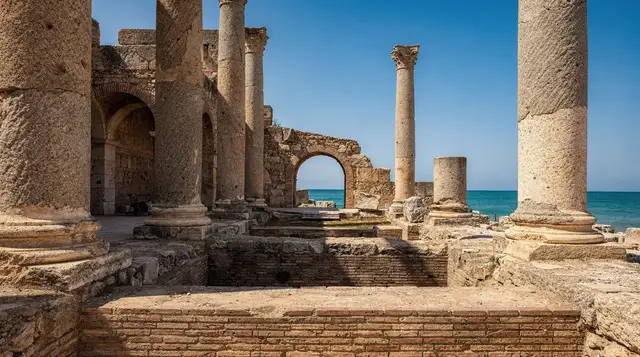
At four or five days, a single Roman-sites day trip becomes realistic without cutting into time in Tunis itself. Dougga, roughly ninety minutes each way, is the strongest single addition; Kairouan, Tunisia’s fourth holy city, is a compelling alternative if Islamic heritage interests you more than Roman ruins. Some travellers instead use the extra days for the Cap Bon coast around Kelibia and Kerkouane, a quieter and less-visited alternative to the standard Roman-sites route. Our four-day and five-day itineraries both work through specific versions of this structure.
A private tour of Nabeul, Hammamet and Sousse suits travellers using a fourth or fifth day to head east toward the coast rather than south toward Roman sites — pottery workshops in Nabeul plus beach time in Hammamet make for a genuinely different kind of day than another archaeological site.
A week or more: Kairouan, the coast, and beyond
A full week supports two day trips rather than one, or a single overnight excursion further afield. A common structure pairs a Roman-sites day (Dougga and Bulla Regia, say) with a Kairouan day, giving a genuine spread across the region’s Roman and Islamic heritage without needing a car for the whole trip. Travellers wanting to go further south toward El Djem or the Sahara at this point are better served treating that as an overnight rather than a rushed same-day round trip — El Djem alone is a three-hour drive each way from Tunis.
An overnight trip to Kairouan, El Jem, Monastir and Sousse solves this distance problem directly by building the overnight into the itinerary rather than trying to compress four destinations into a single long day.
Alternatively, a private day trip covering Kairouan and El Jem from Tunis, Hammamet or Sousse works as a long but single-day option for travellers based on the coast rather than in the capital, where the distances involved are somewhat shorter. See one week in Tunis and its region and one week: Tunis and the Sahara for two different ways of using seven days.
Weighing a week against two separate shorter trips
Some travellers with flexible schedules ask whether a single week-long trip beats two separate three-or-four-day visits spread across different years. There’s no universally right answer, but the trade-offs are worth naming. A single longer trip amortises the flight cost and jet-lag adjustment across more days on the ground, and it supports a genuine loop itinerary that a shorter trip can’t accommodate — Tunis, a Roman-sites day, Kairouan and a coastal stretch, say, all in one visit.
Two shorter trips, by contrast, allow more flexibility around timing — visiting once in spring and once in autumn, for instance, seeing the same region under different conditions — and reduce the risk of a single trip feeling overloaded if energy or interest flags partway through. Neither approach is wrong; it mostly comes down to how much you enjoy a packed single itinerary versus returning to a place you already know a little.
What doesn’t scale well no matter how many days you have
Some things don’t get better simply by adding more days. The medina itself, for instance, is thoroughly walkable in a single focused day — spreading it across three half-days tends to dilute rather than deepen the experience, since the souks and monuments cluster tightly together. Similarly, doubling up on Roman sites (Dougga one day, El Djem the next) works fine logistically but can start to feel repetitive unless you’re genuinely drawn to the archaeology; most visitors get more out of pairing one Roman-sites day with something different, like Kairouan or the coast.
What extra days beyond a week actually buy you
Past seven days, the marginal value shifts away from Tunis itself and toward the rest of the country. An eighth or ninth day rarely means “one more thing in the capital region” — by that point, most visitors have covered the medina, the Bardo, Carthage, Sidi Bou Said and at least one day trip thoroughly.
Instead, extra days tend to go toward a genuine change of scenery: a coastal stretch around Sousse and Monastir, a push into the Sahara around Douz or Tozeur, or a slower-paced loop through the north-west toward Bizerte and Tabarka. None of these require Tunis as a base once you’re there, which is why a longer trip often makes more sense structured as a loop — starting and ending in Tunis, but genuinely leaving the region in between — rather than as a series of ever-longer day trips radiating from the same hotel.
This is also the point where trip length starts to interact meaningfully with budget. A three-day trip and a ten-day trip don’t just differ in duration; they differ in how much of the cost sits in transport and accommodation for places outside Tunis versus concentrated in the capital. Our Tunis budget guide breaks down how costs shift as an itinerary extends beyond the capital region.
How trip length interacts with season
The calendar affects how much a given number of days can comfortably hold. In the cooler shoulder seasons — spring and autumn — a five-day itinerary with a full day trip to Dougga or Kairouan feels entirely manageable, since walking around shadeless archaeological sites at midday isn’t punishing. In peak summer, the same five-day plan often benefits from an extra buffer day, or from scheduling the day trip’s site visits for early morning before the heat sets in, since a rushed, overheated afternoon at El Djem or Dougga tends to leave a worse impression than the site deserves.
Winter rarely forces schedule changes, though shorter daylight hours mean day trips further afield need an earlier start than in summer to leave enough time on site. See Tunis weather, month by month if you’re trying to match trip length to a specific travel window.
Matching day count to travel style
Independent travellers using public transport — the TGM, louages, taxis — generally need slightly more days than a driver-led itinerary covers the same ground in, simply because of waiting and connection time. Travellers using organised day trips or a private driver can often compress a five-day self-guided plan into four, since transfers and route planning are handled for you. Families with young children usually need to slow the pace regardless of transport style, since archaeological sites in particular involve more walking on uneven, shadeless ground than a typical city itinerary. See private or group tours in Tunisia if you’re deciding between these approaches.
Mistakes to avoid
Frequently asked questions about how long to stay in Tunis
Is two days enough to see Tunis properly?
Two days covers the essentials — the medina plus either the Bardo or Carthage — but doesn’t leave room for all three. It’s a solid short trip rather than a rushed one, as long as expectations match the scope.
What’s the ideal number of days for a first-time visitor?
Four to five days strikes the strongest balance: full coverage of Tunis, Carthage and Sidi Bou Said, plus one day trip further afield, without the itinerary feeling padded or compressed.
Can I see Tunis and the Sahara in one week?
It’s possible but tight, and it means treating the trip as two distinct legs — roughly three days around Tunis and three to four dedicated to the desert loop — rather than a single relaxed itinerary. See our one-week Tunis and Sahara itinerary for a version that respects the driving distances.
How many days does the medina alone need?
A single full day, focused, covers the medina thoroughly. Rushed visitors sometimes do it in an unhurried half-day, but a full day allows time to get genuinely lost in the smaller lanes, which is part of the point.
Is one day in Tunis worth doing at all?
Yes, if it’s a stopover rather than your main trip — a tight medina loop plus either Carthage or Sidi Bou Said is achievable and worthwhile, even if it’s not a complete visit.
Should I add extra days for Kairouan or stick to Roman sites?
Add Kairouan if Islamic heritage and a different kind of medina interest you; stick to Roman sites if Dougga, Bulla Regia and El Djem are more your focus. Both are valid uses of an extra day, and few visitors regret adding either.
Do I need more days if I’m travelling with children?
Generally yes — archaeological sites and the medina’s cobbled lanes both move more slowly with young children, so building in a little slack, or a shorter daily itinerary, tends to work better than a packed adult-paced schedule.
How does trip length affect my choice of base?
Shorter trips (two to three days) are simplest based centrally in Tunis. Longer trips (five-plus days) can afford a base change — a few nights in Tunis, then a few on the coast — without excessive repacking and travel time.
Is it better to do fewer things well or try to see everything?
Fewer things well, consistently. Tunis and its region reward unhurried time at each site far more than a checklist approach does, particularly at the Bardo and Carthage, both of which have enough depth to fill more time than a rushed visit allows.
Does trip length change which airport I should use?
Not usually. Most itineraries centred on Tunis still make most sense flying into Tunis-Carthage airport regardless of length, unless the trip leans heavily coastal toward Hammamet or Sousse from the outset, in which case Enfidha-Hammamet can shorten the transfer on both ends.
Trip-planning essentials on GetYourGuide
Verified deep-linked GetYourGuide tours. Book through these links and we earn a small commission at no cost to you.
These are our own photographs of Tunisia, not the operator's pictures of this tour — open the tour page to see those.