Four days in Tunis and around
Four days is where a Tunis trip stops being purely a city stay and starts reaching into the wider region — this itinerary keeps two days in Tunis itself, adds a full day trip to Dougga, Tunisia’s best-preserved Roman town, and closes with a night on the Hammamet coast before flying home or continuing elsewhere. It works well either self-driven or with an organised day tour handling the Dougga leg, since the interior roads are less straightforward than the TGM-linked city stops.
| Where | Tunis, Carthage, Dougga, Hammamet |
| Cost | Roughly 250-380 TND per person across four days, including one Dougga day tour |
| Time needed | Four days, ideally with one overnight shift to Hammamet |
| Getting there | TGM within Tunis; a private tour or rental car for Dougga; a short coastal transfer to Hammamet |
| Best time | Spring or autumn, when the interior heat around Dougga is more manageable |
Day one: the medina and Carthage
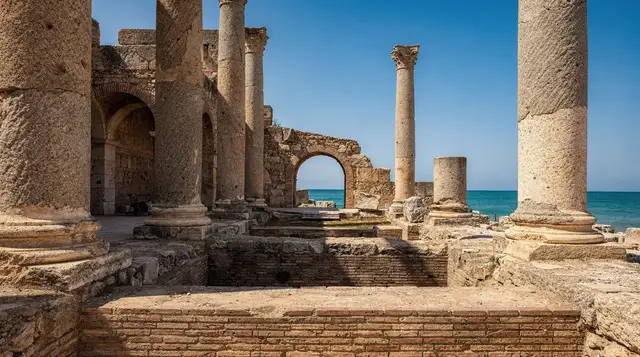
Start in the medina of Tunis, following a walking route through the medina to Ez-Zitouna mosque and the souk quarters, then take the TGM to Carthage for the afternoon. A complete visitor guide to the Carthage archaeological sites covers Byrsa hill and the Antonine baths, the two sites most visitors manage comfortably in a single afternoon alongside a morning already spent in the medina.
| Day | Focus | Transport |
| One | Medina and Carthage | Taxi, TGM |
| Two | Bardo and Sidi Bou Said | Taxi, TGM |
| Three | Dougga day trip | Private tour or car |
| Four | Hammamet | Coastal transfer |
Day two: the Bardo and Sidi Bou Said
Day two visits Le Bardo in the morning — the Bardo museum: a complete visitor guide and the mosaics of the Bardo, room by room both help plan a two-hour visit — before an afternoon in Sidi Bou Said, reached via the TGM from Tunis Marine. The cafés of Sidi Bou Said makes a good closing stop before returning to Tunis for the evening.
Day three: Dougga, the best-preserved Roman town in North Africa
Day three is a genuine day trip into the interior, roughly two hours’ drive from Tunis, to Dougga. Dougga: the best-preserved Roman town in North Africa explains why this hilltop site, largely unrestored and still standing much as it was left, is considered by many visitors the single most rewarding Roman site in Tunisia — more so than Carthage’s scattered fragments, since Dougga preserves an entire town layout, from the capitol and theatre down to residential streets and a public latrine.
A private day tour to Dougga and Bulla Regia via Testour is the most efficient way to cover the distance and see two major sites in one day, since Bulla Regia’s underground villas — built partly below ground level to escape the summer heat — sit roughly forty minutes further from Dougga and are difficult to combine without a driver managing the route.
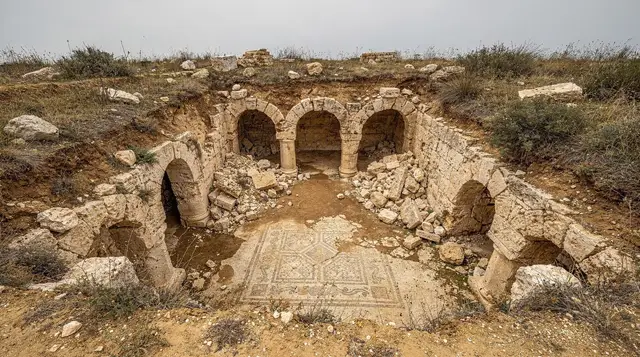
Bulla Regia and its underground villas and Testour, the small Andalusian-founded town passed en route, both add texture to what would otherwise be a straightforward there-and-back drive. A day tour taking in Oudhna, Testour, Djebba and Dougga is a useful alternative if a wider spread of smaller Roman and rural stops appeals more than the Bulla Regia pairing.
For visitors more drawn to a third significant Roman site than to Bulla Regia’s villas, a day tour combining Testour, Dougga and Zaghouan swaps in Zaghouan and its Roman water temple, the source point of the aqueduct that once supplied Carthage.
Day four: on to Hammamet
Day four shifts to the coast, with a transfer of roughly an hour from Tunis to Hammamet. The medina of Hammamet is smaller and less overwhelming than the Tunis medina, a gentler final stop after three fuller days, and the beaches of Hammamet covers where to spend an afternoon by the sea if that’s the priority for a closing day.
Visitors continuing on from Hammamet rather than flying out of Tunis-Carthage airport should note that Enfidha-Hammamet airport serves the region directly, which can simplify the return journey compared with backtracking to Tunis.
Doing it in reverse: Hammamet-based visitors
This itinerary also works starting from Hammamet rather than Tunis, which suits visitors on a beach-first trip who want to add Tunis’s highlights as excursions rather than relocating. A day trip from Hammamet covering the medina, the Bardo, Carthage and Sidi Bou Said compresses days one and two above into a single long day from a Hammamet base, leaving the Dougga day trip as a separate excursion on another day of the same stay.
Do you need a car for this itinerary?
Within Tunis, no — the TGM and taxis cover days one and two comfortably. For day three’s Dougga trip, a private tour with a driver is considerably more practical than self-driving for most visitors, since the interior roads and site layout are less signposted than the coastal routes, and a guide adds real value at a site with limited on-site interpretation. Hiring a car in Tunisia and driving in Tunisia cover the self-drive option if that’s preferred over a tour.
Where to stay across the four days
For days one and two, central Tunis — Ville Nouvelle or the Belvédère district — keeps the medina, Bardo and TGM stops all within easy reach. Day three’s Dougga trip works from the same Tunis base, with an early pickup if using a guided tour, so there’s no need to change hotels before the interior day.
Day four then shifts entirely to Hammamet or Yasmine Hammamet for the final night, with either a full resort stay or a smaller medina-adjacent hotel depending on whether beach time or old-town atmosphere matters more for a single night. Where to stay in Tunis covers the city-centre options in more depth.
Cost breakdown across four days
| Bardo and Carthage tickets | Around 20-25 TND combined |
| Dougga day tour (private, with driver and guide) | The largest single cost of the trip, typically covering Dougga plus a second site |
| Taxis and TGM within Tunis (two days) | 25-40 TND total |
| Transfer to Hammamet | Varies by transport choice; shared or private options both exist |
| Meals across four days (roughly 10-12) | 15-35 TND per person per meal, mid-range restaurants |
Self-driving day three instead of booking a tour lowers the single largest cost line, at the expense of navigating unfamiliar interior roads and a site with limited on-site interpretation — most first-time visitors find the guided option worth the difference for Dougga specifically, even if they’re comfortable self-driving elsewhere in the country.
What four days still leaves out
Four days doesn’t reach El Djem’s amphitheatre, Kairouan, or the Sahara — each of these needs either a longer trip or a further, dedicated day trip. Five days in Tunis and the north adds Bizerte instead of extending south, while the best day trips from Tunis surveys El Djem, Kairouan and other options for a longer stay.
Is four days the right length?
Mistakes to avoid
Frequently asked questions about four days in Tunis and around
Is Dougga worth a full day trip from Tunis?
Yes — most visitors who’ve also seen Carthage rate Dougga as the more complete and visually striking Roman site, since it preserves an entire hilltop town rather than scattered fragments.
Do I need to rent a car for this itinerary?
Not necessarily. A private guided day tour covers the Dougga leg without self-driving, and the two Tunis city days work fine with TGM and taxis.
Can I skip Hammamet and still make this a good four-day trip?
Yes — the first three days (medina, Bardo and Carthage, then Dougga) form a complete, satisfying trip on their own if the coastal night doesn’t fit your plans.
How far is Dougga from Tunis?
Roughly two hours’ drive, depending on the route and any stops along the way at Testour or Bulla Regia.
Should I combine Dougga with Bulla Regia or with Zaghouan?
Both work well; Bulla Regia adds underground Roman villas with a distinctive design, while Zaghouan adds a Roman water temple and mountain scenery. Neither is clearly better — it depends on which appeals more.
Is Hammamet worth visiting if I’ve already seen Sidi Bou Said?
Yes, though for different reasons — Hammamet’s medina is smaller and calmer, and its main draw is the beach and resort atmosphere rather than historical sightseeing.
What airport should I fly out of after this itinerary?
Either Tunis-Carthage or Enfidha-Hammamet, depending on your airline and route; Enfidha often suits visitors ending their trip already in Hammamet.
Is four days enough time, or should I extend to five?
Four days covers this itinerary’s stops comfortably. Five days, as in the itinerary below, adds Bizerte and the north coast if that region interests you.
What should I pack for the Dougga day trip specifically?
Comfortable walking shoes matter more here than almost anywhere else on this itinerary, since Dougga’s paths are uneven ancient paving rather than flat modern walkways, and there’s minimal shade across most of the site. A hat, sun protection and a full water bottle are worth carrying rather than relying on finding supplies on-site, since facilities at Dougga are more limited than at Carthage or the Bardo.
tours.4 days
Verified deep-linked GetYourGuide tours. Book through these links and we earn a small commission at no cost to you.
These are our own photographs of Tunisia, not the operator's pictures of this tour — open the tour page to see those.