One week in Tunis and its region
Seven days is a genuinely comfortable amount of time to cover the best of Tunis and the region within a couple of hours’ drive, without the itinerary collapsing into a string of transfers. This route bases you in Tunis for the first half of the week, uses it as a hub for two organised day trips to the Roman interior, then moves to the coast at Hammamet before finishing with a run up to Bizerte and Tabarka in the north. It deliberately skips the Sahara, which needs its own multi-day trip rather than a rushed detour; if the desert matters more to you than the north coast, the one-week Tunis and Sahara itinerary swaps the northern leg for Tozeur, Douz and Matmata instead.
| Where | Tunis, Carthage, Dougga, Kairouan, El Djem, Hammamet, Bizerte and Tabarka |
| Cost | Roughly 900–1,400 TND (about €270–420) per person for a week, excluding flights |
| Time needed | 7 days |
| Getting there | Fly into Tunis-Carthage International Airport |
| Best time | March–May or September–November |
How the week breaks down
The logic behind this route is to front-load the parts that don’t need a car — the Tunis medina, Carthage, the TGM line to La Marsa — before switching to organised day trips for the sites that are genuinely awkward to reach independently, like Dougga and Bulla Regia. The second half of the week moves base to Hammamet, which cuts driving time to Kairouan and El Djem roughly in half compared with doing them from Tunis, then finishes with a two-day loop north to Bizerte and Tabarka before returning for a flight out of Tunis-Carthage.
| Day | Base | Focus |
|---|---|---|
| 1 | Tunis | Medina, Ville Nouvelle, arrival |
| 2 | Tunis | Carthage and Sidi Bou Said |
| 3 | Tunis | Dougga and Bulla Regia via Testour |
| 4 | Hammamet | Transfer, coast, medina |
| 5 | Hammamet | Kairouan and El Djem |
| 6–7 | Bizerte / Tabarka / Tunis | North coast loop, return, departure |
Day 1: the medina and Ville Nouvelle
However you arrive, give the first afternoon to Tunis itself rather than rushing straight out to a day trip. The medina walking route threads from Bab Bhar through the souks toward Ez-Zitouna mosque, whose interior is closed to non-Muslims but whose courtyard is visible and worth the stop. Expect to get genuinely lost at least once; the alleys aren’t laid out for tourists, and that’s most of the point. Come back out via Avenue Habib Bourguiba into the Ville Nouvelle for the contrast: French colonial-era boulevards, the cathedral, and pavement cafés that feel closer to southern Europe than to the medina a few hundred metres away.
Save the souks’ bargaining for a bit later in the trip, once you’ve had a chance to compare prices across a couple of shops — the bargaining guide has the realistic version of how this actually goes, which is less dramatic and less confrontational than most guidebooks suggest. If jet lag or a late arrival cuts the day short, the medina rewards a slower, second pass more than most sites do, so nothing here is wasted if you come back to it on day two or three.
Day 2: Carthage and Sidi Bou Said
Carthage deserves a full morning rather than the rushed hour some day tours give it. Take the TGM train from central Tunis to Carthage-Salammbô or Carthage-Hannibal, and work through Byrsa hill’s museum, the Antonine baths and the Punic ports at your own pace — the Carthage archaeological sites guide covers the sequence, and the multi-site ticket guide explains what the combined pass actually includes, which is worth buying before you start rather than site by site.
By early afternoon, continue two stops further on the TGM to Sidi Bou Said, whose blue-and-white streets are genuinely worth the postcard reputation even if they’re busiest around midday with day-trippers from cruise ships. A coffee at one of the hillside cafés with a view over the bay is a reasonable way to close the day, and anyone who’d rather have the whole circuit organised in one go can book From Tunis: Half-Day Tour to Carthage and Sidi Bou Said instead of managing the TGM connections independently.
Day 3: Dougga and Bulla Regia via Testour
This is the day trip that makes the most sense as an organised tour rather than a rental car, since Dougga and Bulla Regia sit roughly two hours apart from Tunis in different directions, connected by minor roads that a first-time visitor won’t know well. Tunis or Hammamet: Dougga and Bulla Regia via Testour private tour covers both sites plus a stop in Testour, the small Andalusian-founded town on the way, in a single long day with a driver-guide who knows the roads.
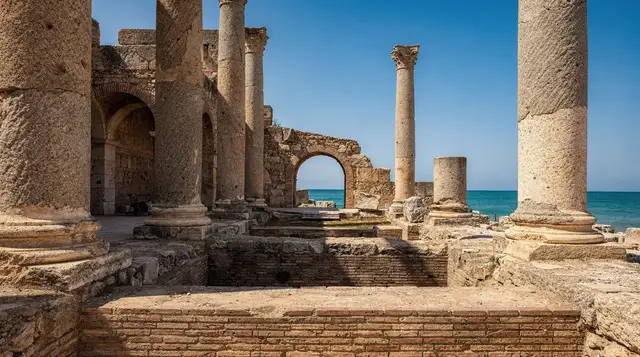
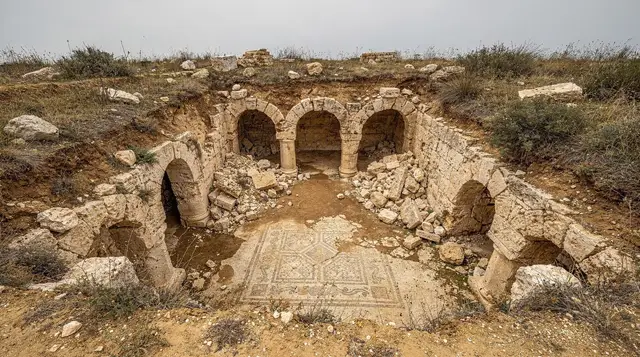
Dougga is the better-preserved of the two, with a largely intact theatre, capitol and forum that read as an actual Roman town rather than a scattered ruin field — the Dougga complete guide covers what to prioritise if time runs short. Bulla Regia’s underground villas, built partly below ground as a defence against summer heat, are the more unusual stop and the one first-time visitors tend to remember longest; the Bulla Regia guide has the detail on which villas still have intact mosaics in place. Both sites are covered together in the Roman Tunisia itinerary if this day leaves you wanting more.
Day 4: transfer to Hammamet
Moving base to Hammamet on day four cuts significant driving time out of the rest of the week, since Kairouan and El Djem are both closer from the coast than from Tunis. The transfer itself takes about an hour by louage or an organised transfer, and arriving by early afternoon leaves time to settle in and see Hammamet’s own medina — smaller and calmer than Tunis’s, and genuinely walkable in under an hour. The Hammamet medina guide and Hammamet beaches guide both cover what’s worth prioritising if you only have the one afternoon before tomorrow’s day trip.
Day 5: Kairouan and El Djem
This is the longest day of the week, and worth treating as such rather than trying to add anything else on top. Tunis/Hammamet/Sousse: Kairouan and El Jem Private Daytrip covers both UNESCO sites from a Hammamet pickup, starting with Kairouan’s Great Mosque and medina in the morning before continuing to El Djem’s amphitheatre in the afternoon, when the light through the arcades tends to be better for photos anyway. The Kairouan medina guide and El Djem amphitheatre guide both cover what to expect at each stop in more depth.
If a full nine-hour day feels like too much, or you’d rather split the two sites across separate mornings, Hammamet: Kairouan Half-Day Guided Tour with Hotel Pickup covers just Kairouan in half the time, leaving the afternoon free for the beach — though it does mean El Djem has to be dropped or added on a different day, which this particular week doesn’t have room for.
Days 6–7: Bizerte and Tabarka in the north
The final stretch swaps Roman ruins for coastline. Tunis or Hammamet: 2-day northern Tunisia tour with a night in Tabarka picks up from Hammamet or Tunis and runs up through Bizerte’s old port and fishing harbour before continuing to Tabarka, close to the Algerian border, for an overnight stay. The Bizerte day trip guide has more on Bizerte’s own old town and canal if you want context before the tour reaches it.
Tabarka is a genuinely different landscape from the rest of the trip: pine-covered hills coming down almost to the water, a Genoese fort on an offshore islet, and a much quieter pace than the coast further south. The tour returns to Tunis on day seven in time for an evening flight, or with enough slack for a last coffee in the Ville Nouvelle if the flight is later. Anyone flying out of Tunis-Carthage can check the airport guide for timing the return.
Getting around without a car
This itinerary is built around organised day trips and the TGM rather than a rental car, which suits most first-time visitors better than self-driving unfamiliar rural roads. The getting around Tunis guide covers the TGM, the metro léger and taxis within the city, while louages explained is worth reading before the Hammamet transfer, since shared taxis are the cheapest way to cover that stretch if you’d rather not book a private transfer.
Anyone who does want the flexibility of a car for a slower version of this same route should read the car hire guide first, since insurance and road conditions outside the toll motorways are worth understanding before committing.
Budget for the week
Costs vary a lot depending on where you sleep and whether you book tours privately or in a shared group, but a mid-range week for one person, excluding international flights, tends to land somewhere between 900 and 1,400 TND. The Tunis budget guide breaks this down by category in more detail, and the currency tool is worth bookmarking for quick TND conversions while you’re travelling, since prices are rarely quoted in euros on the ground.
Common mistakes with this route
Frequently asked questions about a week in Tunis
Do I need a rental car for this itinerary?
No. Every long-distance leg in this route — Dougga and Bulla Regia, Kairouan and El Djem, Bizerte and Tabarka — is covered by an organised day trip, and the Tunis-to-Hammamet transfer is straightforward by louage. A car adds flexibility but isn’t necessary.
Could this itinerary work in reverse, starting in Hammamet?
Yes, and it might suit anyone flying into Enfidha-Hammamet airport rather than Tunis-Carthage better. Start with the Kairouan and El Djem day trip, then the north coast loop, before finishing with three nights in Tunis and the Dougga day trip.
Is seven days too long if I’ve been to Tunisia before?
For a repeat visitor who has already covered Tunis and Carthage, four or five days focused on Dougga, Kairouan, El Djem and the north coast would cover the same new ground without repeating the first two days.
How much walking does this route involve?
A fair amount on the medina and Carthage days, less on the day-trip days where you’re mostly moving between sites by vehicle with shorter walks at each stop. Comfortable, closed shoes matter more than fitness level.
Can I swap Bizerte and Tabarka for extra time in Hammamet?
Yes, that’s a reasonable trade if beach time matters more to you than the north coast, though you’d be skipping a genuinely different landscape that most of Tunisia’s coast doesn’t offer.
What’s the best time of year to do this specific route?
Spring and autumn suit it best. Summer works but the archaeological sites — Dougga, Bulla Regia and El Djem especially — are far more comfortable with an early start when it’s not at peak heat. The best time to visit tool has a fuller month-by-month breakdown.
Do I need to book the day trips in advance?
Yes, ideally a few days ahead, especially the Dougga and Bulla Regia tour and the two-day north coast trip, since both involve fixed vehicle capacity and, for the northern trip, a hotel booking in Tabarka.
Is this itinerary suitable for someone travelling solo?
Yes. All of the day trips run as shared group tours by default, which suits solo travellers well, and both Tunis and Hammamet are comfortable bases to navigate independently between the organised days.
tours.7 days
Verified deep-linked GetYourGuide tours. Book through these links and we earn a small commission at no cost to you.
These are our own photographs of Tunisia, not the operator's pictures of this tour — open the tour page to see those.