The UNESCO sites of Tunisia in six days
Tunisia holds eight UNESCO World Heritage sites, a striking number for a country this size, and six of them sit within a day’s drive of Tunis, close enough to visit properly without living out of a suitcase for weeks. This itinerary devotes one day to each: the medina of Tunis, the ruins of Carthage, the Roman town of Dougga, the holy city of Kairouan, the amphitheatre of El Djem, and the Punic city of Kerkouane. It is built around a private driver-guide rather than a rental car, since the distances between sites are significant and self-driving between six separate destinations in six days leaves little energy for actually looking at what you have driven to see.
| Where | Tunis medina, Carthage, Dougga, Kairouan, El Djem, Kerkouane |
| Cost | Roughly 1,400 to 2,100 TND per person for six days, mid-range |
| Time needed | Six full days |
| Getting there | Private driver-guide or day tours from Tunis |
| Best time | March to May or October to November |
Why these six sites specifically
Tunisia’s UNESCO list also includes Ichkeul National Park and the medina of Sousse, both genuinely worth visiting but left out of this particular route: Ichkeul is a nature reserve that sits awkwardly alongside six days of dense archaeology and mosque visits, and the medina of Sousse duplicates much of what a day in the medina of Tunis already covers, without adding a distinct enough experience to justify a seventh day for most travellers. The six sites kept here span three different periods and cultures — Punic Carthage and Kerkouane, Roman Dougga and El Djem, and Islamic-era Kairouan and the medina of Tunis — which is what makes the itinerary read as a genuine survey of the country’s history rather than six variations on the same theme.
Day 1: the medina of Tunis
Start in the medina of Tunis itself, listed by UNESCO for its remarkably intact medieval urban fabric rather than any single monument. The walking route through the medina covers the Ez-Zitouna mosque courtyard, the souks and Dar Ben Abdallah in a logical order, and mosque etiquette in Tunisia is worth reading beforehand, since the mosque’s prayer hall is not open to non-Muslim visitors and knowing that in advance avoids an awkward moment at the door.
A full day here, rather than a rushed morning, is what the UNESCO listing actually rewards: it is the accumulated density of streets, doorways and daily life that makes the medina significant, not one standout building.
Day 2: Carthage
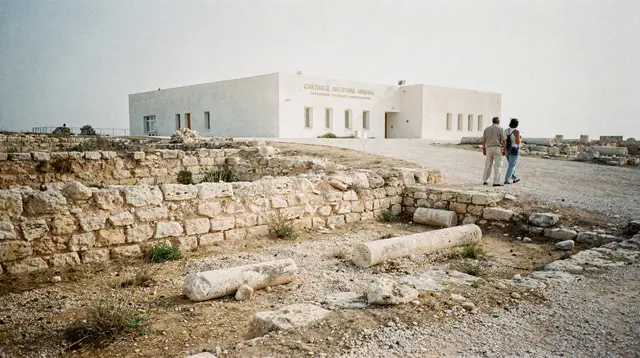
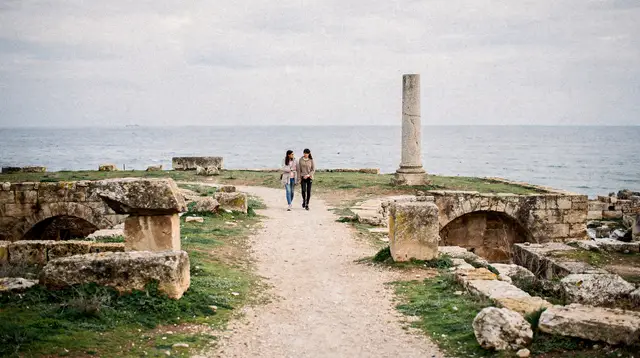
Carthage is Tunisia’s best-known UNESCO site and also its most misunderstood: the Punic city that gave Rome its greatest rival was largely destroyed and later built over by the Romans, so what survives today is a scattering of separate sites across a modern, wealthy suburb rather than a single walkable ruin.
The complete visitor guide to Carthage’s archaeological sites and the multi-site ticket guide are worth reading in advance, since a single ticket covers several separate locations and understanding that structure beforehand saves real time on the day. Byrsa hill, the Antonine baths and the Punic ports are the three stops worth prioritising if time is tight.
Day 3: Dougga
Dougga is widely regarded as the best-preserved Roman town in North Africa, and unlike Carthage it survives as a genuine, readable town rather than fragments — see the complete Dougga guide for what makes the theatre, capitol and baths here different from anywhere else in the country. Getting there independently is impractical without a car, so this is a natural day to use an organised tour: From Tunis: UNESCO Dougga, El Kef kasbah & Musti day trip pairs Dougga with the hilltop kasbah at El Kef and the smaller Roman site at Musti, adding useful context on the wider region for a similar cost to a Dougga-only tour.
Day 4: Kairouan
Kairouan holds a distinct kind of significance: it is considered the fourth holiest city in Islam after Mecca, Medina and Jerusalem, and its Great Mosque, with its distinctive minaret and vast prayer hall, anchors a UNESCO listing built around the city’s religious and architectural role rather than a single ruin. The Kairouan medina guide covers the wider old town beyond the mosque itself, including the carpet workshops the city is known for. Getting here from Tunis takes around two hours by car or organised transport, making it a comfortable full-day round trip rather than an overnight necessity, though staying a night in Kairouan is a reasonable option if the pace of the itinerary allows it.
Day 5: El Djem
The amphitheatre at El Djem is Tunisia’s single most photogenic Roman structure: a colosseum built for a provincial town in the middle of the countryside, with capacity for around 35,000 spectators despite the modest size of the surrounding settlement, which tells you something about how wealthy Roman North Africa’s grain trade actually was.
The complete amphitheatre guide covers the underground chambers beneath the arena floor, which are as interesting as the seating tiers above and easy to miss without knowing to look for them. El Djem sits roughly two and a half hours from Tunis, making this the longest single travel day of the itinerary; a driver-guide who can also work the Kairouan-to-El Djem link on day four rather than two separate return trips to Tunis is a meaningfully more efficient use of the two days together.
Day 6: Kerkouane
Kerkouane closes the itinerary with the Punic period it opened with on day two, but tells a genuinely different story: this is the only Punic city in Tunisia never rebuilt by the Romans, so its original street plan, house foundations and even individual bathtubs survive largely untouched, unlike the fragments left at Carthage. Kerkouane sits on the Cap Bon peninsula, roughly two hours from Tunis, and a return day trip closes the loop before a final night in the capital.
Booking this route as a single package
Rather than arranging six separate day tours, one operator runs the entire route as a single multi-day private package: Private tour of Tunisia: 6 UNESCO sites in 6 days covers all six sites in this itinerary with one driver-guide throughout, which removes the repeated logistics of booking, confirming and being collected for six separate excursions.
For travellers with only four days rather than six, Best of Tunisia: 4 days of history, UNESCO sites and Roman ruins compresses the Roman and UNESCO highlights into a shorter package, necessarily dropping one or two sites rather than covering all six. A shorter single-day option, From Tunis: UNESCO World Heritage tour, is useful as an add-on or a way to sample the concept before committing to the full six-day route.
UNESCO sites at a glance
| Site | Period | Day in this itinerary |
|---|---|---|
| Medina of Tunis | Medieval Islamic | Day 1 |
| Carthage | Punic and Roman | Day 2 |
| Dougga | Roman (Numidian origins) | Day 3 |
| Kairouan | Early Islamic | Day 4 |
| Amphitheatre of El Djem | Roman | Day 5 |
| Kerkouane | Punic | Day 6 |
Two further Tunisian UNESCO sites, Ichkeul National Park and the medina of Sousse, are not part of this six-day route; see Ichkeul national park if you want to add a seventh day for the nature reserve specifically.
Frequently asked questions about a UNESCO sites itinerary in Tunisia
Are all six sites suitable for visitors with limited mobility?
Carthage, Dougga and Kerkouane all involve walking over uneven ancient stonework with limited shade, which makes them genuinely demanding for anyone with mobility limitations; the medina of Tunis and Kairouan’s Great Mosque courtyard are comparatively flatter, though still not fully accessible.
Could this itinerary be extended to include Ichkeul and Sousse for all eight UNESCO sites?
Yes, adding Ichkeul as a nature-focused day and Sousse’s medina as an extra city day would extend the route to around eight days total, though the pace would need to slow to avoid site fatigue.
Is six days too rushed for genuine history enthusiasts?
For a first overview, six days works well; travellers who want to go deeper at any single site, particularly Carthage or Dougga, may prefer to add an extra day rather than treat every stop as a single fixed visit.
Do I need a guide, or can I visit these sites independently with information panels alone?
On-site information varies considerably by site; Carthage and Dougga have reasonable interpretation, while a guide adds meaningfully more context at Kerkouane and Kairouan’s Great Mosque, where the historical detail is less obvious from the stonework alone.
What is the best order to visit these six sites in, if not exactly as listed here?
The order in this itinerary is designed to minimise backtracking, roughly working from Tunis outward and back; swapping days is possible but Kairouan and El Djem are close enough to each other that keeping them adjacent, as here, is worth preserving in any reordering.
Is this itinerary suitable in summer?
It is physically demanding in summer heat, particularly at exposed sites like Dougga and El Djem with little shade; spring and autumn are considerably more comfortable for six consecutive days of site visits.
How does the six-day private tour compare in cost to booking each day separately?
The bundled six-day package generally works out less expensive per day than six separate bookings, largely because it avoids the fixed pickup and admin costs that come with each individual tour.
Can this itinerary be combined with time on the coast afterward?
Yes, Hammamet or Sousse both work well as a few relaxed beach days tacked on after this itinerary, since both sit within a short drive of the route’s later stops at El Djem and Kerkouane.
Culture & heritage tours on GetYourGuide
Verified deep-linked GetYourGuide tours. Book through these links and we earn a small commission at no cost to you.
These are our own photographs of Tunisia, not the operator's pictures of this tour — open the tour page to see those.