Dougga: the best-preserved Roman town in North Africa
Is Dougga worth the drive from Tunis?
For anyone with an interest in Roman archaeology, yes. Dougga has more standing structures than Carthage or El Djem, spread across a genuinely scenic hillside above the Medjerda valley. The trip takes most of a day, so it suits travellers with at least two full days in the Tunis area rather than a rushed stopover.
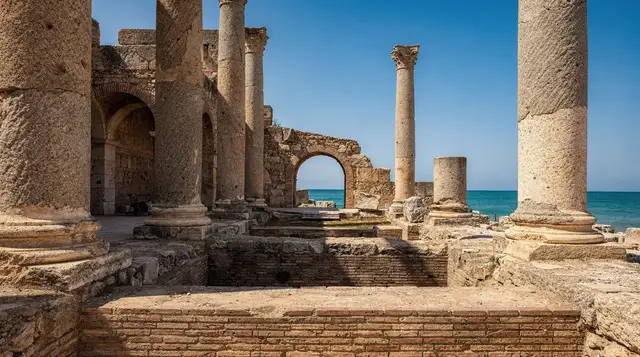
Most Roman sites in Tunisia give you fragments: a few columns, a mosaic floor, the outline of a street plan traced in low stone. Dougga is different. Perched on a hillside near the small town of Teboursouk, roughly two hours west of Tunis, it is widely considered the best-preserved Roman town in North Africa, with a capitol still standing to nearly its full height, a theatre still used for performances, and public latrines that survive in a state of completeness that’s rare anywhere in the former Roman world. UNESCO listed it as a World Heritage Site in 1997, and the citation specifically cites the completeness of the urban fabric, not just the individual monuments.
The trade-off is distance. Dougga sits well outside the cluster of sites around Tunis and Carthage, so seeing it properly means committing the better part of a day, either as a self-drive trip or as part of an organised tour that usually bundles it with one or two other stops in the region.
| Where | Near Teboursouk, about 105 km west of Tunis, in the Medjerda valley |
| Cost | Around 12 TND (roughly €3.50) entry; combined tickets and guide fees extra |
| Time needed | 2 to 3 hours on site; a full day including travel from Tunis |
| Getting there | Car hire or organised tour, about 2 hours each way from Tunis |
| Best time | Morning, before the midday heat; spring and autumn are most comfortable |
A hill town that Rome mostly left alone
What makes Dougga unusual isn’t any single monument but the sheer density of what remains standing. Unlike Carthage, which was flattened, rebuilt, and then swallowed by a modern city, Dougga was gradually abandoned after the Roman and Byzantine periods and never built over. A small Berber village occupied part of the site into the twentieth century, and when French archaeologists cleared it in the early 1900s, they found a town plan largely intact: streets, a forum, temples, baths, a theatre, a market, and residential quarters all readable in relation to one another, rather than as isolated ruins.
The site began as a Numidian and Libyco-Punic settlement before Rome absorbed it, and that layered history is still visible. Interested visitors can read more about how this fits the wider region in the Tunisian history timeline and in the guide to Berber heritage in Tunisia, since Dougga’s pre-Roman origins are unusually well documented for the region.
The hillside setting matters as much as the ruins themselves. Dougga sits above open farmland in the Medjerda valley, and from the highest points of the site, especially near the theatre, the view runs out over olive groves and wheat fields toward the surrounding hills. It’s a working agricultural landscape today much as it likely was in Roman times, which gives the site a sense of continuity that’s harder to find at more urbanised Roman locations.
The capitol
The capitol of Dougga is the site’s single most photographed structure, and for good reason: it stands close to its original height, with six Corinthian columns supporting a triangular pediment, set on a raised platform overlooking the forum below. Built in 166 to 167 AD and dedicated to Jupiter, Juno, and Minerva, it’s one of the best-preserved Roman temples anywhere in North Africa, and one of relatively few in the region where the full building profile, not just the base or a scatter of columns, remains legible from ground level.
The pediment carries a relief depicting the apotheosis of the emperor Antoninus Pius, still identifiable despite centuries of weathering. Steps lead up to the temple platform, and it’s worth the short climb for the view back down over the forum and out across the valley, which frames the scale of the town more clearly than photographs from ground level manage to convey.
The Roman theatre
Below the capitol, cut into the hillside in the standard Roman fashion, the theatre at Dougga seats around 3,500 people and remains in good enough structural condition that it still hosts performances during the town’s annual cultural festival, usually held in summer. Walking up through the tiered seating gives one of the better vantage points over the site as a whole, and the acoustics, a common point of interest at Roman theatres generally, are still noticeably effective even without amplification.
Compared to the more heavily restored Roman theatre at El Jem’s amphitheatre or the theatre in Carthage, Dougga’s feels less polished and more archaeological, with weathered stone and grass growing between some of the upper tiers. That’s part of its appeal for visitors who prefer sites that haven’t been extensively reconstructed for tourism.
The Libyco-Punic mausoleum
A short walk from the main Roman core stands one of Dougga’s more unusual monuments: a Libyco-Punic mausoleum dating from the 2nd century BC, predating the main Roman development of the site by several centuries. It’s a tall, tower-like funerary monument, built for a local Numidian notable, and its survival is partly an accident of colonial-era archaeology: the structure was dismantled and rebuilt after a 19th-century attempt to remove an inscribed stone from it for a European museum caused it to partially collapse.
The mausoleum is a useful reminder that Dougga’s history didn’t begin with Rome. It sits slightly apart from the main circuit of Roman buildings, and travellers pressed for time sometimes skip it, but it’s a five-to-ten-minute detour and one of the only substantial pre-Roman funerary monuments still standing anywhere in Tunisia.
The forum, market and residential streets
Dougga’s forum is modest in scale compared with major imperial cities, but its layout is unusually easy to read: paved ground, surrounding porticoes, and clear sightlines to the capitol above. Just off the forum, the old market building retains its stone counters and layout, giving a concrete sense of how commerce was organised in a provincial Roman town of moderate size.
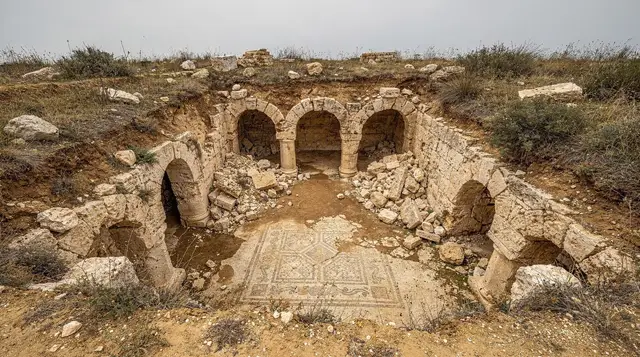
Beyond the civic core, the site includes stretches of residential streets and house foundations, with mosaic fragments in places, though the finest mosaics recovered from Dougga itself have mostly been moved to the Bardo Museum in Tunis for conservation. Visitors expecting to see Dougga’s best mosaics in situ should adjust expectations accordingly; what remains on site is largely architectural rather than decorative, and the mosaics are worth seeking out separately in Tunis.
The public latrines
One of Dougga’s more memorable, if less grand, survivals is a set of public latrines near the baths complex, with stone seating still largely intact in a circular arrangement. It’s a small detail, but it’s the kind of everyday infrastructure that rarely survives from the ancient world in recognisable form, and it tends to be one of the more commented-on stops among visitors precisely because it makes Roman daily life feel tangible in a way grander monuments sometimes don’t.
Comparing Dougga to Tunisia’s other Roman sites
Travellers weighing Dougga against Carthage or El Djem often want a direct sense of what each offers before committing a full day to any one of them.
| Site | Distance from Tunis | What stands out |
|---|---|---|
| Dougga | About 105 km, 2 hours | Most complete standing town; capitol, theatre, forum together |
| Carthage | Within Tunis, 20–30 minutes | Historic significance; fewer standing structures, more spread out |
| El Djem | About 200 km, 2.5 hours | Best-preserved Roman amphitheatre in Africa; less of a town layout |
| Bulla Regia | About 165 km, 2.5 hours | Unique underground Roman villas |
The dedicated guide to Carthage versus Dougga goes into more detail on that specific comparison for travellers trying to choose between the two, and the broader ranked guide to Roman sites near Tunis covers the full set including Uthina and Thuburbo Majus.
Getting to Dougga from Tunis
Dougga is roughly 105 km west of Tunis, close to the town of Teboursouk, and the drive takes around two hours each way by car via the A3 motorway toward Béja before turning off onto secondary roads for the final stretch. There is no direct public transport route that makes the trip practical for most visitors: reaching Dougga by louage typically means changing at Teboursouk or Le Kef and then arranging local transport for the final few kilometres, which adds significant time and uncertainty compared with driving or joining an organised tour.
For visitors without a hire car, an organised excursion is the more reliable option. A 12-hour tour covering Kairouan, Makthar and Dougga combines the Roman site with two other significant stops in the interior, and suits travellers who want to make the most of the long drive west by seeing several places in one outing rather than returning to Dougga separately. Details on Kairouan itself are covered in the Kairouan medina guide.
Travellers with less time available might prefer a half-day tour to Dougga from Tunis, which focuses on the site itself without adding extra stops, though given the two-hour drive each way, “half-day” in practice usually stretches close to a full day once travel time is included.
Combining Dougga with Testour or El Kef
Because the drive out is long, most operators pair Dougga with at least one other stop along the same route rather than running it as a standalone excursion. A cultural tour combining Dougga and Testour adds the distinctive Andalusian-influenced architecture of Testour, a town settled by Moriscos expelled from Spain in the 17th century, whose main mosque has a clock that famously runs anticlockwise.
The guide to the Andalusian towns of Tunisia covers Testour’s background in more depth, and the Testour and Medjerda valley day trip guide lays out that specific combination as a standalone itinerary.
For a more ambitious day covering the wider El Kef region, a day trip from Tunis to Dougga, the El Kef kasbah and Musti extends the route further west to the hilltop citadel town of Le Kef and the lesser-visited Roman ruins at Musti. This is a longer day than the other options here, generally starting early and returning to Tunis after dark, so it suits travellers prioritising archaeological and historical depth over a relaxed pace.
Those planning a broader trip around Tunis rather than a single excursion may find it useful to check how many days in Tunis and the wider best day trips from Tunis guide, since Dougga is one of several full-day options that compete for the same block of time in a typical itinerary. The Roman Tunisia itinerary also places Dougga within a multi-day route dedicated specifically to the country’s Roman sites.
Tickets and practical visiting information
Entry to Dougga costs around 12 TND (roughly €3.50), payable in cash at the ticket booth near the entrance; card payment isn’t reliably available, so bringing small-denomination dinars is worth planning for. There’s no strict time limit on visits, but most travellers spend two to three hours exploring the site properly, longer if visiting with a guide who stops to explain individual monuments in detail.
There is limited on-site shade and few facilities beyond a small café near the entrance, so bringing water, particularly in warmer months, is worth planning for. Practical guidance on costs across the wider trip is covered in the budget planning tool and the Tunis budget guide, and currency questions specifically are addressed in the currency tool.
Terrain and footwear
Dougga is built across a genuinely sloping hillside, and the paths between monuments are uneven: worn stone, loose gravel, and in places, no clearly marked path at all between one ruin and the next. This isn’t a flat, paved archaeological park in the way some more heavily developed sites are. Solid, closed walking shoes with good grip make a real difference, and this is one Roman site in Tunisia where sandals or flat-soled shoes are a genuine liability rather than just a minor inconvenience.
When to visit
Spring (March to May) and autumn (September to November) offer the most comfortable conditions for a site with as little shade as Dougga, with mild temperatures that make the uphill sections toward the capitol and theatre more manageable. Summer visits are feasible but demanding; arriving as early as the site allows and avoiding the midday hours makes a significant difference to comfort. Winter is generally mild in this part of Tunisia and rarely a barrier to visiting, though rain can make some of the unpaved paths between monuments slippery. General seasonal guidance for the region is covered in the best time to visit Tunis guide and the best time tool.
Frequently asked questions about visiting Dougga
How long does the round trip from Tunis take?
Expect around four hours of driving in total, roughly two hours each way, plus two to three hours on site. A realistic full day, door to door, runs eight to ten hours depending on how long you spend at Dougga itself and whether the trip includes additional stops such as Testour or Le Kef.
Do I need a guide to appreciate the site?
A guide isn’t strictly necessary since the layout is unusually easy to follow compared with more fragmentary sites, but a guide adds meaningful context on the mausoleum’s history and the capitol’s inscriptions that isn’t otherwise explained on site through signage, which is fairly minimal.
Is Dougga suitable for children?
It can work well for older children with an interest in history, given how much is visibly standing rather than requiring imagination to picture. The uneven terrain and long drive make it a harder sell for very young children, and there’s limited shade for breaks during a long visit.
Can I combine Dougga with Bulla Regia in one day?
It’s possible but demanding, since Bulla Regia lies further north-west and adding it typically pushes total driving time past five hours. Most operators treat Dougga and Bulla Regia as separate day trips rather than combining them, and the Bulla Regia underground villas guide covers that site’s specific logistics if it’s under consideration as an alternative outing.
Is there anywhere to eat near Dougga?
There’s a small café near the site entrance with basic refreshments, but options are limited. Most organised tours build in a lunch stop in Teboursouk or Testour, and self-drive visitors are generally better off planning a meal in one of those towns rather than expecting substantial food options at the site itself.
How does Dougga compare to Volubilis or Timgad for someone who has visited other North African Roman sites?
Travellers who’ve been to Volubilis in Morocco or Timgad in Algeria often note that Dougga sits in similar territory: a hillside Roman town with a strong sense of overall layout rather than isolated monuments. Dougga’s capitol and theatre are comparably well preserved, and its Libyco-Punic mausoleum adds a pre-Roman layer that neither of those sites quite matches in the same form.
Is the site accessible for visitors with mobility difficulties?
Not easily. The paths are uneven, unpaved in places, and involve a genuine uphill walk to reach the capitol and theatre, the two most significant structures on site. Visitors with mobility concerns should weigh this carefully against the long drive required to reach Dougga in the first place.
What should I bring for a visit?
Water, sun protection, cash in dinars for the entry fee, and sturdy closed shoes are the essentials. A hat and light layers are worth packing given the exposed, largely shadeless terrain, and a camera is worth having ready given the scale of what’s visible from the higher points of the site.
Roman & Punic site tours on GetYourGuide
Verified deep-linked GetYourGuide tours. Book through these links and we earn a small commission at no cost to you.
These are our own photographs of Tunisia, not the operator's pictures of this tour — open the tour page to see those.