Carthage is not one ruin — it’s a modern, wealthy Tunis suburb with a dozen scattered archaeological sites tucked between villas, embassies and the presidential palace grounds. That surprises some first-time visitors expecting something closer to Pompeii, a single fenced ancient city you walk through in sequence. The reality is more fragmented and, honestly, requires a bit more context to appreciate: this was once one of the ancient Mediterranean’s great cities, destroyed by Rome in 146BC and rebuilt as a major Roman city not long after, and almost nothing from either era survives whole.
| Where | Coastal suburb roughly 15km north-east of central Tunis |
| Cost | Multi-site ticket around 12 TND, covering several key sites |
| Time needed | Half a day for the main sites; a full day with Sidi Bou Said |
| Getting there | TGM light rail from Tunis Marine, roughly 25-30 minutes |
| Best time | Morning, before the midday heat |
Why Carthage looks the way it does
Rome levelled Punic Carthage after the Third Punic War in 146BC, and while Julius Caesar and Augustus later refounded it as a Roman colony that grew into one of the empire’s most important cities in Africa, both destructions — the Roman sack and, later, Vandal and Arab-era decline — left the site badly fragmented. What survives is scattered across the modern suburb because the modern suburb was built directly on top of, and around, the ancient one, rather than the ancient city being preserved as a single protected zone the way, say, Pompeii was.
Understanding this before you arrive changes the visit considerably. Rather than expecting one continuous ancient city, come prepared for a series of separate stops, each telling part of the story, connected by a short taxi ride or a longer walk through ordinary residential streets. A complete visitor guide to the Carthage archaeological sites lays out the full list and how they connect, and it’s worth reading before you go rather than improvising on the day.
The multi-site ticket
Carthage’s main sites are covered by a single multi-site ticket, valid across several locations including Byrsa hill and the national museum, the Antonine baths, the Roman villas, and a handful of smaller sites. It is, by most measures, good value, but the system for using it — where to buy it, which sites it actually covers, whether it’s valid for one day or longer — is not always obvious from the ticket booths themselves. The Carthage multi-site ticket, and how to use it well explains the mechanics in enough detail to avoid buying a second ticket unnecessarily or missing a site that was already covered.
A walking tour of the Carthage archaeological sites and ruins is a practical way to see the scattered sites without working out your own route between them, and a guide can do far more with the fragments on the ground than the on-site signage alone.
Byrsa hill and the national museum
Byrsa hill is Carthage’s highest point and, not coincidentally, the location of both the acropolis of Punic Carthage and, later, the heart of the Roman city, now topped by a French colonial-era cathedral converted into a cultural centre. The Carthage national museum on the same hill holds finds from across the site, including Punic funerary material and Roman-era mosaics and sculpture, and the hilltop itself offers one of the best overview panoramas of how the ancient city related to the modern coastline and the Gulf of Tunis.
Byrsa hill and the Carthage national museum is worth reading in advance, since the museum’s Punic collection — smaller and less headline-grabbing than the Bardo’s Roman mosaics — rewards a bit of context that isn’t always well provided on-site.
The Antonine baths and the Roman city
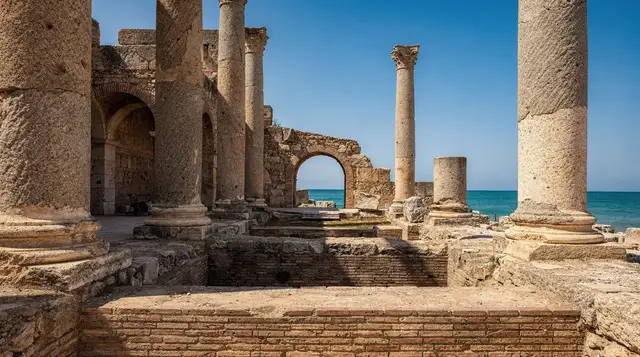
Down near the coast, the Antonine baths were, in their day, among the largest bath complexes in the Roman world outside Rome itself, and although only the substructure survives above a certain height, the scale is still apparent from the surviving foundations and the handful of towering column fragments left standing. It’s arguably the single most visually impressive site at Carthage for a visitor without deep archaeological background, since the sheer footprint of the complex is legible even in ruin.
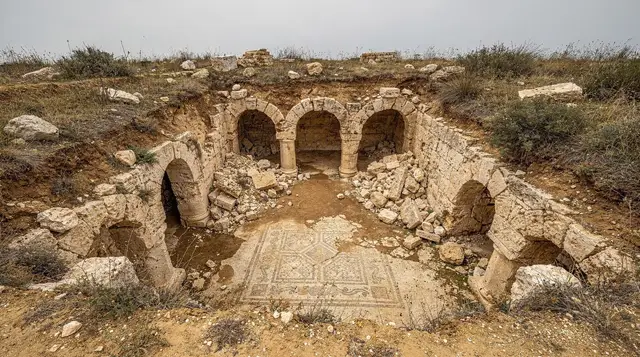
Nearby, the Roman theatre — still used for the Carthage international festival each summer — and a cluster of restored Roman villas give a sense of residential Roman Carthage, with mosaic floors and garden layouts partially reconstructed for visitors. The Antonine baths of Carthage and the Roman theatre and Roman villas of Carthage both go into more site-specific detail than a single overview page can.
| Site | Era | What survives |
| Byrsa hill | Punic and Roman | Museum, foundations, panoramic view |
| Antonine baths | Roman | Substructure and column fragments |
| Roman theatre | Roman | Restored seating, still in use |
| Roman villas | Roman | Partial reconstructions, mosaic floors |
| Punic ports | Punic | Two circular harbour basins, largely silted |
| Tophet | Punic | Funerary stelae, open-air site |
The Punic ports
Two circular harbour basins near the coast mark the site of ancient Carthage’s military and commercial ports, engineered to shelter and rotate a substantial Punic fleet — a genuinely impressive piece of ancient engineering, though what remains today is largely silted and overgrown rather than a dramatic ruin. The Punic ports of Carthage explains what you’re actually looking at, since without that context the ports can read as unremarkable ponds rather than the sophisticated naval infrastructure they once were.
Managing expectations
Honestly, Carthage disappoints some visitors, and it’s worth saying so directly rather than oversell it: this is not a site where you’ll be visually overwhelmed the way you might be at El Djem’s amphitheatre or Dougga’s hilltop town. Carthage’s value is more intellectual than visual — understanding what stood where, and why a civilisation this significant left comparatively so little standing. Visitors who prepare with some background, or who go with a guide who can narrate the fragments into a coherent story, tend to come away far more satisfied than those who wander between sites with no context.
A combined day tour of Carthage and Sidi Bou Said is the most popular way to see Carthage for exactly this reason — it pairs the archaeological sites with a guide’s narration and follows with Sidi Bou Said’s blue-and-white streets, which gives the day a lighter, more visually rewarding close after an intellectually demanding morning among ruins.
Getting there and around
The TGM light rail is the standard way to reach Carthage from Tunis, running from Tunis Marine station with several stops actually named for different parts of Carthage — Carthage Salammbô, Carthage Byrsa, Carthage Hannibal, Carthage Présidence and Carthage Dermech among them — which roughly correspond to different clusters of sites. The TGM: Tunis to La Marsa by train explains which stop suits which site, since getting off at the wrong one adds a longer walk than necessary between locations that are otherwise a short hop apart by train.
Within Carthage itself, walking between sites is possible but involves stretches of ordinary suburban road with limited shade, so budget more time than the straight-line distances suggest, or use taxis between the more spread-out sites if the heat is a factor.
Combining Carthage with the rest of a Tunis trip
Carthage sits naturally alongside Sidi Bou Said and La Marsa on the same TGM line, and Carthage and Sidi Bou Said in a day is the itinerary most visitors end up following, needing no car and no early start.
For a broader comparison of Tunisia’s Roman-era sites, Roman sites near Tunis, ranked weighs Carthage against Dougga, Bulla Regia and El Djem for visitors deciding how to split limited time, and a tour of the El Djem amphitheatre is worth considering if the scale of Roman North Africa’s best-preserved single structure appeals more than Carthage’s scattered fragments.
For visitors basing themselves outside Tunis, a day trip from Hammamet covering the Bardo, the Tunis medina, Carthage and Sidi Bou Said packages the full Tunis-area highlight reel into a single organised day, useful for visitors staying on the Hammamet coast who want Carthage without relocating.
Mistakes to avoid
Frequently asked questions about visiting Carthage
How much time do I need at Carthage?
Half a day covers the main sites — Byrsa hill, the Antonine baths, and either the Roman villas or the Punic ports — at a reasonable pace. A full day, adding Sidi Bou Said afterward, is the more common and more rewarding option for most visitors.
Is Carthage disappointing compared with other Roman sites in Tunisia?
Visually, compared with El Djem’s intact amphitheatre or Dougga’s hilltop town, yes, Carthage’s fragments are less immediately dramatic. Historically and intellectually, it’s arguably more significant than either, and preparation or a guide closes most of that visual gap.
What does the multi-site ticket cover?
It typically covers several of Carthage’s main sites in a single purchase, including Byrsa hill and the museum, the Antonine baths and a handful of smaller locations, though exact inclusions can shift, so check current details when you buy.
How do I get to Carthage from Tunis without a car?
The TGM light rail runs directly from Tunis Marine station to several stops within Carthage, taking roughly 25-30 minutes and running every 15-20 minutes through the day.
Can I combine Carthage and Sidi Bou Said in one day without a tour?
Yes — both sit on the same TGM line, a few stops apart, and independent travel between them is straightforward. A guided tour adds context and removes the need to work out ticketing and stops yourself.
Is there shade at the Carthage sites?
Limited. Most sites are open-air with little natural or built shelter, so sun protection and water matter more here than at some of Tunisia’s more sheltered indoor museums.
Are the Carthage sites suitable for children?
The scattered, fragmentary nature of the sites can be harder for younger children to engage with than a single, visually dramatic ruin like El Djem. Older children with some background on Carthage’s history tend to get more out of the visit.
Is Carthage worth visiting if I’ve already seen the Bardo’s Carthage collection?
Yes — the Bardo shows the objects found at Carthage, but seeing the actual sites where they were excavated, and understanding the city’s layout on the ground, adds a dimension the museum alone doesn’t provide.