The Café des Nattes question
Every guidebook mentions the Café des Nattes, the woven-mat-floored café at the top of Sidi Bou Said’s main street, usually with a photo of its blue-and-white arched entrance and a line about how “everyone” stops there. I did too, twice, on two separate visits a year apart, specifically to answer a question that kept nagging at me: is this actually worth doing, or is it a ritual that’s outgrown whatever made it worth doing in the first place. The honest answer sits somewhere in between, and it depends heavily on when you go.
| Where | The top of the main pedestrian street in Sidi Bou Said, above Tunis |
| Cost | A mint tea or coffee runs roughly 8–15 TND (2.50–5 EUR), noticeably above typical café prices elsewhere |
| Time needed | Twenty minutes is enough to form an opinion; longer if you want to actually sit and watch the street |
| Getting there | The TGM train from Tunis to Sidi Bou Said, then a short uphill walk |
| Best time | Early morning or after sunset, avoiding the midday tour-group peak |
What the Café des Nattes actually is
Founded in the nineteenth century, the café takes its name from the woven mats — nattes — once used as seating and flooring, and it sits at the point where Sidi Bou Said’s main street opens onto a small square with views back down toward the harbour. It’s genuinely old, genuinely historic, and genuinely the kind of place that once hosted the town’s actual social life rather than a curated tourist experience. That history is real. What’s changed is who’s sitting in it now, and how much of the original atmosphere survives the volume of visitors passing through daily. Our food and drink hub covers this kind of café culture across the wider region.
The midday version
My first visit was at midday in high season, and I’ll be blunt: it was underwhelming. Every table was full, mostly with visitors rather than locals, service was slow enough that a simple mint tea took nearly twenty minutes to arrive, and the woven-mat seating — the actual namesake feature — was worn enough in places to feel more like a prop than a functioning piece of furniture. The view was still genuinely lovely. Everything else about the experience felt like standing in a queue that happened to have chairs. Our guide to the cafés of Sidi Bou Said covers several alternatives worth considering if the Café des Nattes’ midday crowds put you off, which they reasonably might.
The early-morning version
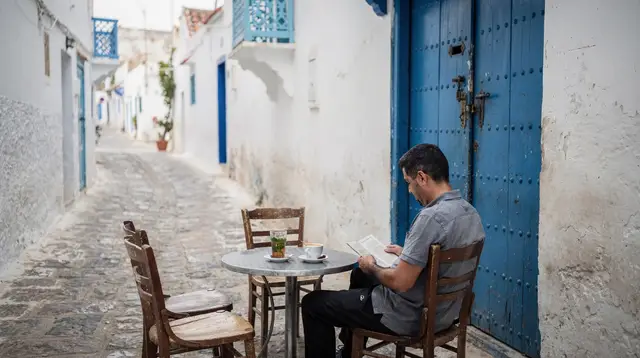
My second visit, a year later, was deliberately timed for just after eight in the morning, and it was a genuinely different place — maybe four other tables occupied, unhurried service, and enough quiet to actually notice the details: the tilework, the carved wooden ceiling, the way the light came through the archway onto the mats. This is the version worth having, and I’d go so far as to say the midday version isn’t worth the detour at all if this quieter alternative is available to you instead. Our complete guide to Sidi Bou Said covers the town’s rhythm across the day in more detail, which is useful for timing a visit around the crowds generally, not just at this one café.
| Midday, high season | Early morning | |
|---|---|---|
| Tables occupied | Full, long wait for seating | Roughly a quarter full |
| Service speed | Slow, up to twenty minutes for tea | Prompt, unhurried but attentive |
| Noise level | Loud, tour groups passing through | Quiet enough to hear the fountain |
| Overall impression | A queue that happens to have chairs | Close to the café’s historic reputation |
a guided visit to Sidi Bou Said at sunset offered a third useful version of the town entirely — golden light on the blue-and-white architecture, and a guide who pointed out details about the town’s Andalusian influences that I’d missed on both my self-guided visits, café included.
Is the coffee actually good
Setting the atmosphere question aside, the coffee and mint tea themselves are perfectly decent but not remarkable, and priced noticeably above what the same drink costs almost anywhere else in the region, Sidi Bou Said included. You’re paying for the location and the history, not for a coffee that would stand out on its own merits. I don’t think that’s dishonest exactly — old, famous cafés in most cities charge a premium for the setting — but it’s worth knowing going in rather than expecting a transcendent cup of coffee to match the view.
Our guide to mint tea and café culture in Tunisia and guide to Tunisian pastries and sweets both cover what to expect from Tunisian café culture more broadly, and how the Café des Nattes fits into, or slightly apart from, that wider picture.
What locals actually think of it
I asked a Sidi Bou Said resident I got talking to on my second visit what she made of the café, and her answer was more nuanced than either dismissal or endorsement: it’s a genuine piece of the town’s history that happens to have become a tourist landmark, and most residents now go to quieter, cheaper cafés elsewhere in town rather than competing for a table at the famous one. That distinction — historic and worth knowing about, but not where locals actually spend their coffee time now — feels like the most accurate framing I found on either visit.
How it compares to La Marsa’s café scene
A short TGM ride further along the coast, La Marsa has its own café culture, generally cheaper and considerably less performative than Sidi Bou Said’s tourist-facing strip. I spent an afternoon comparing the two directly, and La Marsa’s cafés felt closer to what the Café des Nattes might have been decades ago, before its current level of fame — unhurried, locally driven, priced for residents rather than visitors. Our Sidi Bou Said or La Marsa comparison guide weighs the two towns against each other in more depth than a single café comparison can.
a full-day tour of Sousse and Monastir with lunch gave me a useful point of comparison from a different coastal town entirely — Monastir’s café scene around its harbour has a similarly relaxed, unhurried character to La Marsa’s, for what it’s worth, if you’re weighing where to spend a slower café afternoon beyond the Tunis area.
Pairing it with the rest of Sidi Bou Said
Whatever you decide about the café itself, it’s worth treating as one stop within a broader wander through the town rather than the entire point of the visit — the blue-and-white streets themselves, the views from the upper terraces, and the smaller lanes away from the main pedestrian street are arguably more rewarding than any single café. Our two-day Tunis itinerary and Carthage and Sidi Bou Said day trip guide both position the café as a stop within a fuller day rather than a destination on its own.
A different kind of café day, further afield
On a later trip, wanting a genuinely different pace, I took a longer guided day inland instead of returning to Sidi Bou Said a third time, and it recalibrated how I thought about café culture generally — the version in Kairouan, closer to the Great Mosque, felt considerably less self-conscious than anything on the Sidi Bou Said tourist strip, more genuinely woven into daily life there.
a full-day guided tour of Kairouan and El Djem with lunch included exactly this kind of stop, and comparing Kairouan’s more workaday café culture against Sidi Bou Said’s famous one was, honestly, more illuminating than either place alone would have been.
Mistakes to avoid
Frequently asked questions about the Café des Nattes
Is the Café des Nattes worth visiting?
Yes, but timing matters enormously. Early morning or evening visits deliver something close to its historic reputation; midday visits in peak season tend to disappoint given the crowds and slow service.
How much does a coffee or mint tea cost there?
Expect roughly 8 to 15 TND (2.50 to 5 EUR), noticeably higher than typical Tunisian café prices, reflecting the location and history more than anything exceptional about the drink itself.
What’s the best time of day to visit?
Just after opening in the morning or after sunset, both of which avoid the midday tour-group peak and let you actually experience the space rather than queue for it.
Do locals still go to the Café des Nattes?
Not much, based on what residents told me. Most now prefer quieter, less expensive cafés elsewhere in Sidi Bou Said or in nearby La Marsa, treating the famous café as more of a tourist landmark than a regular haunt.
Is there a better alternative in Sidi Bou Said itself?
Several smaller cafés along the town’s quieter lanes offer a comparable view and atmosphere without the crowds or premium pricing, covered in our guide to the town’s café scene generally.
Is Sidi Bou Said worth visiting just for this café?
No — treat the café as one stop within a wider wander through the town’s streets and viewpoints, which offer more substance than any single café visit can provide on its own.
How does it compare to café culture in La Marsa?
La Marsa’s cafés are generally cheaper, less crowded, and feel closer to how the Café des Nattes might have felt before its current level of fame — a useful comparison if the crowds put you off.
Is it worth combining a Sidi Bou Said visit with a guided tour?
It can be, particularly for sunset timing or added historical context, though the town is also entirely walkable and manageable independently if you’d rather explore at your own pace.
Tunis food & drink tours on GetYourGuide
Verified deep-linked GetYourGuide tours. Book through these links and we earn a small commission at no cost to you.
These are our own photographs of Tunisia, not the operator's pictures of this tour — open the tour page to see those.