Roman sites near Tunis, ranked by what you actually see
Which Roman site near Tunis should I prioritise if I only have one day?
Carthage, without much debate. It's closest to Tunis, has the greatest concentration of visible history, and includes the Antonine baths, Byrsa hill and the Punic ports. Dougga is the pick for a second Roman-sites day.
Tunisia has an unusual density of Roman archaeological sites for a country of its size, a legacy of having been one of the empire’s wealthiest agricultural provinces — the granary of Rome, as it was sometimes called. Around Tunis alone, within a two-to-three-hour driving radius, you can reach Carthage, Dougga, Bulla Regia, Oudhna, Thuburbo Majus, Zaghouan’s water temple, and, further south, the freestanding amphitheatre at El Djem. That’s more than most visitors have time for, and not all of them deserve equal priority.
This guide ranks the main sites by what you actually see relative to the effort of getting there, based on genuine visitor experience rather than historical importance alone — a site can be hugely significant historically while offering a fairly thin visible experience today, and that gap matters when you’re deciding how to spend a limited number of days.
| Site | Drive from Tunis | What you actually see | Time needed |
|---|---|---|---|
| Carthage | 20-30 min | Antonine baths, Byrsa hill, Punic ports, museum | Half day |
| Dougga | 1.5 hours | Best-preserved Roman town in North Africa | 2-3 hours |
| El Djem | 3 hours | Near-complete freestanding amphitheatre | 2-2.5 hours |
| Bulla Regia | 2.5 hours | Underground villas with in-situ mosaics | 1.5-2 hours |
| Zaghouan | 1 hour | Water temple, mountain backdrop | 1-2 hours |
| Thuburbo Majus | 1 hour | Capitol columns, winter baths mosaics | 45 min-1.5 hours |
| Oudhna (Uthina) | 30-40 min | Smaller hillside-cut amphitheatre | 45 min-1 hour |
Carthage: the obvious priority
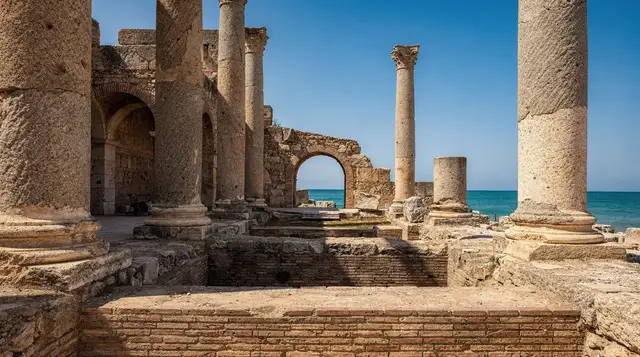
Carthage sits closest to Tunis of any significant Roman site, reachable in twenty to thirty minutes by TGM train or car, and it offers by far the greatest concentration of visible history within a single area: the Antonine baths, one of the largest Roman bathing complexes ever built; Byrsa hill with its national museum and views over the modern city and bay; the remains of the Punic ports that once anchored Carthage’s naval power; and scattered villa and theatre ruins across the modern suburb that now occupies the ancient site. For a first and possibly only Roman-sites day near Tunis, Carthage should be the priority, without much debate.
If Carthage is your first stop, the Carthage archaeological sites guide explains how the different areas fit together, and the Antonine baths, Byrsa hill and Punic ports each have their own write-up. The Carthage multi-site ticket is worth reading before you arrive, and the wider Carthage destination page puts the whole area in context.
Dougga: the best single Roman town
If you have a second day for ruins, Dougga is the clear next step. Widely regarded as the best-preserved Roman town in North Africa, it retains a genuinely complete capitol you can walk into, a well-preserved theatre still occasionally used for performances, and enough of the surrounding street grid and residential structures to give a real sense of a working Roman town rather than a scattered set of monuments. The drive is about ninety minutes each way, making it a comfortable half-day-plus rather than a full-day commitment.
For a deeper look at the town itself, see the complete Dougga guide or the more practical Dougga day trip guide. If you’re still undecided between the two headline sites, Carthage vs Dougga sets them side by side, and the blog piece Dougga at eight in the morning gives a feel for the site early in the day.
El Djem: worth the distance if you can manage it
El Djem’s amphitheatre is arguably the single most impressive individual structure among all these sites — a near-complete, four-storey freestanding colosseum with a walkable underground substructure, ranking among the best-preserved Roman amphitheatres anywhere. The catch is distance: three hours from Tunis each way makes it a genuine full-day undertaking from the capital, though it’s far more accessible from Sousse or Hammamet, at around one to one-and-a-half hours. If your itinerary includes coastal time near Sousse, prioritise El Djem; if you’re Tunis-based only, weigh the three-hour drive against your other priorities.
A private tour covering six UNESCO sites across Tunisia in six days is one practical way to see Carthage, Dougga, El Djem and other major sites without repeatedly planning individual day trips, if you have the time for a longer, structured itinerary.
Practical details for the amphitheatre are in the El Djem amphitheatre guide and the El Djem day trip guide, while El Djem from the top tier is a personal account of the climb. The El Djem destination page and the El Djem archaeological museum round out the picture.
Bulla Regia: the most distinctive experience
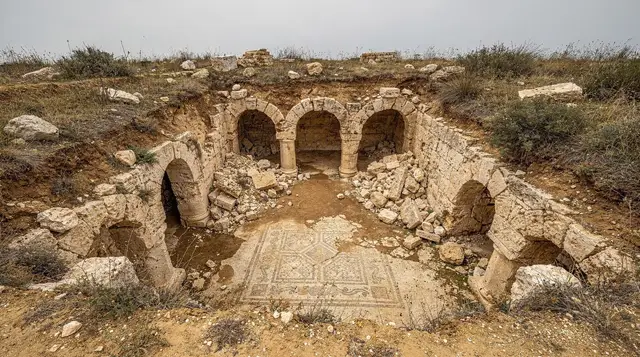
Bulla Regia doesn’t compete with Dougga or El Djem for scale, but it offers something none of the other sites do: Roman villas built partly underground to escape summer heat, with mosaic floors still in place in the rooms where they were laid. At two and a half hours from Tunis, it’s usually paired with Dougga on the same route, and that combination — Dougga’s completeness plus Bulla Regia’s underground novelty — makes for one of the strongest single Roman-sites days available near Tunis.
The Bulla Regia underground villas guide covers what the cellar-level rooms look like, and the Bulla Regia destination page helps with planning the route. Because the road passes through the Medjerda valley, the Testour and Medjerda valley day trip is a natural way to break up the journey.
Zaghouan, Thuburbo Majus and Oudhna: the efficient trio
These three sites sit within a compact area south of Tunis and are almost always visited together as a half-day loop, since none of them individually justifies a dedicated trip from the capital. Zaghouan’s water temple has the most scenic setting, framed against the mountain; Thuburbo Majus has the more substantial standing ruins, including six columns of its capitol; Oudhna, the closest to Tunis at thirty to forty minutes, offers a smaller, hillside-cut amphitheatre that’s informative if you’ve already seen El Djem but not a substitute for it if you haven’t.
Combined, the three make an efficient and rewarding half-day for travellers who’ve already covered Carthage and Dougga and want to go deeper into the region’s Roman history without a long drive. A four-day tour covering the best of Tunisia’s history, UNESCO sites and Roman ruins is a reasonable option for travellers wanting a structured multi-day itinerary that includes several of these sites alongside other historical stops like Testour.
Each stop on the loop has its own page: the Thuburbo Majus guide, the Uthina and Oudhna guide, the Zaghouan water temple guide and the combined Zaghouan and Thuburbo day trip. Walkers may also like the Zaghouan mountain hike.
How to prioritise with limited time
With one day: Carthage. With two days: Carthage plus Dougga. With three days: Carthage, Dougga, and either Bulla Regia (if underground architecture interests you) or the Zaghouan-Oudhna-Thuburbo Majus loop (if you’d rather cover more ground with less driving). El Djem earns its place on a fourth day, or earlier if you’re coastal-based near Sousse or Hammamet rather than staying in Tunis itself.
For travellers who’d rather combine Roman sites with a broader look at Tunis, a cultural walk through Tunis’s most beautiful sights is a useful complement on a day when ruins aren’t the plan, giving context on the capital itself between site visits elsewhere.
If you’d like these suggestions turned into a ready-made schedule, the Roman Tunisia itinerary and the UNESCO Tunisia itinerary follow the same logic. For choosing between several sites without a long list of day trips, best day trips from Tunis and private vs group tours in Tunisia are useful companions, and car hire in Tunisia is worth a look if you want to set your own pace.
What none of these rankings capture
Ranking by “what you actually see” deliberately sets aside pure historical significance, since that’s a different question from what makes a satisfying visit. Utica, for instance, ranks low on visible remains despite genuine historical importance as one of the oldest Phoenician settlements in North Africa — its significance vastly outweighs what survives on the ground. If historical weight rather than visual spectacle drives your interest, factor that in separately; this ranking is built around visitor experience, not academic importance.
Weather and season matter too. Sites on open plains — Thuburbo Majus, Oudhna, El Djem — offer little shade and get genuinely hot from late spring through early autumn, while Bulla Regia’s underground rooms and Zaghouan’s pine-shaded temple stay noticeably cooler, a real consideration if you’re visiting in summer.
Utica has its own entries in the Utica archaeological site guide and the Utica destination page, and the broader story behind all of these places is told in the Tunisian history timeline. For seasonal planning, best time to visit Tunis is a good next read.
Ranking by what each site does uniquely
Beyond raw completeness, it’s worth ranking these sites by what each one offers that none of the others do, since that’s often a better guide to a second or third visit than a straightforward completeness comparison. Bulla Regia’s underground villas are genuinely unique in the region — no other site near Tunis has anything comparable. El Djem’s freestanding, walkable substructure beneath the arena floor is a similarly singular experience.
Zaghouan’s water temple offers the region’s only genuinely scenic, mountain-backed Roman setting, a real contrast to the flat, exposed plains most other sites sit on. Carthage alone combines multiple distinct site types — baths, a hilltop civic centre, ancient ports — within a single compact area, which is precisely why it remains the strongest single choice for a first and only Roman-sites day.
Dougga’s uniqueness lies less in any single feature and more in completeness itself: it’s the closest any site in the region comes to letting you picture an entire functioning Roman town, streets and all, rather than a scattered set of standout monuments. Thuburbo Majus and Oudhna, by contrast, don’t really offer anything the other sites don’t do better elsewhere — their value is almost entirely about efficient combination with Zaghouan on a single loop, not standout individual features.
Building a longer Roman-sites itinerary
For travellers with four or more days who want to build an itinerary specifically around Tunisia’s Roman heritage rather than treating it as one component of a broader trip, a logical sequence looks something like: Carthage and the Bardo museum on day one to establish context and see the finest surviving mosaics before visiting the sites they came from; Dougga on day two, ideally paired with Bulla Regia given their proximity on the same route; the Zaghouan-Oudhna-Thuburbo Majus loop on day three as an efficient, less demanding day after two longer ones; and El Djem, ideally with an overnight near Sousse, as a dedicated day four rather than a rushed add-on to any of the earlier days.
The Bardo day is covered in detail in the Bardo Museum complete guide and Bardo museum mosaics highlights, and why the Bardo deserves a whole morning explains why it earns the time.
This sequence deliberately front-loads the two strongest sites (Carthage, Dougga) while saving the most physically demanding drive (El Djem from Tunis) for a day when you can either overnight closer to it or accept the long round trip with lower time pressure elsewhere in the itinerary.
Mistakes to avoid
Frequently asked questions about Roman sites near Tunis
Which Roman site is closest to Tunis?
Carthage, at around twenty to thirty minutes by car or TGM train, is by far the closest major Roman site, followed by Oudhna at thirty to forty minutes.
Is Dougga better than Carthage?
They’re different kinds of sites rather than directly comparable. Carthage offers a wider spread of historical eras and a stronger site museum context; Dougga offers the single most complete Roman town layout in North Africa. Most itineraries benefit from including both rather than choosing one over the other.
How many Roman sites can I realistically see in three days?
A reasonable three-day plan covers Carthage on day one, Dougga (possibly combined with Bulla Regia) on day two, and either the Zaghouan-Oudhna-Thuburbo Majus loop or a coastal extension toward El Djem on day three, depending on your base.
Is El Djem worth it if I’m only staying in Tunis?
It’s worth it if you can commit a full day to the round trip, since the amphitheatre itself is genuinely exceptional. If your schedule is tight, prioritise Carthage and Dougga first and add El Djem only if time allows.
Do I need a guide for these sites, or can I visit independently?
Independent visits work well for Carthage and Dougga, which have more developed signage and infrastructure. The smaller sites — Bulla Regia, Thuburbo Majus, Oudhna, Zaghouan — have sparser signage, so a guide adds more relative value there if you want full context rather than just the visual experience.
Which site has the best-preserved mosaics still in place?
Bulla Regia and Thuburbo Majus both retain floor mosaics in situ rather than removed to museums, which is relatively unusual for Tunisian Roman sites, where the finest mosaics typically ended up in the Bardo.
Are these sites suitable for a full family day?
Carthage and Dougga are the most manageable for families given better infrastructure and shorter walking distances relative to what there is to see. The smaller inland sites involve more driving relative to time on site, which can be harder to sustain with young children.
Should I visit Roman sites before or after Carthage’s Bardo museum?
Visiting the Bardo museum before heading to the sites themselves, particularly Bulla Regia and Thuburbo Majus, adds useful context since many of the best mosaic finds from those sites are displayed there rather than left in place.
Which site offers something none of the others do?
Bulla Regia’s underground villas and El Djem’s walkable amphitheatre substructure are both genuinely unique within the region — no other nearby site offers a comparable experience. Zaghouan’s mountain-backed setting is similarly distinct among sites that otherwise sit on flat, exposed plains.
What’s a sensible order for a four-day Roman-sites itinerary?
Carthage and the Bardo museum on day one, Dougga paired with Bulla Regia on day two, the Zaghouan-Oudhna-Thuburbo Majus loop on day three, and El Djem as a dedicated day four, ideally with an overnight near Sousse to shorten the return drive.
Roman & Punic site tours on GetYourGuide
Verified deep-linked GetYourGuide tours. Book through these links and we earn a small commission at no cost to you.
These are our own photographs of Tunisia, not the operator's pictures of this tour — open the tour page to see those.