Camel trekking in the Tunisian Sahara
Is camel trekking in Tunisia worth doing, and how long a trek should you book?
Yes, if you have at least a spare afternoon in the south — even a one-hour sunset ride near Douz gets you onto genuine erg dunes. But a short ride is closer to a photo opportunity than a Sahara experience; an overnight trek of one or two days is what actually delivers the silence, the dark sky and the sense of distance most people picture when they imagine camel trekking, and it's worth the extra planning if your schedule allows it.
Camel trekking is the activity most people picture when they imagine a trip into the Tunisian Sahara, and it’s also the one most often oversold by a single photo of a rider silhouetted against a dune at sunset. The reality spans a much wider range than that image suggests: a fifteen-minute loop near a car park at one end, and a genuine multi-day expedition with camps, guides and a support crew moving you steadily further from the last paved road at the other. Both are legitimately called camel trekking, and knowing which one you’re actually booking matters more than most tour listings make clear.
Almost all of Tunisia’s camel trekking happens around Douz and the Nefzaoua region, at the northern edge of the Grand Erg Oriental, with a smaller cluster of operators working out of Ksar Ghilane further south. This guide covers how the different lengths of trek actually compare, what a day and a night on a camel are really like, and how to choose between the short taster rides and the longer treks that give the desert time to feel genuinely remote.
| Where | Mainly around Douz and Sabria, Nefzaoua region; also from Ksar Ghilane further south |
| Cost | Short rides from around 40 TND (about €12); overnight treks from roughly 300-450 TND (about €90-135); multi-day treks scale up from there |
| Time needed | 1 hour for a short ride; 1 to 4 days for a proper trek into the erg |
| Getting there | Douz is roughly 470 km / 6-7 hours from Tunis by road; most trekkers arrive as part of a longer southern tour |
| Best time | November to March; summer heat between June and August makes multi-day treks a serious physical undertaking |
How camel trekking in Tunisia actually works
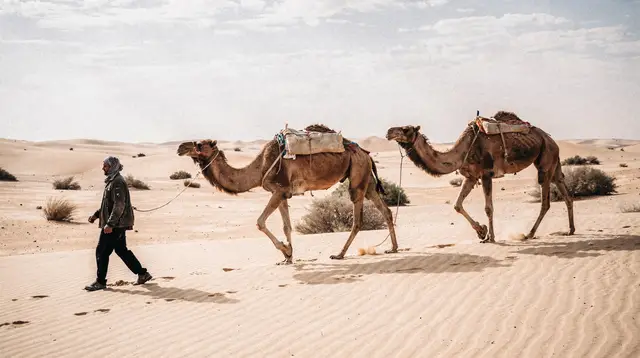
A Tunisian camel trek, whatever its length, follows a fairly consistent structure: a guide walks alongside a small string of camels, each carrying one rider, at the animal’s own unhurried pace, which averages somewhere around 4 to 5 km an hour on flat sand and considerably less crossing higher dunes. Riders don’t control the camel directly in most set-ups — the guide leads the line on foot or occasionally from the front camel — so the experience is closer to a guided walk than anything resembling independent riding. For treks longer than a couple of hours, a support vehicle or a second group of pack camels typically carries water, food, tents and bedding, meeting the group at agreed points rather than trekking the full distance itself.
Mounting and dismounting is the part most first-timers find more startling than the riding itself: a kneeling camel rises rear legs first, which pitches an unprepared rider sharply forward, then front legs, tipping back the other way. Guides talk riders through it, and after the first mount most people settle into the rhythm without difficulty, though a saddle-sore afternoon on day one of a multi-day trek is common enough that it’s worth expecting rather than being surprised by.
Short rides: an hour or two near Douz
The most heavily booked camel experience in Tunisia is the short ride out of Douz, typically departing from the village of Zaafrane a short drive from town, where dunes begin close enough to reach on foot from the car park. A sunset or sunrise Sahara camel ride from Douz runs for roughly an hour to ninety minutes and delivers exactly what it promises: a short loop over the nearest dunes timed for the best light of the day, with a guide leading the group and a stop partway through for photographs.
It’s worth being honest about what this does and doesn’t deliver. The dunes near Zaafrane are genuine erg sand, not a staged approximation, so the photograph is real. But an hour on a camel a short walk from a road is a taster, not an immersion — there’s no real sense of distance or isolation, since the car park and other tour groups are rarely far away. Treat it as a reasonable add-on to a day trip through Douz, our Douz gateway to the Sahara guide covers the town more fully, rather than as a substitute for an overnight trek if genuine remoteness is what you’re after.
Overnight and multi-day treks: what actually changes
The real difference between a short ride and a proper trek isn’t really about the camel at all — it’s about what happens once the group stops for the night. A single overnight trek gets you one camp in the dunes, typically a couple of hours’ ride from the nearest road, with dinner cooked over a fire, a mat and blankets under open sky or in a simple tent, and a night with none of the ambient light that even a small town produces.
A Sahara desert overnight camel trek departing from the Sabria area, south-west of Douz, is a good example of this format: enough riding to feel like a proper expedition, one full night away from any road, and a return the following day rather than a multi-day commitment.
Multi-day treks push the isolation further, both in distance and in the number of nights spent without any vehicle sound or artificial light nearby. A three-day Sahara desert camel trek from Douz typically covers two nights in the dunes, with the riding spread across manageable daily stretches rather than long forced marches, and it’s this extra distance and time that most trekkers describe as the point at which the Sahara actually starts to feel the way they’d imagined it — no tracks in the sand except the ones your own group made, and a horizon with genuinely nothing built on it.
For travellers with more time and an interest in the people who once lived a fully nomadic life in this landscape, a four-day Sahara desert and Berber culture tour extends the format further, combining trekking with visits to communities and sites connected to the region’s Berber heritage rather than focusing purely on distance covered. It’s a different kind of trip from a straightforward endurance-style multi-day trek, and worth considering if the cultural context matters as much to you as the desert itself.
| Trek length | Nights in the dunes | Typical distance from the road | Roughly |
|---|---|---|---|
| 1 hour (sunset/sunrise) | None | A short walk from the car park | 40-70 TND (about €12-21) |
| Overnight (1 night) | 1 | A couple of hours’ ride out | From around 300-450 TND (about €90-135) |
| 3-day trek | 2 | Well into the erg | From around 650 TND (about €195) |
| 4-day trek | 3 | Well into the erg, with cultural stops | From around 800 TND (about €240) and up |
Treat these figures as an order of magnitude rather than a fixed quote — prices shift with season, group size and exactly what’s included, and it’s worth confirming what a listed price covers, particularly around meals, water and bedding, before comparing two operators directly against each other.
What a night in the desert actually involves
The physical experience of an overnight trek surprises most first-timers more than the riding does. Desert nights drop sharply in temperature even after a scorching day, sometimes by 20°C or more between afternoon and the early hours, so the light layer that felt sensible at 4pm is rarely enough by midnight; proper layering matters far more than most people pack for.
Camps are basic by design: a fire for cooking and warmth, mats and blankets rather than raised beds in most set-ups, and toilet facilities that amount to finding a suitable spot away from camp rather than anything built. None of this is a flaw in the experience — it’s the actual condition of trekking away from infrastructure — but it’s worth knowing in advance rather than discovering at 2am.
Our dedicated guide to desert camps and bivouacs in Tunisia goes through what a night in the dunes involves in more detail, including the difference between a basic camel-trek camp and the more comfortable fixed bivouacs some operators run near Ksar Ghilane.
Food on a trek is simple and generally good: bread, a tajine or couscous cooked over the fire, tea brewed the traditional way with a fair amount of ceremony and sugar, and dates as a matter of course given how close most routes pass to date-palm growing areas. Guides and support crews handle the cooking, and dietary restrictions are worth flagging when booking rather than assuming they’ll be accommodated on the spot, since supplies for a multi-day trek are planned and packed in advance.
Physical demands and who a trek suits
Camel trekking asks less raw fitness than most people assume, since the camel does the walking, but it does ask for a reasonable tolerance of discomfort: hours in a saddle produce genuine soreness by the end of a first day, more so for anyone unused to riding, and multi-day treks compound that across several days without a soft bed to recover in between. Anyone with back or hip problems, or limited mobility getting on and off a kneeling camel, should discuss this with an operator before booking rather than finding out the hard way partway into a trek.
Children can generally manage a short ride without difficulty, but multi-day treks are a harder sell for most families — long hours on a camel, cold nights and no proper toilets test most kids’ patience faster than adults’, and our guide to taking children into the Tunisian Sahara goes through what tends to work for families weighing up how far to push a desert trip. Older travellers in reasonable health generally do well on shorter treks, and it’s worth choosing an overnight rather than a three- or four-day option if stamina is a concern, since the core experience — a night away from any road — comes through on a single night almost as strongly as on three.
Choosing between Douz, Sabria and Ksar Ghilane as a starting point
Most Tunisian camel treks start from one of two general areas: the Douz/Sabria cluster in the Nefzaoua, or further south from Ksar Ghilane, where a separate scene of shorter camel rides operates alongside the region’s warm spring. The Douz and Sabria operators generally offer the widest range of trek lengths, from the shortest sunset rides to the most ambitious multi-day expeditions, and it’s the more established base for anyone planning a dedicated trekking trip rather than a single add-on activity.
Our Ksar Ghilane hot spring guide covers what camel rides look like there specifically — generally shorter excursions of 45 minutes to an hour, combined with the spring and a 4x4 loop rather than a standalone multi-day trekking base.
For travellers deciding how many days to give a Sahara trip generally, whether trekking is the main activity or one part of a broader itinerary, our two-day versus three-day Sahara tour guide and the wider Sahara tours from Tunis, compared roundup both help frame how a camel trek fits against other ways of spending time in the desert, including 4x4 excursions and quad tours that cover more ground more quickly but with a very different feel.
Booking from Tunis, Hammamet or Sousse
Very few visitors treat a multi-day camel trek as a standalone booking made once they’ve already reached Douz independently; most arrange transport, the trek itself and any hotel nights before or after as a single package departing from Tunis or the coastal resort towns. This removes the need to plan the roughly six-to-seven-hour drive south to Douz separately, and it bundles the logistics of meeting a trekking guide and support crew into a single confirmed arrangement rather than something to coordinate on arrival.
Anyone planning a trip that combines trekking with the rest of a longer southern loop should read our one week: Tunis and the Sahara itinerary, which shows how a multi-day trek typically slots into a broader route without eating into time better spent seeing Tozeur, Matmata or the mountain oases.
What to pack for a camel trek
Layering is the single most important packing principle: a base layer for daytime warmth, a genuinely warm layer for after dark, and something windproof, since exposed dune ridges catch a surprising amount of wind even on an otherwise still night. Closed shoes rather than sandals matter for walking on sand and getting on and off the camel safely, and a head torch is close to essential once the fire dies down and camps settle into genuinely dark conditions with minimal ambient light.
Sun protection — a hat, sunglasses and sunscreen — matters as much for a trek as for any other desert excursion, since hours in the saddle mean sustained exposure rather than the brief stops of a driving-based tour. Our full what to pack for a night in the Sahara checklist covers this in more detail, including what most operators supply as standard against what you should bring yourself.
Mistakes to avoid
Frequently asked questions about camel trekking in Tunisia
How long should a first-time camel trek be?
An overnight trek is the sweet spot for most first-timers: long enough to get a genuine night away from any road, with dark skies and real silence, without the compounding physical demands of a multi-day trip. A one-hour ride is a fine add-on if time is genuinely limited, but it’s a different, much lighter experience than an overnight or multi-day trek.
Is camel trekking uncomfortable or painful?
Some soreness is normal, particularly on a first multi-day trek, since hours in the saddle work muscles most people don’t use in daily life. It’s manageable rather than genuinely painful for most reasonably fit adults, and guides generally build in breaks; anyone with back, hip or joint concerns should mention this when booking so the operator can advise on trek length.
What’s the difference between trekking from Douz and trekking from Ksar Ghilane?
Douz and the nearby Sabria area have the widest range of trek lengths and the most established operators for multi-day expeditions, making them the better base for a dedicated trekking trip. Ksar Ghilane offers shorter rides, generally 45 minutes to an hour, usually combined with the warm spring and a 4x4 loop rather than as a standalone multi-day trekking base.
Do I need previous riding experience to go camel trekking?
No — camels are led by a guide rather than ridden independently in most Tunisian trekking set-ups, so no prior riding experience is needed. The main skill required is managing the mounting and dismounting motion, which guides talk riders through, and settling into the animal’s rolling gait, which most people adjust to within the first twenty minutes or so.
What should I expect for food and water on a multi-day trek?
Expect simple, generally good food cooked over a fire — bread, a tajine or couscous, tea, dates — carried in by a support vehicle or pack camels rather than prepared at the trek’s start and carried the whole way. Water is provided as part of the package on organised treks, but it’s worth confirming quantities and bringing a personal supply as backup, particularly in warmer months.
Is camel trekking safe?
Organised treks with established operators are generally safe, with experienced guides who know the terrain and manage the animals professionally. The main practical risks are heat, dehydration and cold-night exposure rather than anything related to the camels themselves, so following an operator’s guidance on layering and water intake matters more than any concern about the animals.
Can you go camel trekking as a day trip from Tunis?
Not really, in any meaningful sense — Douz is roughly six to seven hours from Tunis by road, which rules out a genuine trekking day trip. Almost all camel treks are booked as part of a multi-day southern Tunisia tour that includes the transport south, or arranged once you’re already in the Douz area as part of a longer independent trip.
How does camel trekking compare to a 4x4 or quad tour of the same area?
A camel trek moves at a fraction of the speed of a 4x4 or quad, covering far less ground but delivering a quieter, slower, more immersive sense of the desert, without engine noise breaking the silence. A 4x4 or quad tour suits travellers short on time who still want to see more remote dune scenery quickly; camel trekking suits anyone for whom the pace and quiet are as much the point as the destination itself.
Sahara desert tours on GetYourGuide
Verified deep-linked GetYourGuide tours. Book through these links and we earn a small commission at no cost to you.
These are our own photographs of Tunisia, not the operator's pictures of this tour — open the tour page to see those.