The Roman theatre and the Roman villas of Carthage
Is the Roman theatre and villas area at Carthage worth visiting?
Yes, but with realistic expectations. The theatre has been heavily rebuilt for modern concerts, so it reads more like a working venue than an ancient ruin, and the villas survive mostly as foundations and mosaic fragments rather than standing rooms. Both are covered by the Carthage multi-site ticket and worth 45 minutes to an hour if you're already visiting the wider archaeological area.
Two of Carthage’s Roman-era sites sit close enough together to visit in one stop, though they tell quite different stories. The Roman theatre is still a working venue, restored and fitted with modern seating for a summer arts festival, while a short walk uphill the so-called villas quarter preserves the footprints of wealthy Roman houses with a few surviving mosaic floors and sweeping views over the bay of Tunis. Neither matches the scale of the Antonine baths or the completeness of Dougga, and both ask a bit of imagination from visitors used to more intact ruins. This guide sets out what’s actually original, what’s been rebuilt, and whether the stop earns its place in a half-day at Carthage.
| Where | Carthage suburb, on the hillside south-west of Byrsa hill |
| Cost | Included in the Carthage multi-site ticket, roughly 12 TND (about €3.50) |
| Time needed | 45 minutes to an hour for both sites together |
| Getting there | Short taxi ride from the TGM Carthage-Hannibal or Carthage-Salammbô stations |
| Best time | Late morning, once the site has opened but before the midday heat |
Two sites, one stop: theatre and villas explained
Visitors often assume “the Roman theatre and villas” refers to a single fenced enclosure, but it’s really two adjoining areas a short walk apart on the same hillside, both covered by the same ticket and usually visited together. The theatre sits lower down, close to the road, while the villas quarter occupies higher ground just above it, with paths connecting the two that make it easy to see both without backtracking. Understanding that they’re separate before arriving helps set expectations, since the theatre reads as a compact, self-contained venue while the villas area is more of an open, park-like archaeological zone with scattered remains.
Neither site has its own dedicated entrance gate with staff selling single tickets; access runs through the general Carthage multi-site pass covered in the Carthage multi-site ticket guide. If you’re planning a first visit to Carthage as a whole, the Carthage archaeological sites guide lays out how this stop fits alongside Byrsa hill, the Antonine baths and the Punic ports.
The Roman theatre: how much is actually ancient
The Roman theatre at Carthage was originally built in the late first or early second century AD, during the city’s rebuilding as a Roman colony after Rome had razed the Punic city centuries earlier. What visitors see today, though, is largely a twentieth-century reconstruction rather than an excavated ancient structure left largely as found. The original theatre had fallen into ruin and was substantially rebuilt from the 1960s onward, with new tiered seating, a rebuilt stage wall and modern lighting and sound infrastructure added specifically so the venue could host live performances again.
That reconstruction is worth stating plainly rather than glossing over, because it changes what kind of experience this is. Compared with the weathered, largely untouched stonework at somewhere like Dougga’s better-preserved theatre, Carthage’s version feels closer to a modern open-air auditorium built on an ancient footprint than an archaeological site in the usual sense. Some of the lower seating rows and the general bowl shape trace the Roman original, but a fair amount of what’s underfoot, including much of the stage building, is twentieth-century concrete finished to resemble ancient stone. Visitors expecting an unrestored ruin sometimes come away disappointed for exactly this reason.
The Carthage international festival
The reconstruction wasn’t done purely for preservation’s sake; it was built to host the Carthage international festival, an open-air arts festival held here every summer since the 1960s, bringing music, theatre and dance performances to the same seating bowl the Romans once used for their own entertainments. Concerts and shows typically run through July and into August, with the theatre closed to daytime sightseeing on performance days or reconfigured with temporary staging that changes how the site looks compared with a quiet daytime visit.
This gives the theatre an unusual double life most Roman ruins don’t have: by day it’s a sightseeing stop with an entry fee, and on summer evenings it becomes a working concert venue with ticketed seating, food stalls and a completely different atmosphere. Travellers visiting in July or August should check the festival’s published schedule before planning a daytime visit, since access and photography rules can differ on show days, and the site sometimes closes to casual visitors while crews prepare a stage.
What the theatre actually looks like today
Walking in, the theatre presents as a fairly compact semicircular bowl, smaller in scale than Rome’s grandest surviving examples, seating a few thousand at full modern capacity rather than the tens of thousands some ancient theatres held. The tiered stone seating curves around a paved orchestra area, with the rebuilt stage wall — plain and largely undecorated compared with the elaborately carved backdrops that survive at some other Roman theatres in North Africa — closing off one side. A handful of original column fragments and carved stone pieces, salvaged from the ancient structure during restoration, are displayed at the edges of the site rather than reinstalled in their original positions.
Photographs from the upper seating rows toward the stage don’t obviously reveal the modern additions, which is part of why the theatre still photographs well and remains a popular stop despite the honest caveats about authenticity. It’s really only up close, examining the texture and joins in the stonework, that the difference between Roman-era fabric and twentieth-century reconstruction becomes clear.
| Theatre feature | Roman original or reconstruction | Notes |
|---|---|---|
| Lower seating rows | Partly original | Some Roman stonework survives at the base |
| Upper seating tiers | Mostly reconstructed | Added for modern festival capacity |
| Stage wall (scaenae frons) | Reconstructed | Ancient wall did not survive intact |
| Column fragments on display | Original | Salvaged pieces, not reinstalled |
| Sound and lighting rigging | Modern | Installed for festival performances |
The Roman villas quarter: what actually survives
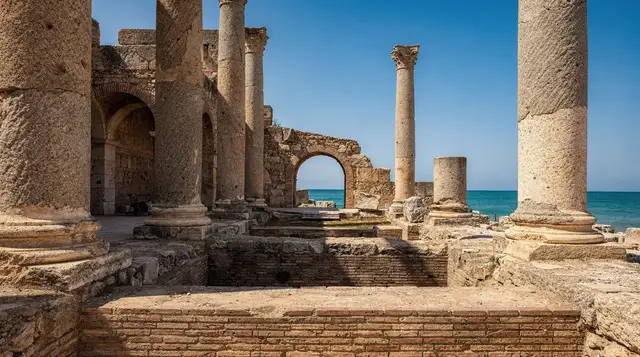
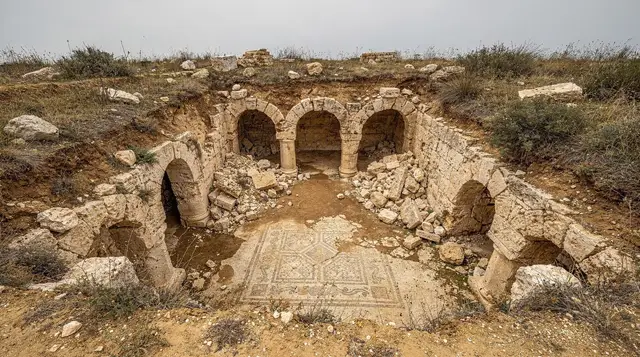
A short uphill walk from the theatre, the villas quarter preserves the layout of a residential district built for wealthy Roman households during Carthage’s time as capital of the province of Africa Proconsularis. Unlike the theatre, nothing here has been rebuilt to modern use — what’s visible is closer to a conventional excavated ruin, which makes for a useful contrast on the same visit. The remains consist mainly of low foundation walls tracing room layouts, sections of mosaic flooring left in situ under simple shelters, and the partial outline of a peristyle courtyard garden that one of the larger villas was built around.
The best-known individual structure here is often referred to as the Villa of the Aviary, named for a surviving mosaic panel thought to depict caged birds, though the mosaic itself has in some periods been relocated to the Carthage national museum on Byrsa hill for conservation, with a reproduction or empty display space left on site — worth checking on arrival if seeing the original mosaic in place matters to your visit. What remains reliably on site regardless are the foundation walls and the layout itself: multiple rooms arranged around a colonnaded garden, giving a genuine sense of how spacious these Roman townhouses were compared with typical housing in the city below.
Reading the villas: why it takes imagination
Because so little rises above knee height, the villas quarter asks more of visitors than most Carthage stops. There are no reconstructed walls or roofs here, unlike the theatre a short walk away, so picturing the original two-storey rooms, painted plaster and furnished interiors depends heavily on the interpretation panels scattered through the site and, ideally, some background reading beforehand. Visitors arriving without any preparation sometimes walk through in ten minutes seeing little more than low stone walls and grass, missing what the site is actually showing them.
The view is arguably as much a draw as the archaeology: the villas sit on high ground with an open outlook over the bay of Tunis, a vista wealthy Roman households here would also have enjoyed from their upper floors, and it’s one of the more pleasant spots on the wider Carthage circuit to pause. Best of Tunisia: 4 days of history, UNESCO sites and Roman ruins includes Carthage among several UNESCO-listed Roman sites across the country, which suits travellers who want the villas and theatre framed within a broader sweep of Tunisia’s Roman heritage rather than as an isolated stop.
The Odéon and other nearby fragments
Close to the theatre, though easy to miss without knowing to look, are the scant remains of the Odéon, a smaller performance venue once used for recitals, lectures and musical competitions rather than the larger dramatic productions staged in the main theatre. Almost nothing survives above foundation level today, and there’s no reconstruction here comparable to what’s been done at the theatre, so the Odéon is more a point of interest for visitors with a particular archaeological curiosity than something worth going out of your way for. A modern water reservoir and a scatter of unexcavated mounds nearby hint at how much of Roman Carthage in this immediate area still hasn’t been properly investigated.
Together, the theatre, the Odéon and the villas quarter formed part of the same elevated residential and civic district in Roman Carthage, distinct from the harbour-side baths and ports covered in the Carthage archaeological sites guide. Seeing all three in sequence, even briefly, gives a better sense of how the district fit together than visiting the theatre alone.
How much time to set aside
Most visitors comfortably cover the theatre in 20 to 25 minutes, enough time to walk the seating bowl, look at the salvaged column fragments and take in the view from the upper tiers. The villas quarter takes a similar amount of time for a walk-through, longer if you’re reading the interpretation panels carefully or lingering over the bay view. Together, budget 45 minutes to a full hour, and slightly longer on a summer evening if festival preparations mean navigating around temporary staging or seating.
This is a modest stop compared with the half-day some visitors set aside for the whole Carthage site, and it pairs naturally with a visit to the nearby Antonine baths or Byrsa hill on the same outing rather than justifying a special trip on its own. Tunis, Carthage and Sidi Bou Said is a common way to see the theatre and villas as part of a wider loop that also covers central Tunis and Sidi Bou Said in a single day.
Getting there and tickets
There’s no dedicated public transport stop directly outside the theatre or villas quarter; the closest TGM light rail stations, Carthage-Hannibal and Carthage-Salammbô, are each roughly a fifteen-minute walk or a short taxi ride away, and most visitors combine the walk with stops at Byrsa hill or the Antonine baths rather than travelling here in isolation. There’s no separate ticket booth at either site — access runs on the same multi-site pass covered elsewhere on this site, generally bought at whichever Carthage location you reach first.
Opening hours broadly follow the rest of the Carthage sites, running from mid-morning into late afternoon with shorter hours in winter, though the theatre’s daytime access can be restricted or altered around festival performances in July and August. There’s no reliable way to check theatre-specific opening status online in advance beyond the festival’s own published schedule, so building a little flexibility into a summer visit is sensible.
Tunis: Medina, Carthage amphitheatre and Sidi Bou Said tour is worth considering for visitors who’d rather have a guide explain which sections of the theatre are original on the spot, since the distinction isn’t always obvious without some prior knowledge, particularly to visitors seeing Roman ruins for the first time.
Comparing the theatre and villas with Carthage’s other sites
Set against the rest of the Carthage circuit, the theatre and villas occupy a specific niche: less monumental than the Antonine baths, less atmospheric than the Punic ports, but offering something neither of those sites does, a genuine sense of a Roman neighbourhood’s layout paired with a still-functioning ancient venue. Visitors pressed for time and choosing only two or three Carthage stops often prioritise Byrsa hill and the Antonine baths first, treating the theatre and villas as an optional add-on rather than a core stop, which is a reasonable call if a day is already tight.
| Comparison point | Roman theatre and villas | Antonine baths | Byrsa hill & museum |
|---|---|---|---|
| Authenticity of remains | Theatre heavily rebuilt; villas mostly original foundations | Largely original, but fragmentary | Original Punic street plan |
| Time needed | 45 min–1 hour | 45 min–1 hour | 1.5 hours |
| Best feature | Bay views, working festival venue | Sheer scale of ruins | Museum collection |
| Skip if pressed for time | Reasonable to skip | Harder to justify skipping | Harder to justify skipping |
Practical planning
For visitors sequencing a full Carthage day, the theatre and villas sit slightly apart from the coastal cluster of the Antonine baths and Punic ports, making them a natural stop either on the way up to Byrsa hill or as a final stop before heading down toward Sidi Bou Said for lunch.
Anyone building a broader itinerary around Roman sites beyond Carthage itself may also want to compare this stop against Dougga or El Djem’s amphitheatre, both covered in the roman sites near Tunis ranked guide, since expectations reset considerably once you’ve seen a more completely preserved Roman site elsewhere in the country.
Travellers planning several days around Tunis and Carthage more broadly may find it useful to check how many days in Tunis actually makes sense before committing to a fixed schedule, and the tunis budget guide for a wider sense of typical daily costs beyond this single ticket. The things to do in Carthage hub also lists the fuller range of stops in the area for anyone still finalising a plan, and the Roman Tunisia itinerary sets out how a theatre-and-villas stop like this one fits into a longer, dedicated Roman-sites route across the country.
Frequently asked questions about the Carthage theatre and villas
Is the Roman theatre at Carthage still used today?
Yes. It hosts the Carthage international festival, an open-air arts festival held most summers, typically running through July and into August, with music, theatre and dance performances staged in the same rebuilt seating bowl visitors see during the day.
How much of the theatre is original Roman construction?
Only a portion, mainly some of the lower seating and scattered stonework. The upper seating tiers, the stage wall and the performance infrastructure are largely twentieth-century reconstruction, built to make the venue usable for modern festival performances rather than preserved as found.
Do I need a separate ticket for the theatre and villas?
No. Both sites are included in the same Carthage multi-site pass that covers Byrsa hill, the Antonine baths and the Punic ports, generally bought at whichever site you visit first rather than at a dedicated booth here.
Can I see the aviary mosaic at the villa site itself?
Sometimes. The mosaic has at points been moved to the Carthage national museum for conservation, with a reproduction or an empty display area left at the villa in the meantime, so it’s worth checking current placement if seeing the original in situ matters to you.
How long should I plan for the theatre and villas together?
Around 45 minutes to an hour covers both comfortably, longer if you want to read the interpretation panels at the villas thoroughly or the theatre has festival staging worth pausing to look at.
Is the theatre open during the summer festival season?
Access can be restricted on performance days while crews set up staging, and the atmosphere differs considerably from a quiet daytime visit. Checking the festival’s published schedule before a July or August visit is worthwhile.
Are the villas worth visiting if I’ve already seen the Antonine baths?
Yes, mainly for the contrast and the view. The villas show a residential Roman layout the baths don’t, and the elevated position over the bay of Tunis is one of the more scenic spots on the wider Carthage site.
How do I get to the theatre and villas from central Tunis?
Take the TGM light rail to Carthage-Hannibal or Carthage-Salammbô, then a short taxi ride or a roughly fifteen-minute walk to reach the site, since neither station sits directly outside it.
Is the site suitable for visitors who dislike heavily restored ruins?
The villas quarter will likely satisfy visitors who prefer unrestored remains, since little there has been rebuilt. The theatre is the opposite case, and visitors who find modern reconstruction unsatisfying may prefer to treat it as a brief stop rather than a highlight.
Roman & Punic site tours on GetYourGuide
Verified deep-linked GetYourGuide tours. Book through these links and we earn a small commission at no cost to you.
These are our own photographs of Tunisia, not the operator's pictures of this tour — open the tour page to see those.