Driving in Tunisia
Is driving in Tunisia difficult for a foreign visitor?
Not especially, once you adjust to local habits around indicating, lane discipline and roundabout etiquette. The coastal motorway is well maintained and easy to navigate; the main challenges are unlit rural roads at night, occasional livestock outside towns, and parking scarcity in older city centres like Tunis's medina area.
Driving in Tunisia sits somewhere between the predictability of a well-signed European motorway network and the more improvisational habits found on smaller roads and in older town centres. The coastal motorway connecting Tunis to Sousse, Sfax and beyond is genuinely good — tolled, well surfaced, clearly signed — and driving it feels little different from a similar stretch anywhere in southern Europe. Step off that motorway onto a rural secondary road or into the tangle of streets around an old medina, and the experience changes considerably. This guide covers what to actually expect: the rules, the tolls, the hazards, and where driving yourself makes more sense than not.
| Where | Right-hand traffic; drive on the right throughout Tunisia |
| Cost | Motorway tolls are modest, typically a few dinars per stretch; fuel is relatively inexpensive |
| Time needed | Plan generously — rural roads and town centres slow progress more than distance alone suggests |
| Getting there | Rental pick-up at Tunis-Carthage or Enfidha-Hammamet airports, or city branches |
| Best time | Daylight hours; avoid unnecessary night driving outside towns |
The basics: which side, and the general rules
Tunisia drives on the right, with standard right-hand-drive-unfriendly signage and road markings consistent with most of continental Europe and North Africa. Seatbelts are required for front-seat occupants, and increasingly enforced for rear passengers too. Speed limits are generally around 50 km/h in urban areas, 90 km/h on the open road, and up to 110 km/h on the tolled motorway, though these are approximate and worth confirming against posted signs, which take precedence.
Police checkpoints are a routine part of road travel, particularly near town entrances and on the approach to some regional boundaries — stopping calmly, having your passport, licence and rental documents ready, and answering questions straightforwardly is normal practice and rarely more than a brief delay.
Roundabouts and junction etiquette
Roundabouts generally follow the give-way-to-traffic-already-circulating convention familiar from much of Europe, though in practice local driving habits around indicating on entry and exit can be less consistent than a visitor might expect — don’t assume another driver will signal their intentions clearly, and drive defensively through any roundabout with multiple lanes. At unmarked or informally organised junctions, particularly in smaller towns, right-of-way can feel more negotiated than rule-based; a patient, unhurried approach serves you far better than assuming priority.
The motorway network and tolls
The A1 motorway running from Tunis south through Hammamet’s junction, Sousse and onward toward Sfax is the backbone of Tunisia’s road network and by far the easiest stretch to drive — well surfaced, clearly signed in both Arabic and French, with service stations at reasonable intervals. Tolls are charged at gates along the route and paid in cash, so keeping a stock of small-denomination dinars in the car for this purpose is a practical habit for any road trip using the motorway.
| Stretch | Approx. distance | Approx. toll |
|---|---|---|
| Tunis → Hammamet junction | ~60 km | A few TND |
| Tunis → Sousse | ~140 km | Under 10 TND |
| Tunis → Sfax | ~270 km | Under 20 TND |
Rural roads and night driving
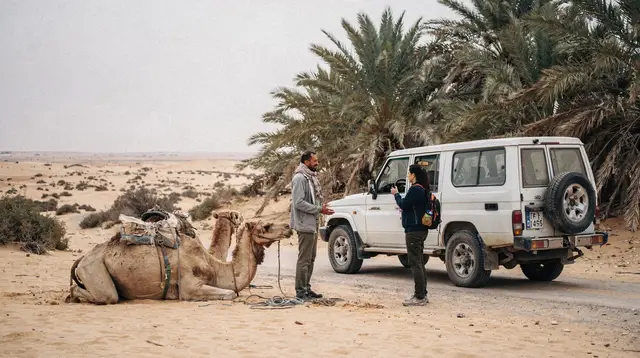
Away from the motorway, road quality varies more, and it’s here that most of the genuine driving challenges in Tunisia surface. Surfaces on secondary roads toward Dougga, Testour or the north-west are generally adequate but can include potholed stretches, particularly after rain, and lighting drops off sharply once you leave town limits — a significant reason to plan rural driving for daylight hours wherever your itinerary allows.
Livestock, particularly sheep and goats being moved along or across rural roads, is a genuine and fairly common hazard outside towns, especially around dawn and dusk when herders are most active. Slowing down through any area with visible animals near the roadside, even if none are currently on the carriage way, is sensible practice.
If there’s a single piece of advice that matters more than any other for driving in Tunisia, it’s to minimise night driving outside the motorway and major towns. Unlit rural roads, unmarked potholes, slower-moving vehicles without working lights, and the livestock risk already mentioned all compound after dark in ways that don’t affect daytime driving nearly as much. The motorway itself is reasonably lit and safe at night, but the moment you leave it for a secondary road toward an inland or rural destination, the calculus changes. Building itineraries so that rural driving happens in daylight — arriving at a hotel before sunset, say, rather than after — is worth the modest scheduling discipline it requires.
Driving in and around Tunis, fuel and service stations
Central Tunis, and particularly the streets around the medina, is a genuinely poor environment for a self-driven car: narrow lanes, informal or scarce parking, and traffic that moves slowly during the day regardless of route. Visitors planning to explore the medina, the Ville Nouvelle or take the TGM out to Carthage are almost always better served parking the car at a hotel and using a taxi, the TGM or the metro léger for that portion of the trip, then returning to driving once ready to head out toward the interior or the north-west. Our guide to getting around Tunis covers these alternatives in detail.
Fuel is relatively inexpensive in Tunisia by broader international standards, and service stations are common along the motorway and in and around most towns, though they thin out on rural stretches — it’s sensible not to let the tank run too low before a longer rural leg, particularly heading toward less populated areas. Most stations offer full service (an attendant fills the tank), and a small tip for the attendant, while not obligatory, is a common courtesy.
Comparing driving to other ways of covering the same ground
For a loop through the interior — Dougga, Bulla Regia, Testour, say — driving yourself offers a flexibility that public transport genuinely can’t match, letting you set your own pace at each site rather than working around a louage’s fill-and-depart schedule. Our car hire guide covers the practicalities of renting, while louages explained covers the shared-taxi alternative for travellers who’d rather not drive at all.
For visitors weighing a self-driven north Tunisia loop against a guided version of the same route, a north Tunisia road trip itinerary and the coastal drive from Tunis to Bizerte both work through what the route looks like either way.
| Approach | Flexibility | Comfort | Best suited to |
|---|---|---|---|
| Self-driven rental | Highest | Depends on driver comfort with local roads | Multi-stop interior or north-west loops |
| Private driver/tour | High, with none of the driving | High | Travellers who’d rather not navigate themselves |
| Louage | Lower, fixed routes | Basic | Budget-conscious, single-destination trips |
Booking a private driver, and parking away from Tunis
Not every visitor wants to navigate roundabout etiquette and unfamiliar rural roads on holiday, and a private driver removes that entirely while still covering ground a train or louage can’t reach efficiently.
A private transfer covering Tunisia’s main cities is a straightforward way to move between major hubs without driving yourself, and for travellers landing at Enfidha-Hammamet and continuing toward Sousse or the coast, a transfer between Enfidha and Sousse or the reverse-direction Sousse to Enfidha airport transfer covers that leg reliably.
A broader private transfer service spanning Enfidha, Hammamet and Sousse is worth considering for a coastal-focused trip with several legs.
Parking is generally more straightforward outside the capital — coastal towns like Hammamet and Sousse, and smaller inland towns near Roman sites, typically offer more accessible parking near hotels and major attractions than Tunis’s older core does. Even so, it’s worth confirming parking arrangements with your accommodation in advance, particularly in older medina-adjacent parts of Sousse or Hammamet, which share some of the same narrow-street constraints as the Tunis medina on a smaller scale.
Driving the Cap Bon loop and the north-west
The Cap Bon peninsula, reaching out from Hammamet toward Kelibia and the northernmost tip of the country, is one of the more rewarding self-driven routes for travellers with a rental car and a day to spare — a mix of coastal roads, vineyards and smaller towns that reward an unhurried pace more than a rushed itinerary would. Our Cap Bon loop day trip guide and the more personal account of driving the Cap Bon loop both cover what the route actually involves, including road quality on the smaller connecting roads between coastal towns.
The hill towns of the north-west — Aïn Draham and Tabarka among them — sit in genuinely different terrain from the flat coastal corridor, with winding, forested roads that are attractive to drive but slower going than distance alone suggests. This is one of the clearer cases where a rental car outperforms public transport, since louages serve the area but with limited frequency and no ability to stop freely along a scenic route. Plan extra time for this stretch specifically, and avoid attempting it for the first time after dark.
Driving during Ramadan, and with children
Traffic patterns shift noticeably during Ramadan, particularly in the roughly hour before sunset (iftar), when roads can become unusually busy as people rush to reach home or a meal in time, followed by quieter roads once the fast breaks. Building extra buffer into any late-afternoon drive during this period, and avoiding unnecessary journeys in the immediate run-up to sunset, is a sensible precaution. Our guide to travelling in Tunisia during Ramadan covers this and other seasonal considerations in more depth.
A rental car can make travelling with young children considerably easier than relying on louages or trains for multi-stop days, since it removes waiting time and allows stops on your own schedule. That said, most standard rental agencies in Tunisia don’t automatically supply child car seats, so requesting one specifically at booking, or bringing your own, is worth arranging ahead of arrival rather than assuming availability. Our guide to Tunis with kids and family day trips from Tunis both note where a self-driven itinerary suits families particularly well.
Cost, and documents to carry at all times
Between fuel, tolls, parking and the rental itself, a multi-day driving itinerary carries a different cost profile than one built around louages, trains and taxis — often higher in absolute terms, but with the convenience and flexibility to match. Our guide to what a trip to Tunis actually costs and the broader transport hub both help weigh this trade-off against the rest of a trip budget, and visas and entry rules for Tunisia is worth checking alongside any driving plans, since entry requirements are handled separately from rental eligibility.
Keep your passport, driving licence (plus International Driving Permit if you have one), and the rental agreement together and accessible in the car — checkpoint stops are routine, and having documents readily on hand keeps these brief. Our car hire guide covers what’s needed to rent in the first place, including licence requirements and minimum age.
Mistakes to avoid
Frequently asked questions about driving in Tunisia
Which side of the road does Tunisia drive on?
The right-hand side, consistent with most of continental Europe and North Africa.
Are Tunisia’s motorways toll roads?
Yes, the main A1 motorway from Tunis toward Sousse and Sfax is tolled at gates along the route, paid in cash.
Is night driving dangerous in Tunisia?
It’s riskier than daytime driving specifically on rural, unlit roads, due to poor visibility, potholes and occasional livestock. The motorway itself remains reasonably safe after dark.
Do I need an International Driving Permit to drive in Tunisia?
Not universally required for every nationality, but commonly recommended alongside your home licence — see our car hire guide for details.
Is it normal to encounter police checkpoints?
Yes, checkpoints are a routine part of road travel in Tunisia, particularly near town entrances. Having your documents accessible keeps these brief and straightforward.
Should I drive in central Tunis, or avoid it?
Avoid it where possible — narrow streets and scarce parking around the medina make a taxi, the TGM or the metro léger far more practical for exploring the city centre itself.
Are there tolls I should budget for on a road trip?
Yes, on the A1 motorway specifically; secondary and rural roads generally have no tolls, but also no motorway-standard surfacing.
Is livestock on the road really a concern?
Yes, particularly on rural roads outside towns around dawn and dusk — it’s a genuine, fairly common hazard rather than a rare exception, and worth slowing down for whenever you see animals near the roadside.
How does driving in Tunisia compare to driving in Morocco?
Broadly similar in character — a strong motorway backbone paired with more variable rural roads and town-centre driving — though each country has its own specific quirks worth researching separately if you’re comparing the two as trip destinations.
Transport passes & transfers on GetYourGuide
Verified deep-linked GetYourGuide tours. Book through these links and we earn a small commission at no cost to you.
These are our own photographs of Tunisia, not the operator's pictures of this tour — open the tour page to see those.