Hiring a car in Tunisia
Is it worth hiring a car in Tunisia?
Worth it if you're covering ground beyond Tunis and the coast — Dougga, the north-west, or a Cap Bon loop, for instance — since public transport thins out fast once you leave the main routes. For a trip confined to Tunis, Carthage and the immediate coast, a car is more hassle than help; the TGM, louages and taxis cover that ground more easily.
A rental car opens up parts of Tunisia that public transport genuinely struggles to reach — the scattered Roman sites around Dougga and Bulla Regia, the hill towns of the north-west near Aïn Draham, a proper loop around Cap Bon rather than a single day-trip slice of it. It’s not, however, a default recommendation for every visitor. Anyone spending their whole trip in Tunis, Carthage and the immediate coast will find a car more burden than benefit, given parking scarcity in the medina area and traffic that can be genuinely slow at peak times. This guide covers what you actually need to rent, what it costs, and where a car earns its keep versus where it doesn’t.
| Where | Tunis-Carthage and Enfidha-Hammamet airports, plus city-centre branches of major agencies |
| Cost | Roughly 40–90 TND per day for a small-to-mid-size car, more for larger vehicles or peak season |
| Time needed | Pick-up typically takes 20–40 minutes with paperwork |
| Getting there | Airport counters are the simplest option for visitors flying in |
| Best time | Book ahead in peak season (spring and early autumn); walk-up availability is less reliable then |
What you need to rent
Most international and local agencies in Tunisia require a driver at least 21 years old (sometimes 23 for certain vehicle categories), a valid driving licence held for at least a year, and a passport for identification. An International Driving Permit isn’t universally mandatory for every nationality but is commonly recommended and, in practice, smooths over any language gap with a rental desk or, in the rare event of a police stop, with an officer more used to seeing a French or Arabic licence. It’s worth arranging one before travelling if your home licence doesn’t include Latin-script details clearly, since obtaining one once in Tunisia isn’t straightforward.
A credit card in the main driver’s name is standard for the security deposit, which agencies place as a hold rather than a charge — the amount varies but is worth confirming before signing, since it can be substantial for a mid-range or larger vehicle.
What it costs
Rental prices in Tunisia are generally lower than in much of Western Europe, though costs climb during peak season — spring and early autumn — and for larger vehicles or 4x4s suited to rougher southern roads. Budget and mid-range hatchbacks and small saloons are the most common and most affordable category for visitors sticking to sealed roads around the north and centre of the country.
| Vehicle category | Approx. daily rate | Best suited to |
|---|---|---|
| Small hatchback | 40–55 TND | City and short regional trips |
| Mid-size saloon | 55–75 TND | Longer road trips, more comfort |
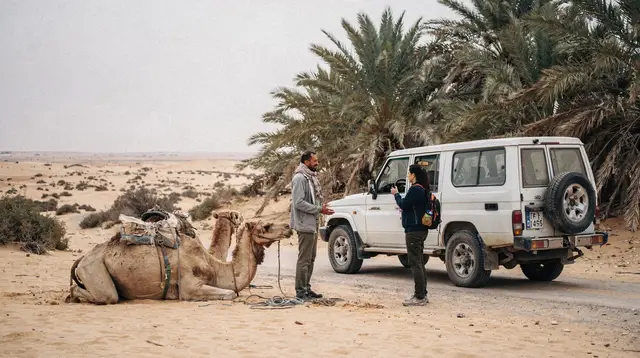
| SUV/4x4 | 80–130 TND | Rougher roads, southern desert approaches |
| Automatic transmission | Add ~10–20% | Drivers not comfortable with manual |
Fuel is relatively inexpensive in Tunisia compared with much of Europe, which helps offset the cost of longer road-trip mileage, though prices do fluctuate and it’s worth checking current rates rather than assuming a fixed figure.
Insurance: what to actually take
Basic third-party liability insurance is a legal minimum and typically bundled into the rental price by default, but the excess (deductible) on collision damage waiver can be steep with the base package many agencies quote first. Paying extra for a reduced or zero-excess option is generally worth it in Tunisia, given road conditions that include unlit rural stretches, occasional livestock on the road outside towns, and driving styles that can differ from what visitors are used to. Photograph the vehicle thoroughly at pick-up, from multiple angles, before driving off — existing scratches and dents not noted at pick-up have a way of becoming disputed at drop-off otherwise.
Which agencies operate where
Major international agencies — the familiar names found at airports worldwide — operate counters at both Tunis-Carthage and Enfidha-Hammamet airports, alongside a number of well-established local agencies that are often noticeably cheaper for a comparable vehicle, though service standards and vehicle age can vary more than with the international brands. Comparing a couple of quotes, including at least one local agency, before booking is worth the small extra effort, particularly for longer rentals where the daily-rate difference compounds meaningfully.
Picking up at the airport versus in the city
Airport pick-up is the simplest option for visitors flying in, letting you start driving directly from arrivals rather than adding a taxi leg first. It typically carries a modest airport surcharge compared with picking up from a city-centre branch, which is worth weighing if your itinerary starts with a few days in Tunis before heading out on the road — in that case, picking up mid-trip from a city branch, after using taxis, the TGM or louages for the Tunis portion, can be the more sensible sequencing, since a car sitting unused (and needing parking) for several city days adds cost without benefit.
If your trip starts with a few days based centrally and a rental only makes sense once you’re ready to head out toward Dougga or the north-west, a private airport transfer to your first hotel covers the initial leg more simply than arranging a rental you won’t use immediately. For travellers landing at Enfidha-Hammamet and picking up a car there before heading toward Sousse or the interior, a transfer between Enfidha and Sousse is a useful fallback for the days before or after the rental period itself.
Road conditions: what to expect
Tunisia’s toll motorway network, running along the coast from Tunis toward Sousse and further south, is well maintained and the fastest way to cover long distances. Secondary roads inland toward Dougga, Testour or the north-west vary more in quality, and rural stretches are frequently unlit at night, which is the single biggest reason to plan driving for daylight hours wherever possible.
Roundabouts follow standard give-way-to-traffic-already-circulating rules, similar to much of Europe, though local driving habits around indicating and lane discipline can feel less consistent than visitors are used to — defensive, unhurried driving serves you well. Our driving in Tunisia guide goes further into road rules, tolls and specific hazards.
| Road type | Typical condition | Notes |
|---|---|---|
| Coastal motorway (Tunis–Sousse–Sfax) | Well maintained, tolled | Fastest long-distance option |
| Main inland roads | Generally good | Some potholed stretches, especially after rain |
| Rural secondary roads | Variable | Often unlit; avoid night driving where possible |
| Southern approach roads | Variable to rough | Consider a 4x4 for anything beyond sealed routes |
Where a car genuinely earns its keep
The clearest case for a rental is a loop that public transport handles poorly — Dougga, Bulla Regia and Testour in a single day, for instance, none of which sit conveniently on a single louage or train route without a lot of backtracking. A north Tunisia road trip or a self-driven Cap Bon loop both make far more sense with a car than stitched together from louages and local taxis. Our roundup of Roman sites near Tunis notes which sites are genuinely awkward without your own transport.
Where a car is more hassle than help
Within Tunis itself, a rental car is close to a liability — parking near the medina is scarce and often informal, traffic on Avenue Habib Bourguiba and the surrounding grid can be slow, and none of the city’s best sights (the medina, the Bardo, Carthage via the TGM) benefit from arriving by car over public transport or a taxi. Visitors whose whole trip is Tunis, Carthage, Sidi Bou Said and the immediate coast are almost always better served skipping a rental entirely. Our guide to getting around Tunis covers why the TGM, metro léger and taxis handle that specific footprint better than a car would.
Car hire versus louages for a self-guided road trip
For travellers weighing a rental against Tunisia’s shared-taxi network, the choice mostly comes down to how many separate, scattered stops you’re trying to cover in a single day. A single-destination day trip — Dougga alone, say — works reasonably well by louage, with a local taxi closing the final short gap from the nearest stand to the site itself.
A loop touching Dougga, Bulla Regia and Testour in one day, by contrast, would mean several separate louage legs with unpredictable waiting between each, which is where a rental car’s door-to-door flexibility genuinely pays for itself. Reaching the further north-west, toward Aïn Draham and Tabarka, follows the same logic — both are reachable by louage, but a rental makes a multi-stop route through the region far less time-consuming.
Picking up mid-trip on the coast
Not every visitor starts a road trip in Tunis. Travellers who spend their first several days around Hammamet or Sousse before wanting to explore the interior or head toward the north-west sometimes find it more convenient to pick up a rental from a coastal branch rather than from Tunis or the airport, avoiding a return trip to the capital purely to collect a car.
A private transfer between Enfidha airport and Sousse, or the broader Enfidha, Hammamet and Sousse transfer service, covers the initial airport-to-coast leg cleanly, leaving the rental itself for once you’re ready to head inland or further afield.
Budgeting a rental into a wider trip
Rental costs, fuel, tolls and parking add up differently than a public-transport-based itinerary, and it’s worth pricing a multi-day rental against the equivalent in taxis, louages and the odd private transfer before assuming a car is automatically the cheaper option — for a short, city-focused trip it usually isn’t, while for a longer road-trip-style itinerary it often is.
Our guide to what a trip to Tunis actually costs and the broader transport hub both help place car hire in the context of the trip’s overall cost rather than pricing it in isolation. Visa and entry requirements are unrelated to rental eligibility but worth confirming regardless before travel — see visas and entry rules for Tunisia for the current picture.
Mistakes to avoid
Frequently asked questions about hiring a car in Tunisia
Do I need an International Driving Permit to rent a car in Tunisia?
It’s not universally required for every nationality, but it’s commonly recommended and worth arranging in advance, since it smooths over language gaps at the rental desk and with local authorities.
What’s the minimum age to hire a car?
Most agencies set the minimum at 21, though some vehicle categories require 23; a licence held for at least a year is also typical.
Is it cheaper to hire from the airport or in the city?
City-centre branches are often marginally cheaper, without the airport surcharge some agencies apply, though airport pick-up is simpler for visitors flying straight in.
Should I pay extra for reduced excess insurance?
Generally yes — the base collision damage waiver often carries a steep excess, and the extra daily cost for a reduced or zero-excess option is usually worth the peace of mind.
Are the roads in Tunisia safe to drive?
The coastal motorway and main roads are generally well maintained; rural roads vary more and are often unlit at night, which is the main hazard to plan around rather than road quality itself.
Is a 4x4 necessary?
Only for genuinely rough terrain, mostly toward the far south beyond sealed roads. For Dougga, the north-west or a Cap Bon loop, a standard car is entirely sufficient.
Can I drop the car off at a different city than where I picked it up?
Many agencies offer one-way rentals between major cities and airports, usually for an additional fee — worth confirming at booking if your route isn’t a simple loop.
Do I need cash for tolls on the motorway?
Yes, tolls on the coastal motorway are typically paid in cash at toll gates, so keeping a stock of small notes in the car is a practical habit for any road trip.
Is it better to rent a car or hire a private driver for a Tunisia road trip?
It depends on how much you value flexibility versus not driving yourself: a rental gives you full control of timing and stops, while a private driver removes navigation and local road-condition guesswork entirely. Our private versus group tours guide covers this trade-off in more depth.
Can I use my rental car to cross into the Sahara region?
Most standard rentals are fine as far as Douz or Tozeur on sealed roads, but agencies often restrict standard vehicles from venturing onto unpaved desert tracks — check your rental terms, and consider a local guided excursion for anything beyond the paved approach roads.
Transport passes & transfers on GetYourGuide
Verified deep-linked GetYourGuide tours. Book through these links and we earn a small commission at no cost to you.
These are our own photographs of Tunisia, not the operator's pictures of this tour — open the tour page to see those.