Three thousand years of Tunisia, in one timeline
What's the simplest way to understand Tunisia's history?
Think of it as five long occupations stacked on top of each other: Phoenician Carthage, Roman Africa, the Arab-Islamic dynasties that founded Kairouan, nearly three centuries of Ottoman rule, and a French protectorate that ended with independence in 1956. Almost every site you'll visit around Tunis belongs clearly to one of those five layers, which makes the country's history far easier to follow on the ground than it looks on paper.
Tunisia packs an unusual amount of history into a small country, and most of it is still visible rather than buried. Within an hour of Tunis you can stand on a Punic hillside, walk a Roman street grid, look up at an Aghlabid minaret and sit in a French colonial-era café, often in the same afternoon. What trips people up isn’t a shortage of sites, it’s the order things happened in and which empire built what. This timeline lays the eras out in sequence, with the specific places around Tunis, Kairouan and the north that belong to each one, so a stop at Carthage or Dougga makes sense in context rather than as an isolated ruin.
Before Carthage: Berber Tunisia
Long before Phoenician ships arrived, the region that is now Tunisia was home to Berber (Amazigh) peoples who had lived across North Africa for millennia, organised into tribal confederations rather than cities. Written history here effectively begins with outside contact, first Phoenician traders establishing coastal posts from the ninth century BC onward, and the archaeological record for this earlier period is thin compared to what followed. That doesn’t mean Berber Tunisia disappeared once Carthage rose.
Berber kingdoms, most notably Numidia under rulers like Massinissa and later Jugurtha, remained a major regional power throughout the Punic and early Roman periods, and Berber identity and language persisted underneath every later conquest. The guide to Berber heritage in Tunisia covers where that continuity is still visible today, from village architecture in the south to the Libyco-Punic mausoleum standing apart from the main Roman ruins at Dougga.
Carthage and the Punic wars, roughly 814 to 146 BC
Tradition dates Carthage’s founding to 814 BC, credited to the Phoenician queen Dido arriving from Tyre, though the archaeological evidence for the earliest settlement is necessarily patchier than the legend. What’s certain is that Carthage grew into the dominant power of the western Mediterranean by the third century BC, controlling trade routes from its harbours on the site of modern-day Carthage, just north-east of central Tunis. Its long rivalry with Rome played out across three Punic wars between 264 and 146 BC, including Hannibal’s famous crossing of the Alps with elephants during the second war, an audacious campaign that came close to breaking Rome before ultimately failing.
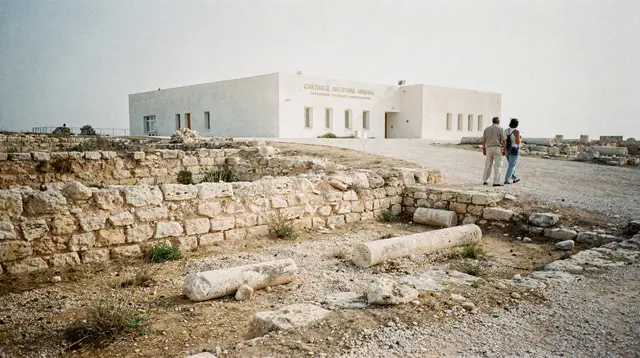
The third war ended differently: Rome besieged and razed Carthage in 146 BC, an act of destruction thorough enough that almost nothing of Punic-era Carthage survives above ground today. What you see at the Carthage archaeological sites now, including the excavated Punic ports, is mostly foundation-level evidence of that lost city, alongside the much larger Roman city built on top of it a century later.
| Founded | Traditionally 814 BC |
| Destroyed by Rome | 146 BC |
| Peak influence | Western Mediterranean trade and naval power |
| What survives today | Foundations, tophet remains, excavated ports; little above ground |
Roman Africa: from ruins to breadbasket, 146 BC to 439 AD
Rome initially left the ruins of Carthage abandoned, but under Julius Caesar and then Augustus the city was rebuilt as a Roman colony, and it grew rapidly into one of the empire’s largest cities outside Italy, eventually a hub of trade, learning and Christian theology. The wider province, Africa Proconsularis, became one of Rome’s most productive grain and olive-oil exporting regions, wealthy enough to fund an extraordinary density of provincial towns.
That wealth is why inland Tunisia today holds sites like Dougga, widely considered the best-preserved Roman town in North Africa, the underground villas of Bulla Regia, built partly below ground to escape summer heat, and the vast amphitheatre at El Djem, a scale of construction that only makes sense once you understand how rich this province had become.
Smaller towns such as Thuburbo Majus and Uthina, and the older Phoenician trading post of Utica, fill out a landscape where Roman-era ruins are genuinely everywhere rather than concentrated at one or two headline sites.
Christianity took hold early and forcefully in Roman Africa; Carthage produced influential early Christian writers, and the region was a centre of theological debate for centuries, well before the religious landscape shifted again with the Arab conquest. This is worth keeping in mind walking around Carthage’s later Roman-era ruins and the Antonine baths, since the city’s importance in this period wasn’t only economic.
Vandals and Byzantines, roughly 439 to 698 AD
Roman control ended abruptly when the Vandals, a Germanic people who had migrated across Spain, crossed into Africa and captured Carthage in 439 AD, making it the capital of their own kingdom for nearly a century. Byzantine forces under Justinian reconquered the region in 533 AD, folding it back into what remained of the Roman world as a Byzantine province, and this period left its own layer of fortifications and church remains, though it’s generally overshadowed by the more visually dramatic Roman and later Arab-Islamic monuments. It was also a genuinely unstable stretch, with repeated Berber revolts and shifting frontiers, setting the stage for the arrival of Arab armies from the east later in the seventh century.
The Arab conquest and the founding of Kairouan, 670 to 909 AD
Arab-Muslim armies advanced into Tunisia from the 640s onward, and the decisive founding moment came in 670 AD, when the general Uqba ibn Nafi established Kairouan as a garrison town and base for further conquest into North Africa and Iberia. Kairouan quickly became a major centre of Islamic scholarship, and the Great Mosque built there is among the oldest and most significant in the Islamic world, still the anchor of the city’s religious status today. Carthage itself was finally taken from Byzantine control in 698 AD, effectively ending the ancient city’s role as a regional capital; power shifted decisively inland and, eventually, to Tunis.
Private tour of Tunisia: 6 UNESCO sites in 6 days is one of the more efficient ways to see this Punic-to-early-Islamic arc in sequence, since several of Tunisia’s UNESCO listings, Kairouan among them, map directly onto the eras covered here.
Medieval dynasties: Aghlabids, Fatimids, Hafsids, 800 to 1574
The centuries after the Arab conquest saw a rotating cast of dynasties rule from Tunisian soil, each leaving a distinct architectural signature. The semi-independent Aghlabids, based in Kairouan from 800 to 909, built the city’s Great Mosque largely into the form seen today and constructed the Aghlabid basins, an early feat of hydraulic engineering. The Fatimids, who emerged from a religious movement in the Kairouan region, briefly ruled from a purpose-built capital at Mahdia on the coast before moving on to conquer Egypt and found Cairo, leaving Mahdia’s old town and its fortified sea gate as a reminder of that short but consequential chapter.
Later, the Hafsid dynasty, ruling from Tunis from 1229 to 1574, presided over what’s often considered a golden age for the city, expanding the medina, attracting Andalusian refugees fleeing the Christian reconquest of Spain, and building much of the dense architectural fabric that survives in the Tunis medina today, including the core of Ez-Zitouna mosque as a centre of learning to rival Kairouan’s.
That Andalusian influx deserves its own mention: refugees from Spain settled across northern Tunisia from the thirteenth century onward and again in larger numbers after 1609, shaping towns like Testour with a visibly different architectural character. The Andalusian towns of Tunisia guide covers where that legacy is most visible today.
Ottoman Tunisia and the beys, 1574 to 1881
Spain and the Ottoman Empire contested control of Tunisia through much of the sixteenth century, a rivalry that ended with Ottoman forces taking Tunis definitively in 1574. Tunisia then remained nominally part of the Ottoman Empire for three centuries, though real power increasingly rested with local rulers, the beys, particularly after the Husainid dynasty took the throne in 1705 and ran Tunisia as a largely autonomous state while still acknowledging Ottoman sovereignty.
This period reshaped Tunis physically, adding Ottoman-style mosques, the dense souk quarters around Ez-Zitouna, and the beylical palaces whose remnants now house museums like Dar Ben Abdallah. It’s also the period that saw Tunisia’s own naval piracy era along the Barbary Coast, a chapter that fed directly into European pressure for intervention later on.
| Era | Roughly when | Capital / centre | Signature site today |
|---|---|---|---|
| Punic Carthage | 814–146 BC | Carthage | Punic ports, tophet |
| Roman Africa | 146 BC–439 AD | Carthage, provincial towns | Dougga, El Djem, Bulla Regia |
| Arab-Islamic dynasties | 670–1574 | Kairouan, then Tunis | Great Mosque of Kairouan, Tunis medina |
| Ottoman Tunisia | 1574–1881 | Tunis | Souks, beylical palaces |
| French protectorate | 1881–1956 | Tunis | Ville Nouvelle, Avenue Habib Bourguiba |
The French protectorate, 1881 to 1956
France established a protectorate over Tunisia in 1881, ruling through the existing beylical structure while controlling administration, finance and foreign policy directly. The most visible legacy for a visitor is urban: French planners built an entirely new European-style city, Tunis’s Ville Nouvelle, alongside the existing medina rather than inside it, with wide boulevards, colonial-era architecture and the layout that still defines central Tunis today, including the avenue now named after the country’s first president.
Nationalist opposition grew through the early twentieth century, led eventually by the Neo-Destour party under Habib Bourguiba, whose long campaign for independence, including periods of exile and imprisonment, culminated in Tunisia’s independence being formally granted in March 1956.
Independence and the Bourguiba era, 1956 to 1987
Habib Bourguiba became Tunisia’s first president and dominated the country’s politics for three decades, pursuing an assertively secular and modernising programme that set Tunisia apart from many of its neighbours. His government’s 1956 Code of Personal Status was genuinely radical for the region: it abolished polygamy, introduced judicial divorce, and gave women rights that remained unusual across the Arab world for decades afterward.
Bourguiba also invested heavily in education and built the tourism industry that still underpins the coast around Hammamet and Sousse. His rule became increasingly autocratic and personalist in later years, and in 1987 he was declared medically unfit to govern in a bloodless transfer of power that brought his prime minister, Zine el-Abidine Ben Ali, to the presidency.
Ben Ali, the revolution, and today
Ben Ali ruled Tunisia for 23 years, a period that combined continued economic development with tightening authoritarian control and a well-documented human rights record that grew harsher over time. That era ended in the winter of 2010 to 2011, when protests sparked by the self-immolation of a street vendor in the interior town of Sidi Bouzid spread nationwide and forced Ben Ali to flee the country on 14 January 2011, an event now generally credited as the opening act of the wider Arab Spring.
Tunisia’s subsequent transition, including a new constitution adopted in 2014 and a period of genuine multiparty political competition, was widely held up as the region’s clearest democratic success story, work recognised internationally when the National Dialogue Quartet received the Nobel Peace Prize in 2015. That trajectory has grown more complicated since, with President Kais Saied consolidating significant power from 2021 onward, a development still shaping the country’s politics as this is written.
Seeing the layers in a short trip
For visitors with only a few days, the practical question isn’t which era is most interesting, it’s which sites let you see several layers at once. Carthage does this well, with Punic remnants, Roman baths and villas, and an Ottoman-era fort all within a short walk of each other. Kairouan does it differently, showing the Arab-Islamic layer at its richest with comparatively little overlap from other eras.
Best of Tunisia: 4 days of history, UNESCO sites and Roman ruins is built specifically around that layered approach, moving from Roman Dougga to the Andalusian town of Testour in a way that makes the timeline click into place on the ground rather than on paper. Anyone short on time who only wants the Roman chapter should instead look at the Roman Tunisia itinerary, while a broader circuit is covered by the UNESCO sites of Tunisia itinerary.
From Hammamet: Half-Day Tour to Discover El Jem is a useful option for anyone based on the coast who wants a single, focused dose of the Roman-era chapter without committing to a longer multi-day circuit.
Practical tips for history-focused travel
Museums matter more here than in many destinations, because they hold the portable finds, mosaics and inscriptions that give context the ruins themselves can’t. The Bardo museum in particular holds one of the world’s largest mosaic collections, lifted from Roman-era villas across the country, and is worth treating as a genuine priority rather than an optional add-on. Tunisia’s Jewish history, a continuous presence from antiquity through the twentieth century, is a further layer easy to miss entirely; the Jewish heritage in Tunisia guide covers where that history is still visible.
Dates on information panels and in older guidebooks sometimes conflict by a few years, particularly for the earlier Punic period, where the archaeological and legendary chronologies don’t fully agree. Treat the centuries-level picture as reliable and the exact years for anything before the Roman period as approximate.
Frequently asked questions about Tunisia’s history
Was Carthage a Roman city or a Phoenician one?
Both, at different times. Phoenician Carthage was founded around 814 BC and destroyed by Rome in 146 BC; almost nothing of that city survives above ground. Rome then rebuilt Carthage from scratch a century later, and it’s this Roman-era city, including the Antonine baths and the theatre, that makes up most of what visitors actually see today.
Why is Kairouan considered so important in Islamic history?
Kairouan was founded in 670 AD as the first Arab-Islamic city in North Africa and quickly became a major centre of Islamic scholarship and law. Its Great Mosque is among the oldest in the Islamic world, and a long-standing local tradition holds that seven pilgrimages to Kairouan carry weight comparable to one to Mecca, which explains the city’s enduring religious status.
What happened to Carthage’s original Punic population?
Roman accounts describe the destruction of Carthage in 146 BC as devastating, though the total depopulation sometimes implied by ancient sources is now generally treated with caution by historians. Punic culture and language persisted in the wider region for some time afterward, gradually absorbed as Roman Africa developed, and Punic-Berber identity fed into the population that later dynasties and conquests continued to reshape.
How did Andalusian refugees change Tunisia?
Muslims and Jews expelled from Spain, in waves from the thirteenth century and especially after 1609, settled across northern Tunisia and brought distinct architectural styles, agricultural techniques and culinary traditions with them. Testour is the clearest example, with a town layout and mosque architecture that visibly differs from the rest of the region.
Is Tunisia’s history taught differently depending on the era?
Tunisian schools generally cover all these periods, but public memory and tourism promotion have shifted focus over time, with post-independence governments emphasising the Arab-Islamic and Berber layers of national identity somewhat more than the colonial-era French period. That’s worth knowing if information panels at some sites feel thinner on twentieth-century context than on ancient history.
What’s the single best site for understanding Roman Tunisia?
Dougga is generally considered the strongest single site, because its street grid, forum, theatre and residential quarters all survive together rather than as isolated fragments, giving a genuine sense of a functioning Roman town rather than a scattered ruin field.
Did the Ottomans ever fully control Tunisia?
Not in practice for most of the period. The Ottomans took Tunis in 1574 and Tunisia remained nominally part of the empire until the French protectorate began in 1881, but from 1705 onward the Husainid beys ran the country with substantial autonomy, paying only loose deference to Istanbul.
Why did Habib Bourguiba’s reforms matter so much regionally?
The 1956 Code of Personal Status gave Tunisian women rights, including judicial divorce and the abolition of polygamy, that were unusual across the Arab world at the time and remained so for decades. It’s frequently cited as a key reason Tunisia’s social and legal landscape still differs noticeably from several of its neighbours.
How recent is the instability people associate with Tunisia?
The 2010–2011 revolution and its aftermath are the main reference point, but Tunisia’s tourist areas around Tunis, Hammamet, Sousse and the north have generally remained calm and functioning since; the is Tunis safe guide covers current, practical safety context rather than the historical narrative.
Culture & heritage tours on GetYourGuide
Verified deep-linked GetYourGuide tours. Book through these links and we earn a small commission at no cost to you.
These are our own photographs of Tunisia, not the operator's pictures of this tour — open the tour page to see those.