Utica: the first Phoenician city in Africa
Is Utica worth visiting given how much less survives than at Carthage?
For most travellers, only as part of a wider day toward Bizerte and Cap Angela, not as a standalone destination. Utica's historical significance as one of the oldest Phoenician settlements in North Africa far exceeds what's visibly left on the ground.
Utica has a genuine claim to being the oldest continuously identified settlement founded by Phoenician traders on the North African coast, predating Carthage itself by, according to ancient tradition, several centuries. It’s the place Cato the Younger chose to make his last stand and take his own life rather than submit to Julius Caesar, and for a long stretch of Roman history it was a significant provincial capital in its own right, briefly rivalling Carthage’s importance after Carthage’s destruction in 146 BC. Given all that, it’s worth being upfront: what’s visible on the ground today is modest, and travellers expecting a site on the scale of Carthage’s Antonine baths or Byrsa hill will likely leave disappointed.
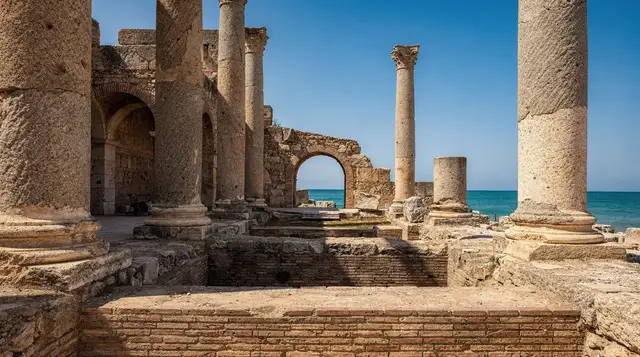
What Utica offers is more about historical weight than visual spectacle. A Roman-era residential quarter with a well-preserved peristyle house known as the House of the Cascade, some public baths, and a scatter of columns and foundations give a sense of the town’s later Roman incarnation, but very little survives from the earlier Phoenician and Punic period that makes Utica historically significant in the first place — much of that lies deeper, harder to excavate, or was built over. The site also sits inland now, several kilometres from the coast, a striking reminder of just how much silt the Medjerda river has deposited since antiquity; in Phoenician times, Utica sat directly on the sea.
| Where | Near Utique village, about 35 km north-west of Tunis |
| Cost | Around 8 TND (roughly €2.30) entry |
| Time needed | 45 minutes to 1 hour |
| Getting there | Car or tour from Tunis, about 45 minutes to 1 hour each way |
| Best time | Morning, combined with Bizerte or Ras Angela |
What actually survives
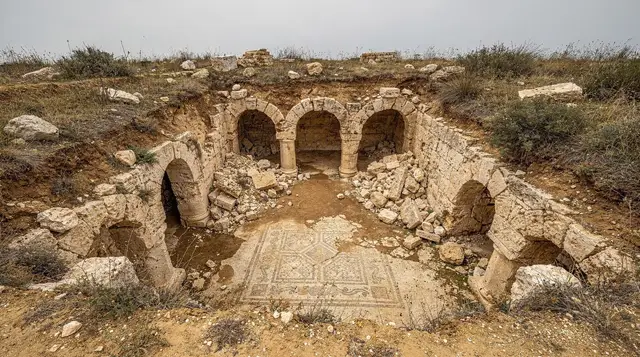
The most substantial visible structure is the House of the Cascade, a large Roman-era residence named for a mosaic-lined water feature that once cascaded down a series of steps in its central courtyard — an elegant piece of domestic engineering, and the single feature most worth the visit on its own. Around it lie the remains of public baths, some column bases from what would have been colonnaded streets, and low-lying foundation walls tracing out the layout of the Roman town’s residential quarter.
Almost nothing visible dates to the Phoenician or Punic era that gives Utica its historical importance; those layers are buried deeper and largely unexcavated, or were built over by later Roman construction. This is the central tension of a Utica visit: the site’s fame rests on a period barely represented in what you can actually see, while what you can see (the Roman residential quarter) is respectable but not exceptional by Tunisian standards.
Why the site is now inland
One of the more interesting facts about Utica, and one worth knowing before you visit so the site makes more sense, is that it was a coastal, even a peninsular, city in Phoenician and early Roman times, with a functioning harbour. Over the following two millennia, sediment carried down by the Medjerda river gradually filled in the surrounding bay, pushing the coastline steadily further away. Today the site sits several kilometres inland, surrounded by flat agricultural land rather than the sea — a genuinely striking illustration of geological change on a human timescale, and a detail that helps explain why a once-major port city ended up in the middle of a field.
Getting there from Tunis
Utica is around 35 km north-west of Tunis, roughly 45 minutes to an hour’s drive depending on the route and traffic leaving the city. There’s no practical public transport connection to the site itself, so this is a car-or-tour destination, and it’s rarely visited alone — most itineraries combine it with Bizerte and the coastal drive north, or with Ras Angela (Cap Angela), the northernmost point of the African continent, both of which sit further along the same general route.
A day trip combining the archaeological site of Utica, Ras Angela and Bizerte is the natural way to see Utica without dedicating a full day to a site that, on its own, doesn’t need much more than an hour. This pairing makes geographic sense and turns what would otherwise be a thin standalone visit into a fuller day covering Roman history, a dramatic coastal landmark, and Bizerte’s old port and medina.
If you’d rather drive yourself, the coastal drive from Tunis to Bizerte is the natural backbone of the day, and our notes on driving in Tunisia and car hire in Tunisia cover what to expect on the road. Once you reach the north, the Bizerte day trip guide and the page on Cap Angela, the northernmost point in Africa help you decide how to fill the rest of the day, and the Bizerte destination page gives the wider picture of the town itself. A quieter alternative to a full day out is to browse the best day trips from Tunis and see where Utica sits among them.
If Utica doesn’t fit your itinerary
Given how modest the visible remains are relative to the drive required, it’s worth being honest that Utica isn’t essential for most travellers, particularly those with limited time who haven’t yet covered Carthage properly. If you’re deciding between Utica and other options for a similar half-day slot, a walking tour of the Carthage archaeological sites and ruins covers far more visible history in a similar amount of time, and should take priority for a first visit to the Tunis area.
For travellers who’ve already done Carthage and want a different kind of day further afield, options like a day trip to Kairouan and El Jem from Hammamet or a stop in Monastir on a guided city tour offer more substantial standalone destinations than Utica does, if your priority is maximising what you see per day rather than historical completeness.
To judge where Utica fits among the region’s ancient sites, the guide to Carthage’s archaeological sites and the ranking of Roman sites near Tunis are the best starting points. Travellers who want a Roman site with far more standing architecture should look at the complete guide to Dougga, and those building a longer route can follow the Roman Tunisia itinerary or the north Tunisia road trip, both of which give Utica a sensible place in a wider plan. The Utica destination page gathers the practical basics in one place.
What the visit feels like
The site is small, flat, and easy to walk in well under an hour, with a scatter of freestanding information panels in French that give reasonable context if you take the time to read them. There’s minimal shade and no facilities beyond a basic ticket booth, so this fits more naturally as a brief stop within a longer day than as a destination requiring its own preparation. The surrounding landscape — flat farmland where a harbour once stood — is worth a moment of reflection even if the ruins themselves don’t take long to see.
Because so few visitors make the trip, you’ll likely have the House of the Cascade to yourself, which does give the visit a certain quiet appeal even if the scale doesn’t match Carthage or Dougga.
The surrounding area, now given over to wheat fields and market gardens, is worth a slow look on the drive in and out. This was the fertile hinterland that made towns like Utica and Thuburbo Majus wealthy in Roman times, and the same agricultural rhythm — cereal cultivation on the flat valley floor, olive groves on the drier slopes further from the river — continues largely unchanged today, one of the more tangible links between the ancient economy you’re reading about on the information panels and the working landscape you’re actually driving through.
Utica’s role after Carthage’s destruction
Utica’s most significant historical moment came in 146 BC, immediately after Rome razed Carthage at the end of the Third Punic War. Having sided with Rome against Carthage during the war, Utica was rewarded by becoming the new capital of the Roman province of Africa, a position it held for roughly a century until Julius Caesar’s reconstruction of Carthage as a Roman colony gradually restored the older city’s regional dominance. This century as provincial capital explains much of the town’s later prosperity and the scale of its Roman-era residential quarter, including the House of the Cascade — this wasn’t a minor provincial town but, briefly, the most important Roman city in North Africa.
That history is almost entirely invisible in what survives today, which is part of why Utica rewards visitors who arrive already knowing the story rather than expecting the ruins to tell it themselves. The site’s information panels touch on this period, but the physical remains from Utica’s century as provincial capital are limited compared with what came before (the Phoenician city) and after (the later Roman residential quarter you actually walk through).
Excavation history and what’s still unknown
Utica has been excavated in phases since the late 19th century, with French colonial-era archaeologists conducting the first systematic digs, followed by further Tunisian-led excavation through the 20th century. Despite this long history of work, significant portions of the ancient city, particularly the earlier Phoenician and Punic layers that give Utica its historical importance, remain unexcavated or only partially understood, buried beneath later Roman construction or simply not yet dug. This is a common pattern across Tunisia’s ancient sites — the layers that interest specialists most are often the hardest and most expensive to reach, sitting beneath centuries of later building.
For casual visitors this mostly matters as context: the site you walk through represents the Roman-era town built on top of the Phoenician one, not a direct window into Utica’s earliest and most historically significant centuries. Ongoing archaeological work occasionally turns up new findings, so it’s worth checking current information before a visit if the academic side of Utica particularly interests you.
Reading a little before you go makes the visit richer. The Tunisian history timeline places Utica’s Phoenician, Punic and Roman chapters in order, and the guide to the Punic ports of Carthage shows what a Phoenician harbour looked like when you can still see one. Since many Utica finds ended up in the capital, the highlights of the Bardo Museum mosaics are a good companion to the House of the Cascade. If your day continues toward the lagoon country, the Ichkeul National Park guide is worth a look, and the blog post on why I keep going back to Bizerte gives a personal sense of the town at the end of this route. For the bigger picture of your stay, the Tunis trip planning guide ties it all together.
Mistakes to avoid
Frequently asked questions about visiting Utica
Is Utica older than Carthage?
According to ancient tradition recorded by Roman and Greek writers, yes — Utica is generally considered to have been founded by Phoenician traders before Carthage, making it one of the oldest Phoenician settlements in North Africa. Archaeological confirmation of the earliest founding dates is less definitive than the traditional accounts suggest, but Utica’s precedence is the accepted historical view.
Why does the site look inland if Utica was a port city?
Sediment carried down by the Medjerda river has gradually filled in the surrounding bay over roughly two thousand years, pushing the coastline several kilometres away from the ancient harbour. What was once a peninsular port city now sits surrounded by flat agricultural land.
How does Utica compare to Carthage for a first visit to Tunis?
Carthage offers far more to see — the Antonine baths, Byrsa hill, the Punic ports, and a proper site museum — and should take priority for anyone with limited time. Utica is a smaller, quieter stop best suited to travellers who’ve already covered Carthage and want to extend into the Bizerte direction.
Can I visit Utica on the way to or from Bizerte?
Yes, this is the most common and sensible way to see it. Utica sits roughly on the route north toward Bizerte and Ras Angela, so combining the three into a single day trip is efficient and avoids a dedicated trip just for Utica.
Is there a museum at the Utica site?
There’s no substantial dedicated museum on site, just information panels in French near the main features. Some Utica finds are held in Tunisian national collections, including the Bardo, rather than displayed at the site itself.
How long should I plan for the visit?
Most visitors need 45 minutes to an hour to see the House of the Cascade, the baths, and the residential quarter’s foundations. It’s a compact site that doesn’t require a long visit, which is part of why it works best as a stop within a longer day rather than a standalone trip.
Is there shade or facilities at the site?
Facilities are minimal — a ticket booth and little else. Shade is limited across the open site, so bring water and sun protection, particularly if visiting between late spring and early autumn.
What’s the connection between Utica and Cato the Younger?
Cato the Younger retreated to Utica after his forces were defeated by Julius Caesar’s army in 46 BC, and chose to take his own life there rather than accept Caesar’s clemency, an episode that became one of the most cited examples of Roman Stoic resolve. The exact site of his death isn’t marked with certainty within the ruins today.
Was Utica ever the capital of Roman Africa?
Yes, briefly. After Rome destroyed Carthage in 146 BC, Utica became the capital of the newly formed province of Africa as a reward for having sided with Rome during the Third Punic War, a status it held for roughly a century until Julius Caesar’s refounding of Carthage gradually shifted regional importance back to that city.
Is much of the site still unexcavated?
Yes, particularly the earlier Phoenician and Punic layers that give Utica its historical significance. Excavation has proceeded in phases since the late 19th century, but substantial portions of the ancient city, especially the pre-Roman city, remain buried beneath later construction or simply not yet dug.
Roman & Punic site tours on GetYourGuide
Verified deep-linked GetYourGuide tours. Book through these links and we earn a small commission at no cost to you.
These are our own photographs of Tunisia, not the operator's pictures of this tour — open the tour page to see those.