Bulla Regia and its underground villas
Is Bulla Regia worth the trip from Tunis?
Yes, if you have a car or join a tour, because the underground villas are unlike any other Roman site in Tunisia. It's a long day on its own, so most visitors pair it with Dougga, roughly forty minutes away.
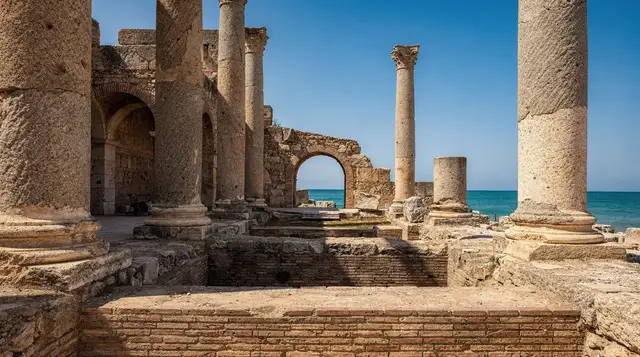
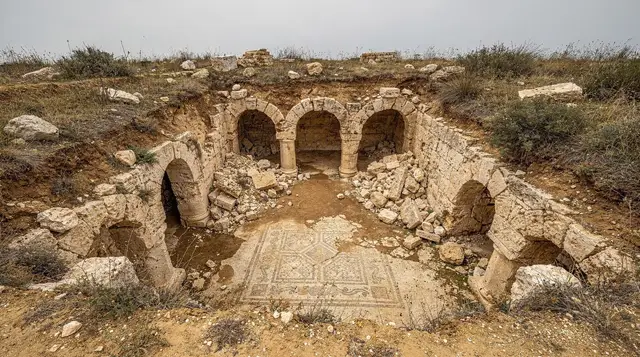
Most Roman ruins in Tunisia look the way you’d expect: columns standing in a field, a theatre cut into a hillside, mosaics under a modern roof in a museum. Bulla Regia does something different. Its wealthiest residents, tired of the summer heat on the plain near the Algerian border, dug their reception rooms and bedrooms a full storey below ground, where the temperature stays noticeably cooler even in July. Walk down a short flight of stone steps today and you’re standing in a Roman dining room with its mosaic floor still largely intact, looking up at a light well that once let in air and daylight. It’s an odd, slightly vertiginous feeling, and it’s the reason people make the two-and-a-half-hour drive from Tunis.
The site itself is modest in size compared with Dougga or Carthage, and you can walk the whole thing in ninety minutes if you’re not lingering. What makes it worth the detour is the concentration of well-preserved floor mosaics still in situ rather than removed to the Bardo, plus the strangeness of an ancient house you enter by going down rather than through a doorway.
If you are still deciding which ancient sites deserve your time, the ranking of Roman sites near Tunis puts this one in context, and the Bulla Regia destination page gives the short version. For the mosaics that did end up in the capital, see the Bardo mosaic highlights; for a longer account of how the finds were looked after, the mosaics nobody photographs is a good companion read.
| Where | Near Jendouba, north-west Tunisia, about 6 km from Jendouba town |
| Cost | Around 12 TND (roughly €3.50) entry; camera fee sometimes charged separately |
| Time needed | 1.5 to 2 hours on site |
| Getting there | Car or organised tour from Tunis, around 2h30 each way; no direct louage route |
| Best time | Morning, before the underground rooms get busy with tour groups |
Why the villas went underground
Bulla Regia was a prosperous Roman town from around the 2nd century AD, built on the wealth of grain exported from the fertile Medjerda valley. Its elite built their houses in the ordinary Roman style at ground level, then — apparently starting in the 2nd or 3rd century — began excavating a semi-basement level beneath the main reception rooms. The engineering is straightforward but effective: a sunken courtyard lets light and air down to rooms cut into the earth, which stay several degrees cooler than the rooms above. This wasn’t a universal Roman technique; it appears concentrated at Bulla Regia and a handful of nearby sites, likely a local adaptation to a hot, dry summer climate.
The two houses everyone visits are the House of the Hunt (Maison de la Chasse) and the House of Amphitrite. Both have underground rooms open to visitors, and both keep their mosaics in place rather than lifted for museum display, which is unusual for a Tunisian Roman site of this quality. The House of Amphitrite in particular has a mosaic showing the sea goddess reclining between two centaur-tritons that’s frequently reproduced in guidebooks, and seeing it on the floor of the room it was made for is a different experience from seeing a fragment in a glass case.
What else is on site
Above ground, Bulla Regia has a reasonably complete Roman theatre, partly restored, still occasionally used for performances during local cultural events. There’s also a basilica, a set of public baths (smaller and less dramatic than the Antonine baths at Carthage), and the remains of a temple dedicated to Apollo. None of these are the main draw, but they round out a visit and help you picture the town as a whole rather than just the two show-house villas.
If you have already seen the Carthage ruins, the comparison is instructive: the Antonine baths at Carthage show Roman public life on a grand scale, and the Roman theatre and villas of Carthage show domestic life above ground, whereas Bulla Regia shows what a wealthy household did when the climate pushed it below.
The site sits on a low rise with views over farmland toward Jendouba, and unlike Dougga there’s little shade, so a hat and water matter more here than at some other sites. The underground rooms themselves are naturally cool, which is a welcome break if you’re visiting between May and September.
Getting there from Tunis
There’s no practical public transport route that gets you to Bulla Regia without a long walk or a taxi at the far end, so this is a car-and-driver or organised-tour destination for the vast majority of visitors. By road it’s around 170 km from Tunis, mostly on the A3 motorway toward Béja and then secondary roads west toward Jendouba — figure two and a half hours each way in normal traffic, more if you hit roadworks near Béja, which are intermittent but common.
Because of the distance, almost nobody visits Bulla Regia on its own. The standard pairing is with a day trip combining Dougga and Bulla Regia, which makes sense geographically since Dougga is roughly forty minutes closer to Tunis on the same general route. If you’d rather go with a smaller group and set your own pace, a private day trip through Testour, Dougga and Bulla Regia adds a stop at the pretty Andalusian-founded town of Testour, with its distinctive clock tower and riverside setting, without extending the day by much.
Choosing between a group and a private vehicle is mostly a question of pace, and private vs group tours in Tunisia lays out the trade-offs. Anyone curious about shared taxis can read how louages work to see why they don’t solve this particular route.
If you’re driving yourself, read car hire in Tunisia and driving in Tunisia first; a rental car with GPS is entirely manageable — Tunisian motorways are well signed in French and Arabic, and the last stretch from Jendouba to the site is a straightforward country road. Just budget for the whole day; there isn’t a version of this trip that takes less than seven or eight hours door to door.
Pairing Bulla Regia with Dougga
Because both sites sit on roughly the same road corridor west of Tunis, almost every operator sells them as a single itinerary, and it’s the right call logistically. Dougga is the larger, more architecturally complete site — its capitol and theatre are the best-preserved in North Africa — while Bulla Regia offers something Dougga doesn’t: the underground villas. Visiting both in one day means around five hours of driving and three to four hours across the two sites, which is a long day but not an exhausting one if you start early.
A VIP day tour covering Dougga, Bulla Regia and Testour is worth the modest premium over a standard group tour if you want a smaller vehicle and more flexibility on timing at each stop, particularly useful if you want extra time photographing the Amphitrite mosaic without a group crowding the small underground room. For travellers who’d rather have lunch built into the day rather than stopping at a roadside café, a Bulla Regia and Dougga tour with lunch included removes one thing to plan.
For a fuller picture of the other site on this route, the complete guide to Dougga covers what to see there, Carthage vs Dougga helps if you must choose, and Dougga at eight in the morning describes what an early start feels like. The Andalusian town on the way has its own write-up in the Testour and Medjerda valley day trip.
What to expect physically
The underground rooms are reached by stone steps that can be uneven and are sometimes damp after rain, so proper shoes rather than sandals make sense. The rooms themselves are compact — you’re not walking through grand halls, more like domestic-scaled spaces that held perhaps a dozen people comfortably in Roman times, which means a tour group of twenty can feel crowded inside. There’s minimal signage in English on site; a guide or a pre-read guide adds a lot to the experience since the mosaics reward knowing what you’re looking at.
There’s a small site museum near the entrance with a handful of additional finds, worth five minutes but not a major attraction in itself. Toilets exist at the entrance but facilities are basic. Bring your own water — there’s rarely a functioning kiosk on site, and the walk between the two main houses and the theatre covers open, sunny ground with no shade en route.
Jendouba as a base or a stop
Jendouba itself is a working provincial town rather than a tourist destination, and most visitors pass through without stopping beyond perhaps a coffee. If you’re combining Bulla Regia with a longer swing through the north-west — Aïn Draham’s forests, or the Roman site at Chemtou further west — Jendouba is the natural overnight base, though hotel options are limited and functional rather than characterful. For a single day trip from Tunis, there’s no reason to linger in the town.
The forested hills of the far north-west make a pleasant contrast with the open farmland here, and the Aïn Draham and Kroumirie forests guide is the place to start if you want to extend the trip.
Fitting Bulla Regia into a wider plan
Because it is so far from the coast, Bulla Regia works best as a deliberate choice rather than an afterthought. The Roman Tunisia itinerary and the UNESCO Tunisia itinerary show how it can sit alongside other ancient sites, while best day trips from Tunis compares it with easier options. Season matters too: the best time to visit Tunis helps you choose a month when the open ground between the villas is comfortable, and the wider Tunis trip planning guide ties the pieces together.
Photography and what not to miss
The Amphitrite mosaic in the House of Amphitrite is the single most photographed feature, but don’t rush past the House of the Hunt’s underground triclinium, which has its own strong geometric mosaic floor and slightly better natural light from its light well, making it easier to photograph without flash. The theatre, seen from the upper seating rows looking down toward the stage and out over the surrounding farmland, is a good wide shot and rarely crowded since most visitors head straight for the underground houses.
Midday sun through the light wells creates a striking, almost theatrical effect in the underground rooms around noon — if photography matters to you, that’s a reason to time your visit for late morning rather than the very earliest opening hour, despite the general advice to arrive early for crowds.
Mistakes to avoid
Frequently asked questions about visiting Bulla Regia
How long does the drive from Tunis actually take?
Budget two and a half hours each way under normal conditions, closer to three if there’s roadwork around Béja, which happens periodically on this route. Add rest stops and the round trip alone takes the better part of a day, which is why almost every visit is structured around combining Bulla Regia with Dougga rather than treating it as a standalone excursion.
Can I visit Bulla Regia by public transport?
Not practically. There’s no direct louage or train route, and the last stretch from Jendouba to the site itself requires a taxi or private vehicle. Nearly all visitors go by rental car or organised tour; public transport would involve multiple changes and still leave you without a way to reach the site itself from Jendouba town.
Are the underground rooms accessible if I have mobility issues?
The steps down to the underground sections are uneven stone with no handrails in most places, and there’s no ramp access. Visitors with significant mobility limitations should expect to see the above-ground remains — the theatre, baths and basilica — comfortably, but the signature underground villas will be difficult or impossible to access safely.
Is there anywhere to eat near the site?
There’s minimal food available directly at Bulla Regia beyond, at times, a very basic kiosk that isn’t reliably open. Most day-trip itineraries either include a stop in Jendouba or a packed lunch, or build in a meal at Testour if that’s part of the route. Bring snacks and water regardless.
How does Bulla Regia compare to Dougga for someone who can only pick one?
Dougga is the more complete and architecturally impressive site, with a genuinely well-preserved capitol, theatre and forum that give a fuller sense of a Roman town. Bulla Regia is smaller but offers the underground villas, which Dougga doesn’t have. If forced to choose one, most first-time visitors get more from Dougga; Bulla Regia is the pick for a second Roman-sites day or for travellers specifically drawn to the underground-house novelty.
Is the site shaded, and what should I wear?
There’s very little shade across the site outside the underground rooms themselves, so a hat, sunscreen and water are important, especially May through September. Comfortable closed shoes matter more here than at flatter sites because of the uneven underground steps.
Are there mosaics that have been removed to the Bardo museum?
Some finds from Bulla Regia are indeed in the Bardo’s collection, but the site’s real distinction is how much has been left in place — the Amphitrite mosaic and several others remain on the floors of the rooms where they were laid, which isn’t the case at most other Tunisian Roman sites where the best mosaics went to Tunis.
Is a guide necessary, or is a tour with a guide meaningfully better than driving yourself?
A guide adds real value here specifically because the underground architecture and mosaic iconography aren’t self-explanatory and signage is limited. Driving yourself is entirely feasible and saves money, but consider at least reading up on the two main houses beforehand, or opting for one of the guided day trips if you want the context explained on site.
Does the site get crowded?
Bulla Regia sees far fewer visitors than Carthage or even Dougga, so outside of the occasional large tour bus, it rarely feels crowded. The narrow underground rooms are the one place a group of fifteen or twenty can feel tight, which is the main reason to aim for an early or late visit if avoiding groups matters to you.
Roman & Punic site tours on GetYourGuide
Verified deep-linked GetYourGuide tours. Book through these links and we earn a small commission at no cost to you.
These are our own photographs of Tunisia, not the operator's pictures of this tour — open the tour page to see those.