Ksar Ghilane: the hot spring at the edge of the erg
Is the Ksar Ghilane hot spring worth the trip into the desert?
Yes, if a night or at least a full day in the Sahara is part of your plan, because bathing in a warm natural pool with sand dunes rising behind it is not something you'll find anywhere else in Tunisia. It's a poor fit for a rushed day trip from Tunis, since the distance alone rules that out; it works best from Douz or Tataouine, or as the final stop on a longer southern loop.
Ksar Ghilane is the point where the paved south of Tunisia gives out and the Grand Erg Oriental takes over. A cluster of palms, a scatter of camps, and a warm spring fed from underground sit right at the foot of the dunes, with a Roman watch fort perched on the ridge above. It is not a town in any real sense — there’s no permanent village to speak of, just the oasis, the camps built around it, and sand in every direction beyond that. People come for one specific thing: to sit in genuinely warm water with a wall of dunes as the backdrop, then stay long enough to watch the light change over the erg at dusk.
It’s also, practically speaking, the furthest most organised tours will take you south-west before turning back toward the coast. Getting here takes real effort — hours of driving, the last stretch on sand or a rough track depending on the route — so almost nobody treats it as a stop on the way to somewhere else. It’s the destination.
| Where | Edge of the Grand Erg Oriental, south of Tataouine and south-west of Douz |
| Cost | Spring access is generally included with a camp stay; a camel ride runs roughly 25-40 TND (about €7-12), a short 4x4 loop around 60-100 TND (about €18-30) per person shared |
| Time needed | Half a day minimum for the spring and fort; most visitors stay one night |
| Getting there | Organised tour, 4x4 with driver, or self-drive from Douz (paved most of the way) or Tataouine (partly piste) |
| Best time | October to April; the spring is at its best on a cool desert evening, and summer daytime heat is severe |
An oasis where the tarmac gives up
The oasis at Ksar Ghilane has been a stopping point for caravans and, later, for the French Foreign Legion, long before it became a tourist destination. What draws people today is almost entirely the spring: a natural source of warm, slightly mineral water that pools at the base of the dunes and has been channelled into a shallow, informal bathing area lined with palms. It isn’t a spa in any polished sense — there’s no tiled edge or changing rooms beyond what the nearest camp provides — but the water itself is real, warm year-round, and genuinely pleasant after a dusty drive or a morning on a camel.
The setting is what makes it. Most hot springs anywhere come with some kind of built environment around them; here the environment is a sand dune rising directly behind the pool, high enough that climbing it for sunset is the obvious thing to do once you’ve dried off. On a clear evening, the combination of warm water, cooling air and the erg turning orange is the reason people plan a whole southern Tunisia itinerary around reaching this specific spot.
The hot spring: what it’s actually like
Don’t expect anything engineered. The spring emerges from the ground at a temperature that’s comfortably warm rather than hot, feeds a shallow channel and a slightly deeper pool shaded by palms, and is open to anyone passing through, not gated or ticketed in the way a formal thermal establishment would be. Some seasons the flow is stronger than others, and the pool’s edges shift a little year to year as sand moves and camps do informal maintenance. It’s rustic, sometimes a little muddy at the entry point, and that’s part of the appeal rather than a flaw to fix.
Bring your own towel and a swimsuit that covers reasonably, since the pool sits in open view of the camps and other visitors, and modest dress is generally appreciated even in a tourist-oriented spot like this. Evenings are the best time to go in: the desert air cools quickly after sunset, which makes the warm water feel considerably better than it does at midday under a punishing sun.
Most people combine this with a night at one of the camps, since the simplest way to reach Ksar Ghilane at all is as part of an organised route — a two-day tour from Tunis and Hammamet covering Ksar Ghilane and Tataouine is the most straightforward way to see the spring, the fort and the town of Tataouine without driving any of it yourself.
The Roman fort of Tisavar
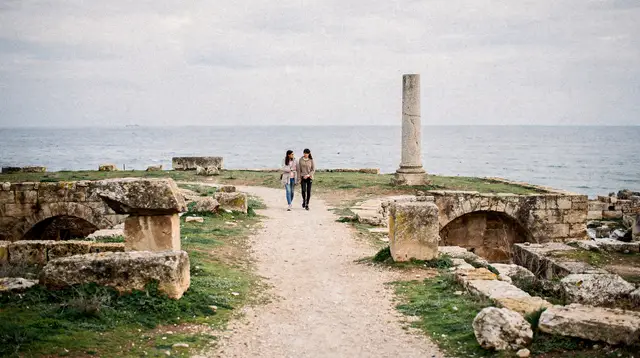
On the ridge directly above the oasis and spring sit the remains of Tisavar, a small Roman fort that once anchored the empire’s southern frontier, part of the same defensive network of watch posts that ran along the pre-desert to monitor movement in and out of the Sahara.
What’s left today is modest — low stone walls, the footprint of a rectangular enclosure, nothing on the scale of El Djem or Dougga — and most visitors spend fifteen or twenty minutes there rather than a full stop in its own right. Go for the view rather than the archaeology: from the fort’s position on the dune, you look down over the palms and the spring on one side and out over open erg on the other, which is a better vantage point than anywhere at ground level in the oasis itself.
Climbing up is a short, sandy walk rather than a hike, doable in ordinary shoes though sandals fill with sand quickly. There’s no signage, no ticket booth and no shade at the top, so a hat matters if you’re going up in daylight rather than for sunset. Honestly, treat Tisavar as a twenty-minute add-on to a spring visit rather than a reason to come to Ksar Ghilane on its own — the fort by itself wouldn’t justify the drive, but paired with the spring and the dunes it rounds out an already worthwhile stop.
Getting to Ksar Ghilane from Douz and Tataouine
There are two practical approaches, and which one makes sense depends on where the rest of your southern Tunisia route is taking you.
From Douz
Douz, often called the gateway to the Sahara, sits roughly 120 km north of Ksar Ghilane. The road is paved for most of the distance via El Faouar, with only the final approach into the oasis requiring a short stretch of sand or track depending on conditions that season — manageable in a standard 4x4 but not something to attempt in a small rental hatchback. Figure around two hours of driving each way, more if you stop for photos along the way, which most people do since the transition from scrub to true dune desert happens gradually and is worth watching unfold.
From Tataouine
Coming from Tataouine, the distance is shorter on paper — under 100 km — but a larger share of the route runs on unpaved track through the pre-desert rather than tarmac, which makes travel time similar to the Douz route despite the shorter distance. This is the direction most tours combining Ksar Ghilane with Chenini, Douiret and the ksour of the Tataouine region take, since it lets you see the fortified Berber granaries of the south on the same day before continuing into the dunes.
| Route | Distance | Road surface | Typical driving time |
|---|---|---|---|
| From Douz | About 120 km | Mostly paved, final stretch on sand | Around 2 hours |
| From Tataouine | About 90-100 km | Partly piste, unpaved for stretches | Around 2-2.5 hours |
| From Tunis (direct) | Around 550-600 km | Paved motorway then regional roads | 6.5-7.5 hours; not a day-trip distance |
Given how far Ksar Ghilane sits from Tunis, almost nobody drives there directly for a single day. It’s either folded into a longer tour of the south — commonly departing from Tunis, Hammamet, Sousse or Monastir and running several days — or reached as one leg of a self-planned loop through Douz, Matmata and Tozeur. Our comparison of Sahara tours from Tunis is a useful starting point if you’re still choosing between operators, and two-day or three-day Sahara tour: which one to book helps decide how much time to give the south in the first place.
If you’d rather not drive the piste sections yourself, a six-day tour of southern Tunisia departing from Tunis, Sousse or Monastir covers Ksar Ghilane alongside the rest of the region’s highlights without you having to plan any of the logistics.
Camel treks and 4x4 loops into the dunes
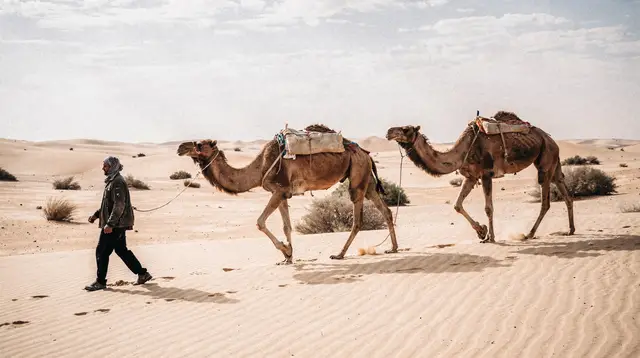
Once you’re at Ksar Ghilane, the two standard ways to get out onto the erg itself are camel and 4x4, and they suit different appetites. A short camel ride — typically forty-five minutes to an hour, arranged directly through your camp — is enough to get a genuine sense of moving through dune terrain at a camel’s pace, with a guide walking alongside rather than any kind of self-directed riding. Our broader guide to camel trekking in the Tunisian Sahara covers longer multi-day options for anyone who wants more than a short taster ride. It’s slow, a little uncomfortable if you’re not used to the saddle, and exactly the experience most first-time visitors picture when they imagine the Sahara.
A 4x4 loop covers considerably more ground in less time — an hour or two threading between dune ridges, often stopping at a high point for photos, sometimes continuing further into the erg than a camel trip would reach in the same window. Drivers know the terrain well enough to avoid getting bogged down, though soft-sand driving still has its moments, part of the appeal for anyone who enjoys that kind of ride.
For a package that bundles both elements together with entry to the oasis itself, a Sahara desert 4x4 tour with a camel ride and the oasis is the most efficient way to do it in a single afternoon if your time at Ksar Ghilane is limited to a few hours rather than an overnight stay.
Neither activity is included automatically with accommodation — expect to pay separately at the camp or arrange it in advance through a tour operator, and expect prices to be quoted per person for shared vehicles or per camel for riding, with some room to negotiate directly with camp staff outside of a pre-booked package.
Spending the night: bivouacs and desert camps
Staying overnight is what turns a spring visit into a proper Sahara experience, and it’s genuinely the better option if your schedule allows it — the light on the dunes at sunset and again before dawn is a different thing entirely from a midday stop. Camps around Ksar Ghilane range from simple shared tents with mattresses on the ground to more comfortable setups with proper beds, private tents and a restaurant serving a set dinner, usually some version of couscous or tajine cooked over a fire, sometimes with music around the campfire afterward.
What a basic bivouac gets you
At the simpler end, a night typically includes a shared or small private tent, dinner and breakfast, and use of the spring, for somewhere in the region of 60-100 TND (roughly €18-30) per person depending on the camp and season. Facilities are basic — shared washroom blocks, no electricity beyond a generator running limited hours, and blankets rather than heating, which matters because desert nights get properly cold even when the days are hot.
The more comfortable option
Several camps have moved upmarket, offering proper beds, private bathrooms in some cases, better food and sometimes a fixed dinner setting under the stars rather than a communal table. These run noticeably higher, often bundled into a tour package rather than booked as a standalone night. If comfort matters more than budget, a south Tunisia tour with a luxury desert bivouac stay is built specifically around this tier, pairing a more comfortable camp with the rest of a southern itinerary rather than leaving you to arrange it separately once you arrive.
Whichever tier you choose, book ahead during the cooler months — October through March sees the heaviest demand, and camps do fill, particularly around public holidays when domestic Tunisian visitors also make the trip south. Our wider guide to desert camps and bivouacs in Tunisia covers what a night looks like across several Sahara locations, not just here.
Practical details: cost, food and what to bring
Food at Ksar Ghilane is entirely camp-based; there’s no independent restaurant scene to speak of, so whatever camp you’re staying with or eating at for the day sets the menu, almost always a fixed dinner rather than a card to choose from. It’s simple, filling food — bread, salad, a tajine or couscous, fruit — priced into the stay rather than charged separately in most cases. Bottled water is sold at every camp, worth stocking up on since you’ll drink more than usual in the dry desert air even outside of summer.
Pack for genuine temperature swings: daytime warmth even in winter, and cold enough after dark that a proper layer matters, not just a light jacket. Closed shoes help for the climb up to Tisavar and for walking on the dunes generally, since loose sand gets everywhere in open sandals. A headscarf or hat cuts down on both sun and blown sand, and a basic first-aid kit is sensible given the distance to any medical facility.
There’s no reliable mobile signal much beyond the immediate area, so download maps and tell someone your route if you’re driving independently rather than joining an organised trip. Our full what to pack for a night in the Sahara checklist goes through this in more detail than fits here.
Cash is essential — TND only, no card machines at the camps or for camel and 4x4 bookings, and the nearest ATM is back in Douz or Tataouine, not at Ksar Ghilane itself.
Combining Ksar Ghilane with the rest of the south
Because of the distance involved, Ksar Ghilane works best as one stop within a broader southern loop rather than a destination reached and left in isolation. The natural pairing going west is Matmata’s troglodyte houses, roughly two to three hours away depending on the exact route, followed by the vast white expanse of Chott el Jerid and the oasis town of Tozeur further north-west.
Coming from the Tataouine side, the ksour towns of Chenini and Douiret slot neatly into the same day before you continue on to the dunes. For a full week combining Tunis with the desert, our one week: Tunis and the Sahara itinerary lays out a route that fits Ksar Ghilane in without over-packing the days either side of it.
Multi-day tours from Tunis, Hammamet, Sousse or Monastir typically structure the trip this way: north Tunisia in the first day or two, a long transfer south, a night at Ksar Ghilane, then a swing back through Matmata and the Sahel on the return leg. If you’re planning independently rather than booking a packaged tour, treat Ksar Ghilane as the anchor point of a southern leg lasting at least two to three days once travel time both ways is accounted for — trying to squeeze it into a single overnight from Tunis leaves almost no time to actually enjoy the spring or the dunes.
When to go, and when to think twice
Late autumn through early spring — roughly October to April — is the sensible window. Daytime temperatures are comfortable for the drive and for time on the dunes, nights are cold but manageable with proper layers, and the spring itself feels genuinely welcoming rather than redundant against already-hot air. December and January bring the coldest nights, occasionally close to freezing, so a proper sleeping arrangement at the camp matters more than in the shoulder months.
Summer is a different proposition entirely. Daytime temperatures regularly climb well past 40°C, sometimes considerably higher, and the drive itself becomes uncomfortable and genuinely risky if a vehicle breaks down on an exposed stretch of road. Camps still operate through summer for the visitors who come regardless, and the spring water feels far less special when the air around it is already hotter than the pool, so unless there’s a specific reason to travel in July or August, most people are better served picking a cooler month.
Mistakes to avoid
Frequently asked questions about the Ksar Ghilane hot spring and oasis
How deep and how hot is the spring water?
The pool is shallow in most places — generally waist-deep or less near the edges, deeper toward the centre in spots — and the water is warm rather than hot, closer to a comfortably heated pool than a scalding thermal source. It’s pleasant to sit in rather than a brief dip, which is part of why an evening visit works so well after a day of driving or dune activity.
Do I need a 4x4 to get there myself?
For the final approach into the oasis, yes — a 4x4 or at minimum a high-clearance vehicle is strongly advised, since the last stretch involves sand or an unpaved track depending on the route and season. Ordinary rental hatchbacks are not suited to this drive, which is one reason most independent travellers join an organised tour or hire a 4x4 with driver for the southern leg of their trip.
Is Ksar Ghilane connected to the Star Wars filming locations in the south?
Not directly. The well-known Tunisian Star Wars locations sit further north-west, around Nefta, Tozeur and Matmata, rather than at Ksar Ghilane itself. Travellers combining both interests typically continue on from Ksar Ghilane toward Tozeur and Matmata as part of the same southern loop rather than expecting film sites at the oasis.
Can I visit just for the day without staying overnight?
Yes, and a day visit is entirely workable if you’re coming from Douz or Tataouine rather than Tunis, giving you time for the spring, a camel ride or short 4x4 loop, and the climb up to Tisavar. That said, an overnight stay adds the sunset and sunrise over the dunes, which is a large part of what makes the detour worthwhile in the first place.
How much should I budget for a night at Ksar Ghilane, activities included?
Figure roughly 100-180 TND (about €30-55) per person for a basic camp stay with dinner and breakfast plus a short camel ride, more if you add a 4x4 loop or choose a higher-comfort camp. Packaged multi-day tours from Tunis or the coast bundle this into a fixed price that also covers transport, which is usually better value than arranging transport and accommodation separately.
Is the water clean enough to swim in comfortably?
The spring is natural and informally maintained rather than chemically treated, so expect a slightly different feel from a chlorinated pool — generally clear, with some sediment near the edges depending on recent weather and how many visitors have been through recently. It’s not a hygiene concern for most travellers, but anyone with open cuts or particular sensitivities should use their own judgement.
What’s the best time of day to visit the spring?
Late afternoon into early evening is the strong favourite: the desert heat has eased, the light turns golden on the dunes, and the water feels noticeably better against cooling air than it does at midday. Early morning is a quieter alternative if you’re staying overnight and want the pool with fewer other visitors around.
Are there shops or a real village at Ksar Ghilane?
No — there’s no village infrastructure beyond the camps themselves, so don’t expect shops, a pharmacy or fuel available on site. Stock up on water, snacks, cash and fuel in Douz or Tataouine before making the final approach, since none of it is reliably available once you reach the oasis.
How does Ksar Ghilane compare to Douz as a Sahara base?
Douz is a proper town with hotels, restaurants and services, and functions as the gateway where most desert trips are organised and provisioned. Ksar Ghilane is the payoff at the end of that approach — no town, no services, but the actual dune-edge oasis and spring experience that Douz itself doesn’t offer directly. Most itineraries use Douz as the base and Ksar Ghilane as the excursion, rather than treating either as a substitute for the other.
Sahara desert tours on GetYourGuide
Verified deep-linked GetYourGuide tours. Book through these links and we earn a small commission at no cost to you.
These are our own photographs of Tunisia, not the operator's pictures of this tour — open the tour page to see those.