Douz calls itself the gateway to the Sahara, and for once the label holds up: this is where the paved road effectively runs out and the dunes of the Grand Erg Oriental take over. It’s a small town of roughly 35,000 people, built around a working palm grove and a livestock market, in Kebili governorate in the far south of Tunisia.
Almost nobody visits it as a standalone destination, because the distance rules that out — it’s a stop on a longer loop through Tozeur, Matmata and the desert, not a day trip from the capital. What you get for the distance is real: camel treks that go somewhere rather than around a car park, a Thursday souk that trades in sheep and dates rather than trinkets, and dunes close enough to walk to from the edge of town on foot.
| Where | Kebili governorate, southern Tunisia, on the northern edge of the Grand Erg Oriental |
| Cost | Walking the town and souk is free; short camel rides from around 30-40 TND (roughly 9-12 EUR) per hour; multi-day treks several hundred TND depending on length and operator |
| Time needed | A half-day if passing through; 1-2 nights if you want a camel trek or a night camped in the desert |
| Getting there | About 7-8 hours by car or louage from Tunis via Kairouan and Kebili; most visitors combine it with Tozeur and Matmata rather than travelling direct |
| Best time | November to March; summer heat is extreme and several camps and operators scale back services |
The gateway to the Sahara, not a desert theme park
Douz markets itself hard on the “gateway to the Sahara” line, and it’s tempting to assume that means a purpose-built tourist strip. It mostly isn’t. The town grew out of a genuine nomadic and semi-nomadic culture — the Marhala/Marazig people, who moved with their herds between the oases and the open desert for centuries before settling into fixed housing over the twentieth century. That heritage still shapes daily life here more than the tour buses do.
Camel breeding, date cultivation in the palm grove, and livestock trading are still real economic activities, not backdrops staged for photographs. The dunes just south of town, sometimes called the “petit erg” locally, are the first real sand sea most travellers coming from Tunis will see, and they mark a genuine geographic and cultural threshold rather than a marketing one. If you’ve read about Tunisia’s desert and Sahara region before arriving, Douz is usually the first place that content actually clicks into focus.
The Thursday souk: a working market, not a show
The weekly souk, held every Thursday morning, is the single best reason to time a Douz visit deliberately rather than just fitting it around a tour schedule. It’s a livestock and general goods market — sheep, goats and the occasional camel change hands alongside dates, spices, wool, secondhand clothes and household goods. This is not staged for visitors; it exists because farmers and herders from the surrounding villages need somewhere to trade, and it would run exactly the same way if no tourist ever showed up.
That’s also why it can feel a little chaotic and unglamorous compared to the curated souks of the Tunis medina — expect dust, noise, animal pens and genuine haggling in Arabic, not neatly arranged stalls for browsing. Go early, before around 10am, for it at its busiest. If your itinerary doesn’t land on a Thursday, don’t force it; the palm grove and dunes are worth the stop regardless, and forcing a schedule change to catch a market can undercut the rest of a Sahara loop through Tozeur and Matmata.
The palm grove: Douz’s other identity
Away from the desert edge, Douz sits inside a substantial oasis of date palms, irrigated by wells and channels that have supported agriculture here for generations. Walking or cycling through the grove is a quieter, greener counterpoint to the dunes, and it’s a useful reminder that Douz isn’t purely a desert-adventure staging post — it’s an oasis town first, with the Sahara arriving at its southern edge.
Deglet Nour dates from this region are considered among Tunisia’s best, and roadside stalls sell them by the kilo, often far cheaper than anything you’ll find back in Tunis. The grove is at its most pleasant in the late afternoon, when the heat drops and local families use the paths for walking. It’s a good complement to a morning at the souk or an afternoon camel ride, and it costs nothing beyond your own time — one of the few genuinely free things to do in Douz, alongside the Chott el Jerid causeway views nearby.
Camel treks: from an hour to several days with nomad guides
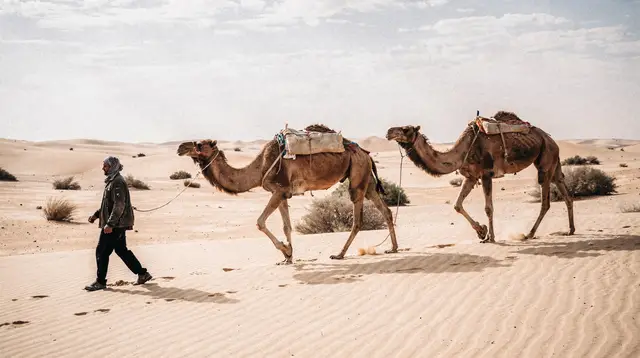
Camel treks are the reason most people build Douz into their route, and the options span a huge range of commitment. At the shortest end, an hour or two on a camel led by a guide gets you into the first dune fields and back before lunch — enough to feel the terrain and take photographs, not enough to feel like an expedition. At the other end, treks of two or three days head deeper into the erg with Bedouin or nomad guides, camping overnight and covering real distance on camelback each day. A shorter option with hotel pickup included suits travellers slotting Douz into a tight loop.
a one-hour quad biking tour into the dunes is a faster alternative for the same terrain if riding a camel for an hour doesn’t appeal, and for a first proper taste of overnight camel travel, a two-day Sahara camel trek is the most commonly booked format. For anyone with more time and a genuine interest in the nomadic route network, a three-day camel trek with nomad guides goes considerably further into the erg and includes at least two nights under canvas. Our camel trekking guide breaks down fitness expectations, what a saddle actually feels like after two hours, and how treks are usually priced.
| Trek length | What it involves | Rough price guide (per person) |
|---|---|---|
| 1 hour | Short ride into the first dunes, guide included, no camping | Around 30-40 TND (9-12 EUR) |
| Half-day / sunset ride | Ride out for sunset over the erg, back by evening | Around 60-90 TND (18-27 EUR) |
| 2 days, 1 night | Ride out, camp overnight in a basic bivouac, ride back | Several hundred TND, varies by operator and group size |
| 3 days, 2 nights | Deeper into the erg with nomad guides, two nights camping | Higher again; usually the top tier most local operators offer |
Quad biking and other ways to see the dunes
Not everyone wants to spend hours on a camel, and quad biking has become the default alternative for a fast, physical dune experience. Tours typically run an hour or two, taking small groups out along marked routes through the nearest dune fields with a guide leading. It’s noisier and less traditional than a camel ride, and it isn’t for anyone hoping for a quiet, contemplative desert experience, but it delivers a genuine adrenaline hit and works well for travellers on a tight schedule who still want to get properly into the sand rather than just viewing it from the road.
a camel ride with hotel pickup and drop-off included is worth considering if you’re staying in town without your own transport and want the logistics handled. Combining a short quad session with a sunset camel ride the same day is a reasonable way to sample both without committing to an overnight camp.
The Douz international festival, if your dates line up
Douz hosts an annual Sahara festival, usually in December, built around horse and camel racing, traditional music, poetry and displays connected to the region’s nomadic heritage — it’s one of the more distinctive cultural events in southern Tunisia and draws visitors from well beyond the local area.
Dates shift from year to year and aren’t fixed years in advance, so treat any specific date you read as provisional and confirm locally or through a tour operator before planning a trip around it. If your visit happens to coincide, it adds a genuine cultural layer beyond the standard camel-and-dunes itinerary; if it doesn’t, don’t rearrange a wider Sahara loop just to try to catch it, since accommodation in Douz gets tight during the festival and prices rise accordingly.
Getting to Douz from Tunis: the honest travel time
This is the detail worth being blunt about: Douz is roughly 500 kilometres from Tunis, and the honest driving time is 7 to 8 hours by car, more by louage once you count waiting for a full vehicle and stops along the way. There’s no direct train service, and flying isn’t a realistic option for this specific leg. Most travellers either drive themselves via Kairouan and Kebili, join an organised multi-day tour that handles the whole route, or take a louage in stages, often breaking the journey in Kairouan or Tozeur rather than attempting it in one push.
Treat Douz as part of a multi-day southern loop, not a place you bolt onto a Tunis-based itinerary as a day trip — the numbers simply don’t work for that. Our comparison of Sahara tours from Tunis lays out realistic day-by-day options, and the louages guide explains how the shared-taxi system works if you’re travelling independently.
Building a Sahara loop: Douz with Tozeur, Matmata and Chott el Jerid
Douz makes far more sense as one stop in a loop than as a destination on its own. The classic route pairs it with Tozeur for its mountain oases and old town brickwork, Matmata for its troglodyte housing and Star Wars filming locations, and a crossing of Chott el Jerid, the vast salt lake between Douz and Tozeur that turns pink and mirror-flat under the right light. A reasonable pace covers this loop in three to four days from Tunis, including the long drive down and back; trying to compress it further usually means arriving everywhere exhausted and leaving with no real time in the desert itself.
Our one-week Tunis and Sahara itinerary sets out a workable version of this route, and the two-day versus three-day Sahara tour guide is useful for deciding how much of the loop to commit to if you’re booking through an operator rather than driving yourself. If Star Wars locations are part of the draw, the filming locations guide covers which sites sit near Matmata and which need a further detour.
A night in the desert: what the camp actually involves
It’s worth being direct about what an overnight camel trek or desert camp is actually like, because marketing photos tend to smooth over the practical reality. Camps range from simple canvas bivouacs with shared facilities to slightly more comfortable fixed tent camps with proper beds, but even the better ones are basic by hotel standards — expect limited or no electricity after dark, shared or minimal washing facilities, and generator power for a few hours at most. The temperature swing is the part most first-timers underestimate: daytime heat can be intense even outside summer, but once the sun goes down the desert cools fast, and nights from November through February can get genuinely cold, close to freezing in the small hours.
Bring proper layers regardless of the season you’re travelling in. On the positive side, the night sky away from any artificial light is exceptional, and sitting around a fire with a nomad guide after a day on camelback is the part most people remember longest, more than the ride itself. Our what to pack for the Sahara guide and desert camps and bivouacs guide go through this in more detail, and our own account of a night in the Sahara is worth reading before you book anything multi-day.
Douz versus Tozeur as your Sahara base
Travellers building a loop often ask whether to base themselves in Douz or Tozeur, since both sit within reach of the desert and the salt lake. They serve slightly different purposes, and picking the wrong one for your priorities can waste a day.
| Douz | Tozeur | |
|---|---|---|
| Strength | Closer to the open dunes and erg; better base for camel treks and quad biking | Better old town, mountain oases, more hotel and restaurant choice |
| Weakness | Fewer dining options, smaller town, less to do beyond desert activities | Dunes and erg require a longer drive out |
| Best for | Travellers prioritising a camel trek or overnight desert camp | Travellers prioritising comfort and a wider range of things to see |
Our dedicated Douz or Tozeur comparison goes into more depth if this is the main decision left in your planning, and the gateway to the Sahara guide covers Douz specifically in more logistical detail than fits on this page.
Frequently asked questions about visiting Douz
How far is Douz from Tunis, realistically?
Around 500 kilometres, which works out to roughly 7-8 hours of driving by car, more by louage once you factor in waiting times and stops. There’s no direct train or practical flight option for this leg, so road travel is the only realistic choice.
Can I do Douz as a day trip from Tunis?
Not sensibly. The round-trip driving time alone approaches 14-16 hours, leaving almost no time in the desert itself. Treat Douz as part of a multi-day southern loop rather than a single-day excursion from the capital.
Do I need to book a camel trek in advance?
Short one-hour rides can usually be arranged locally with little notice, but multi-day treks with nomad guides are worth booking ahead, particularly from November to March when demand is highest and operators have limited camel and guide availability.
Is the Thursday souk worth planning my trip around?
It’s worth timing your visit for if your schedule allows it without major disruption, since it’s a genuine working market rather than a tourist display. If your route doesn’t land on a Thursday, the palm grove and dunes still justify the stop on their own.
How cold does it actually get at night in the desert?
From November through February, overnight temperatures near the dunes can drop close to freezing, even though daytime temperatures may still feel warm. Pack proper layers for any overnight camel trek regardless of how hot the day was.
Is Douz safe to visit?
Yes, in general — southern Tunisia’s tourist areas around Douz see regular, established tour and trek operations. As with any desert activity, the real risks are heat, dehydration and sun exposure rather than personal safety, so treat those seriously, particularly outside the cooler months.
What should I pack specifically for Douz and a desert camp?
Layers for cold nights, a hat and sunglasses for intense daytime sun, closed shoes rather than sandals for camel riding, a scarf or buff against blown sand, and a headtorch, since camps often have limited lighting after dark. Our packing guide for the Sahara covers this in full.
Is Douz better than Ksar Ghilane for a desert experience?
They offer different things. Ksar Ghilane has a hot spring at the edge of the erg and is often reached by a scenic desert track, while Douz has the stronger nomadic town identity, the Thursday souk and generally more established trek operators. Many loops include both rather than choosing one over the other.
How many days should I budget for Douz and the surrounding area?
A half-day covers the town, souk (if timed right) and palm grove without a trek. Add one to two nights if a camel trek, quad biking session and a night camped near the dunes are all part of your plan, which is the version most travellers who make the long drive down actually want.