A night in the Sahara
By the time the sun dropped behind the last ridge of dunes outside Douz, I’d already decided the camel ride in was the highlight, a slow, swaying hour across sand that turned orange and then grey as the light went. I was wrong. The highlight was three hours later, lying on a thin mattress inside a tent with the flap open, looking at a sky with more stars in it than I’d seen in years, cold enough that I’d put on every layer I’d packed and was still counting the hours until the fire got relit for breakfast.
Getting to the edge of the erg
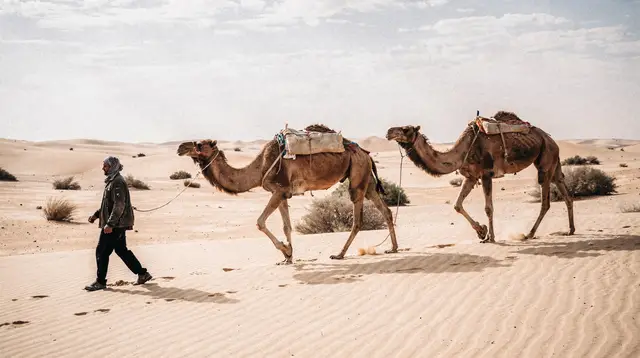
Most overnight Sahara trips out of central and southern Tunisia start from Douz, which markets itself, fairly, as the gateway to the Grand Erg Oriental. The drive down from Tunis is long, the better part of a full day if you’re doing it independently, which is why the long road to Douz is its own kind of experience before you’ve even reached a dune. From Douz itself, the transfer to a bivouac camp is short, sometimes by 4x4, sometimes by camel from a drop-off point a few kilometres out, and it’s this last stretch, not the long drive south, that actually feels like arriving somewhere.
| Stage | How | Roughly how long |
|---|---|---|
| Tunis or Tozeur to Douz | Car, bus or organised transfer | Half a day to a full day |
| Douz to camp drop-off | 4x4 | 20–40 minutes |
| Drop-off to bivouac | Camel or on foot | 45–90 minutes |
What the camp actually looks like
Forget the luxury desert camp images from other countries; a Tunisian bivouac near Douz is usually simpler than that, a cluster of low tents, a communal fire pit, and camp beds or thin mattresses rather than proper furniture. That’s not a complaint, it’s closer to what an overnight desert stay should feel like, and the trade-off is a setup that goes up and comes down easily, leaving almost no trace on the dunes by morning. Desert camps and bivouacs: what a night really looks like covers the range of setups on offer if you want something with a bit more structure, from simple bivouacs to camps with proper tents and a fixed kitchen area.
The cold nobody warns you about
The single biggest surprise of the night was the temperature drop. Daytime highs in the Sahara can be genuinely fierce, but once the sun goes the heat leaves fast, and a February night like the one I had dropped close to freezing by the small hours. What to pack for a night in the Sahara is the single most useful page on this site if you’re planning the same trip, because the camp itself supplies blankets but rarely enough to make up for arriving in a t-shirt and sandals, which is exactly what most people do, having spent the whole day sweating in the afternoon heat further north.
| Time of day | Rough temperature (winter) | What you actually need |
|---|---|---|
| Midday | 20–25°C | Sun protection, water |
| Early evening | 12–16°C | A light layer |
| Overnight | Close to 0–5°C | Thermal layers, a hat, thick socks |
Dinner around the fire
Food at the camp was simple and better than I expected: a tagine cooked slowly over the fire, flatbread baked directly in the coals, sweet mint tea poured from height the way it’s poured everywhere in Tunisia. Nobody rushes this part, and it’s worth not rushing it either, since the meal is really the social centre of the evening, guides and guests eating from the same dishes while the fire is the only light for what feels like a very long way in every direction.
A two-night camp and bivouac adventure in the Sahara is the version of this trip that gives you two full evenings around the fire rather than one, which matters more than it sounds, since the first night is partly spent adjusting to how dark and how cold it actually gets.
The silence, and then the stars
I’ve been in quiet places before, but nothing prepared me for the specific quality of silence once the camp settled down and the last conversations trailed off. No traffic, no generators running nearby, nothing but the occasional shift of sand in the wind. Lying back and looking up, the Milky Way was visible as an actual band across the sky rather than the vague suggestion of it you get from anywhere with real light pollution. It’s the kind of thing photographs never quite capture and the main reason, more than the camel ride or the dunes themselves, that I’d tell someone to do this.
Sleep, honestly
I’ll be direct: I did not sleep well. The ground is uneven under even a good mattress, the cold works its way in regardless of how many blankets you’ve been handed, and camp noise, however minimal, carries further than you’d expect in that kind of silence. This isn’t a five-star night’s rest, and anyone expecting one should adjust their expectations before booking. What you’re trading comfortable sleep for is an experience you won’t get any other way, and for most people that trade is worth making once.
Other ways to do the same night
Not every overnight Sahara trip starts from Douz. A two-day, one-night Sahara excursion departing from Mahdia covers the same style of camp for visitors based further up the coast, with the transfer built into the price rather than arranged separately. And a two-day Sahara tour with meals and a night in a tent is close to the version I did myself, useful if you’d rather have the tent and meals sorted as a single package instead of piecing the trip together stage by stage.
Around Douz, before and after
Douz itself is worth an afternoon before you head into the dunes, its Thursday market genuinely busy with locals rather than staged for visitors, and Douz, the gateway to the Tunisian Sahara covers what else the town offers if you’ve got time either side of the camp.
Further west, Tozeur and the mountain oases make a natural extension if you’re not simply doing a there-and-back trip from Tunis, and Chott el Jerid, the great salt lake between the two, is worth the detour on the drive between them; crossing Chott el Jerid covers what to expect.
If your route runs through Matmata as well, Matmata and its troglodyte houses and the Star Wars filming locations in southern Tunisia are both worth a stop on the way down.
Deciding how long to spend down south
One night in the desert is enough to get the core of the experience, but it isn’t much time once you subtract the long drive south and back. Two days or three days: which Sahara tour to book and Sahara tours from Tunis, compared both cover how the maths works out depending on how much of the rest of Tunisia you want to see, and one week: Tunis and the Sahara is the itinerary I’d actually recommend if the Sahara is the main reason you’re coming.
Mistakes to avoid
Frequently asked questions about camping overnight in the Sahara
How cold does it actually get at night in the Sahara?
In winter, overnight temperatures can drop close to freezing even after a warm day, which surprises most first-time visitors. Layered clothing and a hat make a bigger difference than an extra blanket.
Do I need to be an experienced camel rider?
No. The camel transfer to camp is led by a guide at a slow, steady pace; no prior riding experience is expected or needed.
Is there a toilet or shower at the camp?
Facilities are basic, usually a simple latrine tent rather than plumbing. It’s worth knowing this in advance rather than expecting camp bathroom facilities.
What should I actually pack?
Warm layers for overnight, a headtorch, sun protection for the daytime portion, and anything you can’t sleep without, since the camp’s own supplies are minimal by design.
Is one night enough, or should I book two?
One night covers the core experience but feels short once you factor in the drive south and back. Two nights gives a more settled, less rushed feel to the trip.
Can children do an overnight Sahara camp?
Older children generally manage well; the main considerations are the cold overnight and the length of the camel or 4x4 transfer, both worth checking against a specific child’s tolerance before booking.
Is it safe to camp out in the desert like this?
Yes, organised bivouac camps run this route regularly with experienced guides, and it’s a well-established part of southern Tunisia’s tourism. It isn’t a wilderness survival trip.
Where do most overnight Sahara trips depart from?
Douz is the most common departure point for camps near the Grand Erg Oriental, though trips also run from Tozeur, Matmata and coastal towns further north with the transfer included.
Sahara desert tours on GetYourGuide
Verified deep-linked GetYourGuide tours. Book through these links and we earn a small commission at no cost to you.
These are our own photographs of Tunisia, not the operator's pictures of this tour — open the tour page to see those.