Carthage is not what you expect
I’d built up an image of Carthage from the name alone — Hannibal, the wars with Rome, a city so significant it needed to be levelled and salted, according to the legend, before its rival felt secure. What I found on the ground was a scattered handful of excavated pockets inside a comfortable modern suburb of villas and embassies, connected by a commuter train, with no single dramatic set piece to anchor the whole story. It took me most of a day and a fair bit of recalibration to appreciate what Carthage actually is rather than resent what it isn’t.
What I was expecting, and why it was wrong
The mistake was importing an image of Rome or Pompeii — vast, continuous, walkable as one site — onto a city whose visible Roman-era remains are fragments scattered across roughly two kilometres of the modern suburb of Carthage, itself now a wealthy residential district of greater Tunis.
Add to that the fact that most of Carthage’s original Punic city, the one Hannibal actually knew, was systematically destroyed by Rome in 146 BC and then built over by the Romans themselves a century later, and you end up with a site that is genuinely one of the most historically important places on the Mediterranean and also, visually, quite modest in several of its individual pockets. Neither fact cancels the other out, but arriving expecting the first without warning about the second sets you up to be disappointed by something that doesn’t deserve it.
| Where | Across Carthage’s archaeological zone, north-east of Tunis, along the TGM line |
| Cost | Multi-site ticket around 12 TND (roughly €3.50), covers most included sites |
| Time needed | A full morning for the highlights; half a day to see everything unhurried |
| Getting there | TGM train from Tunis Marine to Carthage-Hannibal or Carthage-Salammbô |
| Best time | Morning, before the exposed sites get hot and the light gets flat |
Byrsa hill: the best single view, and the least visually dramatic ruin
Byrsa hill is where I’d recommend starting, not because the Punic and early Roman remains at its summit are visually spectacular — they mostly aren’t, low foundation walls and a scatter of column bases — but because the hill gives you the only vantage point that actually explains Carthage’s layout as a whole.
From the terrace beside the Carthage national museum you can see the bay, the harbour area below, and the rough spread of the other sites across the suburb, which does more to orient a confused first-time visitor than any map. The museum itself, small and a little dated compared to the Bardo, holds Punic-era funerary items and mosaics that are worth twenty minutes without needing much longer. The Byrsa hill and Carthage national museum guide covers this stop in more detail.
The Antonine baths: the one site that does deliver scale
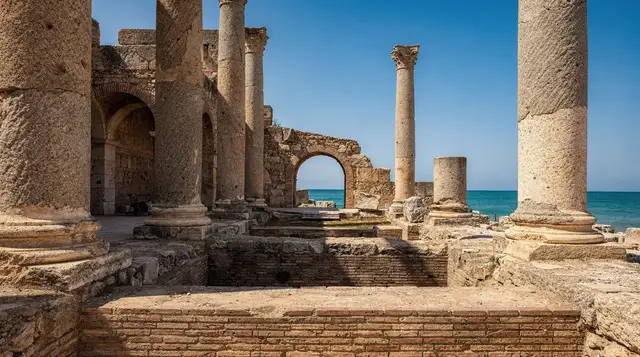
If Byrsa manages expectations downward, the Antonine baths do the opposite. Once among the largest bath complexes in the Roman world, what remains is a genuinely impressive set of foundations and towering column fragments right at the water’s edge, giving a real sense of the structure’s original scale even with most of the upper floors long gone.
This was the site that made the visit click for me — standing among column bases taller than I am, looking out at the same stretch of coast the Romans would have, was the closest Carthage gets to the single dramatic moment I’d been expecting from the name alone. The Antonine baths guide and the Carthage destination page both go into the wider suburb’s layout beyond this one site.
| Carthage site | What’s actually there | Matched my expectations? |
|---|---|---|
| Byrsa hill and museum | Foundation walls, best panoramic view, small museum | No — modest, but valuable for orientation |
| Antonine baths | Massive column fragments, clear sense of scale | Yes — the closest to what I’d pictured |
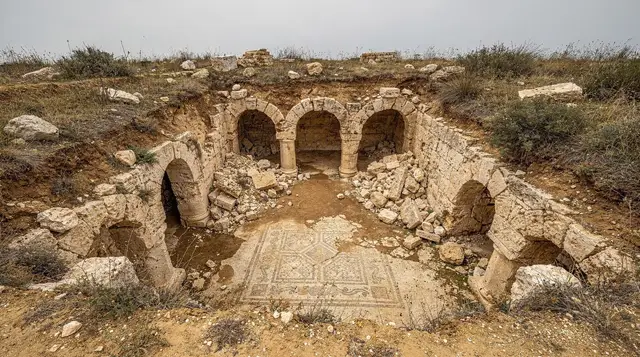
| Roman theatre and villas | Restored theatre (still used for events), scattered villa foundations | Partly — smaller than expected |
| Punic ports | Two circular harbour basins, now mostly silted and residential | No — needs real imagination to read |
The Roman theatre and the Punic ports: reading absence
The Roman theatre has been restored enough to still host performances during the Carthage international festival, which gives it a strange double life — genuine ancient structure, still functionally used, rather than a pure museum piece. It’s smaller than I’d pictured, closer in scale to a local venue than a grand imperial one, though that’s partly because so much of the original stone was quarried away for other buildings over the centuries, a fate common to a lot of Carthage’s ruins.
The Punic ports asked the most of my imagination and rewarded it the least in the moment, though they’ve stuck with me since. Two roughly circular basins, now mostly silted, ringed by ordinary suburban houses, are what remains of what was once a sophisticated dual harbour — a commercial port and a separate, more secretive naval basin capable of sheltering over a hundred warships out of sight of the open sea. Standing there, it’s genuinely difficult to picture that scale of maritime power, and I’ll admit I found the ports underwhelming on the day, in a way I only later understood as a failure of my own imagination rather than a failure of the site.
Piecing it together: why Carthage rewards patience over spectacle
By the time I’d covered Byrsa, the baths, the theatre and the ports, moving between them by TGM and on foot, I’d stopped waiting for a single unifying “wow” moment and started appreciating the site for what it actually is: a fragmented but genuinely rich record of two civilisations that both mattered enormously and left correspondingly patchy physical traces after nearly two thousand years and two rounds of large-scale destruction and rebuilding.
The complete visitor guide to the Carthage archaeological sites and the Carthage multi-site ticket guide both go into more logistical detail than a personal account like this one needs, including which stations serve which ruin, which I didn’t fully work out until my second visit.
For visitors who want the version of Carthage that does deliver a single striking set piece without the fragmentation, Dougga, the best-preserved Roman town in North Africa is the site to compare it against, and I found the two visits genuinely complementary rather than repetitive — Carthage for the history, Dougga for the visual payoff.
If you’d rather have context supplied as you go rather than piecing it together from guides afterward, a full-day Kairouan and El Jem guided tour with lunch gives a sense of how a guide narrates Tunisia’s Roman-era sites when the ruins themselves don’t do all the explaining on their own.
Beyond Carthage: where the “wow” moment actually is
If Carthage leaves you wanting the single dramatic ruin it doesn’t quite deliver on its own, it’s worth knowing that Tunisia has it elsewhere, and not far. El Djem’s amphitheatre, a few hours south, is the site that delivers instant, unambiguous scale the moment you walk in — one of the best-preserved Roman amphitheatres anywhere, no imagination required. A Kairouan, El Jem and Monastir historical treasures tour pairs that with Kairouan’s very different, Islamic-era monumental architecture, which makes for a useful contrast to a morning spent parsing Punic foundation walls.
For a longer, quieter alternative further from the coach-tour circuit, a two-day tour of Le Kef, Kesra and Makthar covers Roman sites that see a fraction of Carthage’s visitor numbers and, partly for that reason, feel considerably more atmospheric to walk through unhurried. See the Roman sites near Tunis, ranked by what you actually see guide before deciding where to go next.
Frequently asked questions about visiting Carthage
Is Carthage worth visiting if the ruins are as scattered as this account suggests?
Yes, but for historical significance more than visual spectacle. If you want a single dramatic ruin, prioritise El Djem or Dougga and treat Carthage as complementary rather than the main event.
Which single Carthage site should I not skip if I’m short on time?
The Antonine baths, without much competition — it’s the one stop that delivers a genuine sense of Roman-era scale that the other sites mostly don’t.
How do I get between the different Carthage sites?
The TGM train connects several stations close to different parts of the site — Carthage-Salammbô, Carthage-Byrsa, Carthage-Hannibal and Carthage-Présidence each serve a different cluster of ruins, detailed in the TGM guide.
Is the Carthage multi-site ticket worth buying, or should I pick one or two sites?
Worth buying if you’re seeing more than one site, which most visitors do — it costs roughly the same as two individual entries and covers the core sites in one pass.
Does Carthage pair well with Sidi Bou Said in a single day?
Yes, and it’s the most common pairing — both sit along the same TGM line, and combining them is covered in the Carthage and Sidi Bou Said in a day guide.
What’s actually left of the original Punic city Hannibal knew?
Very little above ground — Rome’s destruction in 146 BC and subsequent Roman rebuilding erased most of it. The Punic ports and some material in the Byrsa museum are among the clearest surviving traces.
Is the Bardo museum part of a Carthage visit?
Not physically — it’s a separate museum elsewhere in Tunis and needs its own ticket, though many of its best Roman mosaics were found at Carthage. See the Bardo museum complete guide.
How does Carthage compare to Dougga for a first-time visitor?
Dougga delivers a more immediately impressive, better-preserved single site; Carthage delivers more historical weight spread more thinly. The Carthage or Dougga? comparison covers this directly.
Is a guided tour worth it, or is Carthage fine to see independently?
Independent visits work fine with a good guide article in hand, but a guide adds real value here specifically, since the fragmented sites benefit more than most from someone filling in the connective history as you walk.
Roman & Punic site tours on GetYourGuide
Verified deep-linked GetYourGuide tours. Book through these links and we earn a small commission at no cost to you.
These are our own photographs of Tunisia, not the operator's pictures of this tour — open the tour page to see those.