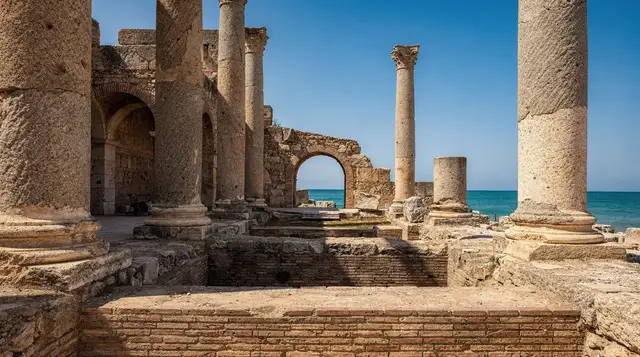
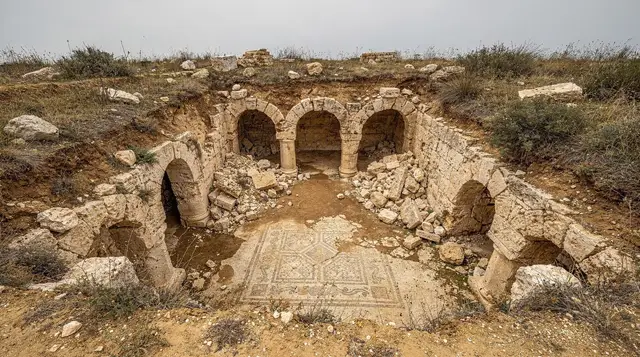
Dougga at eight in the morning
The gate at Dougga opens at eight, and for the first forty minutes or so, the site belongs almost entirely to whoever got there early. No coach groups yet, no guides projecting over each other near the theatre, just wind, birdsong, and about sixty-five hectares of the best-preserved Roman town in North Africa with hardly anyone standing in it. I’ve been back at other hours since, and none of them compare.
| Where | Dougga, around 110 km south-west of Tunis, near Teboursouk |
| Cost | Site entry typically 12 TND, plus a small camera fee |
| Time needed | 2 to 3 hours for a proper visit, longer for photography |
| Getting there | Around 2 hours’ drive from Tunis, usually combined with Testour or Thuburbo Majus |
| Best time | Early morning for light and quiet; October to April for comfortable walking |
What arriving that early actually gets you
The practical case for an early start is straightforward: coach tours from Tunis and Hammamet tend to arrive between ten and noon, and Dougga’s paths and the Capitol steps in particular get crowded fast once they do. Getting there at opening buys roughly ninety minutes of quiet before that happens, which on a site this size — sixty-five hectares, much of it walkable — means you can genuinely have entire streets to yourself.
The theatre, which seats around thirty-five hundred and still gets used for performances during the Carthage international festival, is the single best argument for the early start. Standing in the centre of it with no one else there is a different experience than sharing it with forty people and a guide’s amplified voice.
There’s a photography case too, separate from the crowd logic. Early light comes in low and warm across the ruins, picking out the texture of the stone in a way that flat midday sun doesn’t. By eleven the light has gone hard and the shadows have shrunk to nothing useful. If photographs matter to your trip, this alone justifies the alarm clock.
What Dougga actually contains
Dougga isn’t a single monument but an entire town, largely intact in outline: a Capitol with three surviving columns and pediment, a well-preserved theatre, a forum, temples to several deities, public latrines that still make visitors laugh, and residential quarters spreading down the hillside. It earned UNESCO status specifically because so much of the town survives together rather than as isolated fragments, which is unusual for Roman North Africa. The complete guide to Dougga covers the layout and the must-not-miss corners in far more depth than a single visit can absorb.
Compared with the other major Roman sites within reach of Tunis, Dougga tends to win on completeness rather than any single spectacular structure — El Djem’s amphitheatre is more dramatic in isolation, but Dougga gives you a whole functioning town to walk through. The ranking of Roman sites near Tunis makes the comparison directly, and the specific Carthage versus Dougga question comes up often enough to deserve its own answer.
The walk from the gate to the theatre
| Landmark | Distance from entrance | Note |
|---|---|---|
| The Capitol | Around 400 m, uphill | The most photographed structure on site |
| The theatre | Around 500 m | Best experienced early, before groups arrive |
| The Licinian baths | Around 600 m | Extensive, easy to underestimate the scale |
| The residential quarter | Spread across the lower slopes | Least visited part of the site, worth the extra walk |
The site slopes noticeably, and the walk from the entrance up toward the Capitol and theatre is uphill the whole way, which matters in the heat of a Tunisian summer far more than it does on a cool spring morning. Good shoes are not optional here; the paths are uneven stone in places, and several of the more interesting corners require a bit of scrambling over low walls.
Pairing Dougga with the rest of the region
Most visitors don’t come to Dougga alone. It sits close enough to Testour, with its distinctive Andalusian-influenced architecture and octagonal minaret, that the two combine naturally into one day. A Dougga and Testour cultural tour covers both without requiring you to arrange transport between them separately, and it’s the option I’d point a first-time visitor toward if a full day is available.
For travellers with slightly less time, a half-day Dougga tour from Tunis focuses on the site itself without the Testour detour, which suits anyone short on time or already planning a separate day for the Medjerda valley. Travellers who want to see more of the Roman interior in one go might prefer a day trip combining Dougga and Bulla Regia, pairing Dougga’s above-ground grandeur with Bulla Regia’s underground villas, a genuinely different way Roman settlers here adapted to the local climate.
Zaghouan, with its Roman water temple, sits within reach of the same general route, and travellers building a longer Roman-themed trip should look at the five-day Roman Tunisia itinerary, which strings several of these sites together properly rather than rushing each one.
What most visitors miss
The residential quarter on the lower slopes gets a fraction of the visitors that the Capitol and theatre do, mostly because it requires walking further and offers less obviously photogenic architecture. But it’s where the texture of actual daily Roman life in this town shows most clearly — narrow streets, house foundations, the layout of a settlement rather than its monuments. Anyone with the ninety extra minutes an early start provides should use at least twenty of them down there rather than only at the top of the site. For broader context on how this fits into Tunisia’s longer history, the Tunisian history timeline is worth a read before or after the visit.
Frequently asked questions about visiting Dougga
What time does Dougga open?
The site opens at eight in the morning, and arriving right at opening is the best way to see it without coach group crowds.
How long should I plan for a Dougga visit?
Two to three hours for a thorough visit, longer if photography or the residential quarter interest you specifically.
Is Dougga worth visiting if I’ve already seen Carthage?
Yes — Dougga and Carthage offer genuinely different things. Carthage is coastal, fragmented and Punic-then-Roman; Dougga is inland, largely intact, and purely Roman in what survives.
Can I visit Dougga without a car?
Most independent travellers join an organised tour from Tunis, since public transport options to the site itself are limited. A private driver is the other realistic option.
Is Dougga combined with other sites on a typical day trip?
Yes, most commonly with Testour, sometimes with Bulla Regia or Thuburbo Majus for travellers focused specifically on Roman archaeology.
Is the walk around Dougga difficult?
The site slopes uphill from the entrance and the paths are uneven stone in places, so reasonable fitness and proper shoes help considerably.
Is there shade or anywhere to buy water on site?
Very little shade and no reliable vendors inside, so bring water and sun protection, particularly for a visit outside the cooler months.
Roman & Punic site tours on GetYourGuide
Verified deep-linked GetYourGuide tours. Book through these links and we earn a small commission at no cost to you.
These are our own photographs of Tunisia, not the operator's pictures of this tour — open the tour page to see those.