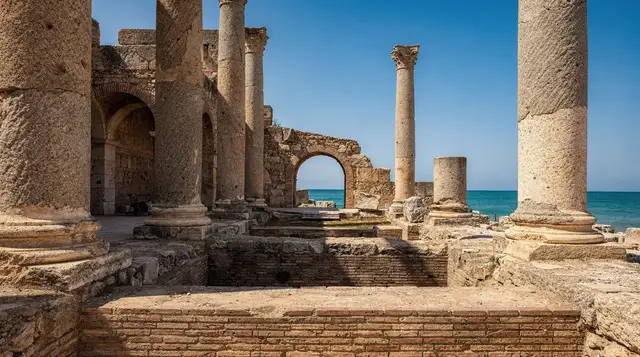
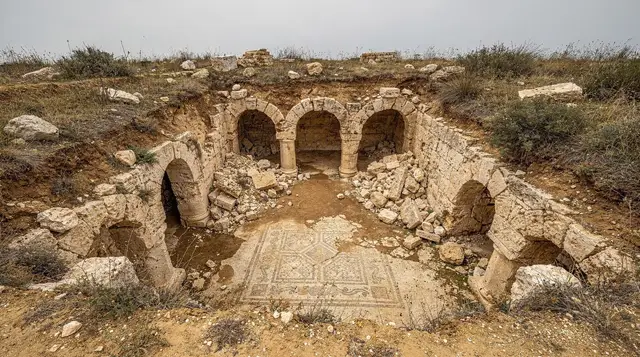
Most Roman sites in Tunisia are read from above: you look down at a mosaic lifted onto a museum wall, or across a field of stone foundations and reconstruct the rooms in your head. Bulla Regia is different, and it is the reason people who have already seen Dougga or Carthage still make the extra drive out here. The town’s richer residents built the lower floor of their houses partly underground, both for coolness in summer and, some archaeologists think, as a status marker in itself, and several of those sunken rooms survive with their mosaic floors still in the ground where they were laid. You climb down a set of stone steps into an actual room, not a diagram of one.
| Where | Near Jendouba, north-west Tunisia |
| Cost | Entry around 8-11 TND per person |
| Time needed | 1.5-2 hours on site |
| Getting there | Car or organised tour from Tunis, around 160 km |
| Best time | Morning, especially outside summer, and avoiding the midday heat below ground |
The underground villas, and why they exist
The best-preserved of these sunken houses is usually called the House of the Hunt, named for a mosaic showing a hunting scene, and the House of Amphitrite, where a mosaic of the sea goddess riding a sea creature is still in place on the floor of an underground room. Walking down into these spaces is genuinely different from anything else on a typical Tunisia itinerary: the temperature drops noticeably as you descend, which makes the original logic of the design obvious within seconds.
Guides on-site, where you use one, generally explain that these lower floors likely served as summer living quarters, with the family moving between levels as the seasons changed, in the same way a modern building might switch between rooms with and without air conditioning.
Above ground, Bulla Regia has the more conventional Roman layout: a forum, a basilica, public baths with sections of hypocaust flooring visible, and a small theatre built into a natural slope. None of it matches Dougga for sheer scale or the drama of its hilltop setting, and that comparison is worth being honest about upfront. What Bulla Regia has that Dougga does not is the underground houses, and for many visitors that single feature justifies the detour on its own. The roman carthage things-to-do hub groups this site with the other major Roman ruins across the country if you are planning which ones to prioritise.
How to pace your visit
A good way to approach the site is to treat the underground houses as the centrepiece and the rest as context. Start with the sunken villas while you are fresh and the light is good, then walk the above-ground ruins at your own speed. Seeing the forum, the baths and the theatre second makes more sense than the reverse, because by then you already understand how wealthy families lived and can picture who used the public buildings.
Take your time in the underground rooms rather than treating them as a quick photo stop. Look at how the vaulted ceilings carry the weight of the floor above, how light reaches the lower rooms, and how the mosaics were laid to be seen from the spot where the household would have sat. Those details are what separate a rewarding visit from a rushed one. If you want a fuller walk-through of the houses themselves, the Bulla Regia underground villas guide covers them room by room.
Photographers should note that the underground spaces are dim and the above-ground ruins are bright, so the two settings ask for different habits. A steady hand and a little patience go further than any equipment. For a wider view of how this site fits among the country’s other ancient cities, the Roman Tunisia itinerary and the UNESCO Tunisia itinerary both place it in a longer route.
Getting to Bulla Regia from Tunis
Bulla Regia sits close to Jendouba, roughly 160 km from Tunis by road, generally around two and a half hours by car via Béja. There is no practical public transport link that goes directly to the site itself; a rental car, a private driver or an organised tour are the realistic options. Most visitors combine it with Dougga, which sits roughly 60-70 km back towards Tunis on the same general route, making a single long day trip that covers two of the country’s most significant Roman sites.
| Option | Approx. time from Tunis | Notes |
|---|---|---|
| Private car / rental | 2.5 hours | Most flexible; easy to combine with Dougga on the same day |
| Organised day tour | Full day | Almost always paired with Dougga, sometimes also Testour |
| Louage + local taxi | 3+ hours, with a change | Involves reaching Jendouba then arranging onward transport; not straightforward |
| Guided private tour | Full day | Better for travellers who want context on-site rather than reading panels alone |
Jendouba itself has a train station on the line from Tunis, but the site sits a short distance outside town, and travellers arriving by rail generally still need a taxi for the final stretch. In practice, almost everyone who visits Bulla Regia arrives by road, either self-driving or on an organised trip.
What to actually expect on-site
The site is spread out and only partly shaded, so bring water and a hat even in cooler months; the underground rooms are pleasantly cool, but the walk between them across open ground is not. Signage is present but sparse compared to more heavily visited sites, which is part of why a guide adds real value here rather than being a nice-to-have.
Descending into the underground rooms involves stone steps that can be uneven and occasionally slippery after rain, worth knowing if mobility is a concern. The mosaics that remain in place are protected but not roped off at a great distance, so you can get genuinely close, closer than you would to most museum-held pieces, which is both the appeal and the reason visitors are asked not to touch the surfaces.
From Tunis: Dougga and Bulla Regia day trip is the standard way most visitors see the site, pairing it with Dougga in a single long day so the drive is only made once. For a smaller-group or private version, Testour, Dougga and Bulla Regia private day trip also takes in Testour and covers the same ground at a more flexible pace, useful if you want longer at the underground villas than a fixed-group itinerary allows.
Testour and Dougga as natural companions
Because of where Bulla Regia sits, almost nobody visits it in isolation. Testour, the small Andalusian-founded town roughly halfway back towards Tunis, makes a natural lunch stop, and Dougga, generally considered the best-preserved Roman town in North Africa, is close enough to combine on the same day without an unreasonable amount of driving.
The Dougga complete guide and the Bulla Regia underground villas guide both go into more depth on each site individually if you are planning the day stop by stop, and the roman sites near Tunis, ranked guide is a useful reference if you are trying to decide how many Roman sites is too many for one trip.
If you are building a longer Roman-themed route rather than a single day, the Roman Tunisia in five days itinerary and the Thuburbo Majus and Uthina (Oudhna) guides cover the other major sites south of Tunis that pair naturally with Bulla Regia and Dougga.
Choosing between a tour and driving yourself
Both approaches work, and the right one depends on how you like to travel. Driving gives you control over timing, so you can arrive early and stay as long as you like among the villas. It also lets you stop in the Medjerda valley without a fixed schedule. The trade-off is the road itself, which is long and calls for concentration; the driving in Tunisia guide and the car hire in Tunisia guide explain what to expect behind the wheel.
An organised trip removes the logistics and usually adds a guide, which matters at a site with sparse signage. If you would rather not choose the route yourself, a guided day combining both Roman sites with a lunch stop keeps the day simple. Travellers deciding between a shared and a tailored day can read the private vs group tours guide before booking.
Who will enjoy it most
Bulla Regia suits people who like to understand how ordinary Romans lived, not only how their cities looked from the outside. It is also a good choice for anyone put off by crowds, since the site tends to feel calm and unhurried. Families, curious teenagers and anyone who enjoys exploring physically rather than reading panels will find the sunken rooms memorable. Travellers short on time, or those who would like a single Roman site to anchor a trip, may prefer to read the Dougga day trip guide or compare the options in the best day trips from Tunis before deciding.
If you are weighing the two big northern sites against each other, the Carthage vs Dougga comparison helps frame what each place does best, and the blog account of Dougga at eight in the morning gives a personal sense of what an early start feels like on the road to this part of the country.
Practical details and opening times
Like most Institut National du Patrimoine sites in Tunisia, opening hours shift with the season, running roughly from mid-morning to early evening in summer and closing earlier in winter, generally somewhere around 5.30pm. There is no reliable food service on-site, so plan to eat in Jendouba or, more commonly, save lunch for Testour on the way back.
Toilets and a small ticket office are present at the entrance, but do not expect facilities beyond the basics. The best time to visit tool and the day trips hub are useful starting points if you are still sketching out the wider route this fits into, and travellers starting from Tunis itself will find the drive out here one of the longer single-site excursions covered on this site.
Frequently asked questions about visiting Bulla Regia
How much does entry to Bulla Regia cost?
Typically somewhere around 8-11 TND per person for the site, though prices for archaeological sites in Tunisia are periodically revised, so treat this as an order of magnitude rather than a fixed number and check current pricing locally.
Can you actually go down into the underground rooms?
Yes, the underground sections of the House of the Hunt and the House of Amphitrite are open to visitors and accessed by stone stairs. This is the main reason to visit and should not be missed once you are on-site.
How does Bulla Regia compare to Dougga?
Dougga is larger, better preserved overall, and sits in a more dramatic hilltop position. Bulla Regia’s distinguishing feature is its underground villas with mosaics still in place, which Dougga does not have in the same way.
Is Bulla Regia suitable for children?
The underground rooms tend to be a hit with children precisely because they are unusual and physically explorable, though the uneven stone stairs and open, unshaded ground elsewhere call for some supervision.
Do I need a guide to appreciate the site?
Not strictly, but on-site signage is limited, and a guide adds real context about the underground villas and the site’s history that is otherwise easy to miss walking around alone.
Is there anywhere to buy food or water on-site?
No reliable food service exists at the site itself. Bring water, and plan to eat either in Jendouba or, more commonly, in Testour on the way back towards Tunis.
How long should I budget for the visit?
Around 1.5 to 2 hours is typical for a thorough look at both the underground villas and the above-ground ruins, longer if you linger over the mosaics or bring a guide who explains each area in detail.
Is Bulla Regia included in most guided Tunisia tours?
It is usually paired with Dougga as a single day trip from Tunis rather than sold as a standalone excursion, since the two sites share most of the drive and complement each other well.