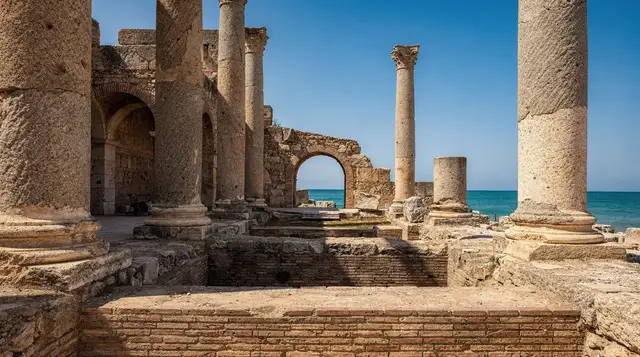
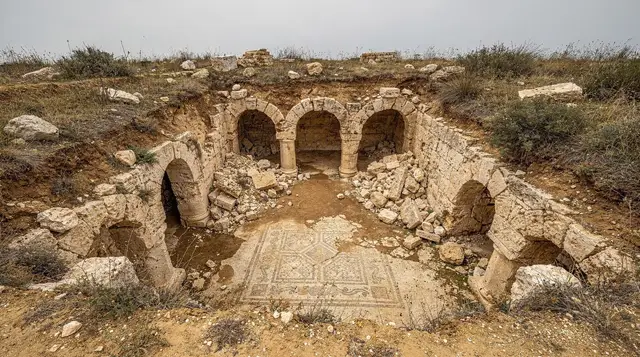
Zaghouan is a small town built into the base of a limestone mountain, and its Roman-era importance came down to a single practical fact: a reliable spring rises here, and the Romans needed water in Carthage. Around 129 AD, under the emperor Hadrian, they built a temple sanctuary directly over the spring and an aqueduct running roughly 130 km to carry the water to the city, one of the longer engineered water routes anywhere in the Roman world. What remains today is a genuinely striking small site, a semicircular colonnaded court built into the hillside, quieter and less visited than Dougga or Carthage, and easy to combine with a walk on the mountain rising directly behind it.
| Where | Roughly 60 km south of Tunis |
| Cost | Temple entry typically around 5-8 TND |
| Time needed | 1-1.5 hours for the temple, a half or full day with hiking added |
| Getting there | Car or organised tour, around an hour from Tunis |
| Best time | Cooler months for hiking; the temple itself is pleasant year-round |
The water temple, and the aqueduct it fed
The temple’s design is unusual among Roman ruins in Tunisia: a curved colonnade wraps around a court built directly against the rock where the spring emerges, with niches that likely held statues of water nymphs, a common motif for Roman shrines built over natural springs.
Water from here was carried by aqueduct across a substantial distance to Carthage, and sections of that aqueduct’s arches are still visible at points along the modern road between Zaghouan and Tunis, most famously near the town of Oudhna and again closer to the capital. The roman carthage things-to-do hub groups Zaghouan with the country’s other major Roman sites, useful context if you are still deciding how many to fit into your trip out of Tunis.
Seeing the temple and a stretch of surviving aqueduct arches together gives a clearer sense of the engineering scale than either does alone, which is part of why organised itineraries usually combine Zaghouan with a stop at Oudhna’s own Roman ruins.
The site is compact compared with Dougga or Bulla Regia, and that is worth setting expectations around: this is not a half-day wander through a full Roman town, but a focused, atmospheric single monument that rewards maybe an hour of unhurried attention rather than an extended visit.
Jebel Zaghouan and hiking above the temple
The mountain rising behind the temple, Jebel Zaghouan, reaches just over 1,200 metres and is a genuine hiking destination in its own right, popular with day-trippers from Tunis on weekends, particularly outside the summer heat. Trails climb through pine and scrubland with views back over the plain towards Tunis and, on a clear day, out towards the Gulf of Tunis. None of the routes are technical, but they do require reasonable fitness and proper footwear; this is a real mountain walk, not a stroll.
Starting early is worth it both for cooler temperatures and to avoid finishing a hike in fading light, since the mountain’s paths are not lit or maintained to a standard you would want to navigate after dark. The packing list tool is a useful check before setting out, since proper hiking shoes are easy to forget when the rest of a Tunisia trip needs little more than sandals.
Getting to Zaghouan from Tunis
Zaghouan is one of the closer destinations on this site to the capital, roughly 60 km away, generally around an hour by car depending on traffic through the southern suburbs of Tunis. It is close enough to combine comfortably with Oudhna’s Roman ruins on the same route, and organised day tours typically do exactly that.
| Option | Approx. time from Tunis | Notes |
|---|---|---|
| Private car / rental | About 1 hour | Straightforward drive, mostly on good roads |
| Louage from Tunis | 1-1.25 hours | Reasonably frequent given the short distance |
| Organised day tour | Half or full day | Usually combined with Oudhna and sometimes Thuburbo Majus |
| Bus | Available but slower | Louage is generally the more practical public option |
Private Roman tour: Oudhna, Zaghouan and Thuburbo Majus covers the water temple alongside two other Roman sites on the same general route south of Tunis, a sensible pairing given how close together they sit. If you would rather keep the day simpler and focused mainly on the temple and aqueduct itself, From Tunis: Oudhna and Zaghouan aqueduct excursion is a shorter, more focused option.
The town below the mountain
Zaghouan town itself grew up around the water source long before the Romans arrived, and it kept its importance through the Ottoman period as a garrison and administrative post controlling the road south from Tunis. A small kasbah and a scattering of Ottoman-era buildings survive in the older part of town, modest compared with the grander examples elsewhere in the country but worth a short walk if you have time before or after the temple.
Local production of olive oil and, in some areas, small-scale sheep farming still shapes the surrounding countryside, and it is common to pass roadside stalls selling oil, honey or dried herbs on the drive in from Tunis, generally a better and cheaper source than anything sold near the main tourist sites further afield.
Weekend mornings bring a modest local market to the town centre, selling produce, household goods and some craft items, a useful stop if your visit happens to coincide with it, though it is not sized or curated for tourists the way markets in Nabeul or Kairouan are. The overall pace here is unhurried, closer to a regional market town than a destination built around visitors, and that ordinary, working character is part of what makes Zaghouan a pleasant half-day away from the more heavily visited sites closer to Tunis.
Why Zaghouan suits travellers who already know the big sites
Many visitors arrive in Tunisia with Carthage, the Bardo and Dougga at the top of the list, and Zaghouan makes the most sense as the quieter complement to those. After a morning among the crowds at the larger monuments, a small temple set against a mountainside feels almost private, and it explains something the big sites only hint at: how a Roman city of that size kept itself supplied with water. If you have already read the Roman sites near Tunis ranked guide, you will recognise Zaghouan as the one that tells the engineering story rather than the urban one.
It also helps with pacing. A trip built entirely around major archaeological sites can become repetitive, and a day that mixes a Roman monument, a mountain walk and an ordinary regional town breaks that rhythm. Anyone choosing between longer excursions can compare it with the other options in best day trips from Tunis, and families can look at family day trips from Tunis to see whether the walking involved suits younger children.
Planning the day around the temple
A workable rhythm is to reach the temple early, spend unhurried time with the colonnade and the spring, and only then decide whether to head up the mountain or on to another site. Taking in the temple first has a practical advantage: it is the part of the day least affected by heat, and it gives you a clear idea of how you feel before committing to a climb.
Think of the aqueduct as the thread connecting the stops. Standing at the spring, then later looking at arches that carried the same water across the countryside, turns separate monuments into one story. The Zaghouan and Thuburbo Majus day trip guide lays out that sequence in practical terms, and the Uthina guide explains what to look for at the aqueduct’s other end of the route.
If you prefer not to drive, a guided day removes the logistics of parking and route-finding, and a day tour covering Oudhna, Zaghouan and Thuburbo Majus is one way to see all three without handling transport yourself, while the private vs group tours in Tunisia guide helps you decide which format suits your group. Those driving themselves should read driving in Tunisia and car hire in Tunisia beforehand, and anyone relying on shared transport will find louages explained useful.
Fitting Zaghouan into a longer stay
Zaghouan works best as a half-day inside a stay of several days rather than a headline attraction. The Tunis in three days and Tunis in five days itineraries leave room for a short excursion like this, and the UNESCO Tunisia itinerary shows how it sits alongside the country’s better-known heritage sites. For help choosing how long to stay overall, see how many days in Tunis, and for the season that suits your plans, the best time to visit Tunis guide covers the year as a whole.
Combining Zaghouan with Thuburbo Majus and Oudhna
The area south of Tunis has a cluster of Roman sites close enough together to combine sensibly in a single day: Oudhna’s amphitheatre and baths, Zaghouan’s water temple, and Thuburbo Majus, a quieter Roman city with its own well-preserved forum and capitol, all sit within a fairly compact radius. The Uthina (Oudhna) and its Roman amphitheatre and Thuburbo Majus: the quiet Roman city near Tunis guides go into each site individually, and the Zaghouan water temple guide covers the temple in more depth than fits naturally on this page.
For hikers specifically, Climbing Jebel Zaghouan covers routes and practical trail advice, and the Roman Tunisia in five days itinerary shows how Zaghouan fits into a longer Roman-focused route alongside Dougga and Bulla Regia. The day trips hub is a good starting point for shorter alternatives if a full Roman circuit is more than your schedule allows.
Practical notes
The temple site has minimal shade, so a hat and water are worth bringing even for a short visit, and more so if you are adding a hike on the mountain afterwards. Opening hours generally follow the same seasonal pattern as other Institut National du Patrimoine sites in Tunisia, roughly mid-morning to early evening in summer and closing earlier in winter. Zaghouan town itself has a handful of simple cafés and restaurants near the centre, useful for a coffee stop before or after visiting the site, though it is not set up for an extended lunch stop the way Testour is.
Parking near the temple is informal, generally along the approach road, and reasonably easy to find outside of peak weekend hiking hours, when day-trippers from Tunis fill the small car park closest to the trailhead. If you are combining the temple with a mountain walk, it is worth arriving as early as reasonably possible, both to secure parking and to have the cooler morning hours for the climb rather than starting in the heat of midday.
Frequently asked questions about visiting Zaghouan
How far is Zaghouan from Tunis?
Around 60 km, roughly an hour by car, making it one of the more accessible day trips on this site from the capital.
Is the water temple worth visiting on its own?
It is a focused, atmospheric site rather than a large one, so most visitors find it works best combined with Oudhna or Thuburbo Majus on the same day rather than as a standalone destination.
Can I hike Jebel Zaghouan without a guide?
Experienced hikers can manage the main routes independently, but a guide adds real value for anyone unfamiliar with the terrain, and is worth arranging for longer or less obvious trails.
How long does the aqueduct that started at Zaghouan run?
Roughly 130 km, carrying water from the spring at Zaghouan to Carthage, one of the longer engineered aqueducts built anywhere in the Roman world.
Is there an entry fee for the temple?
Yes, typically a modest fee in the range of 5-8 TND, though prices for archaeological sites are periodically revised, so treat this as an approximate figure.
What is the best time of year to visit?
The temple itself is pleasant to visit year-round, but if you plan to hike the mountain, the cooler months from October to April are considerably more comfortable than summer.
Can Zaghouan be combined with Thuburbo Majus in one day?
Yes, the two sites sit close enough together, along with Oudhna, that combining two or all three in a single day is a common and sensible itinerary.
Is Zaghouan town itself worth exploring beyond the temple?
It is a modest, working town rather than a major sight in itself; most visitors focus their time on the temple and, for those interested, the mountain trails above it.