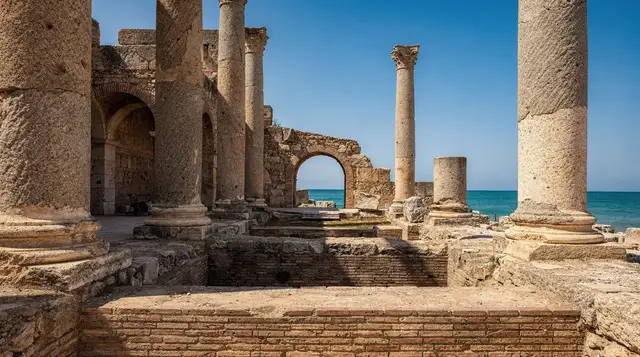
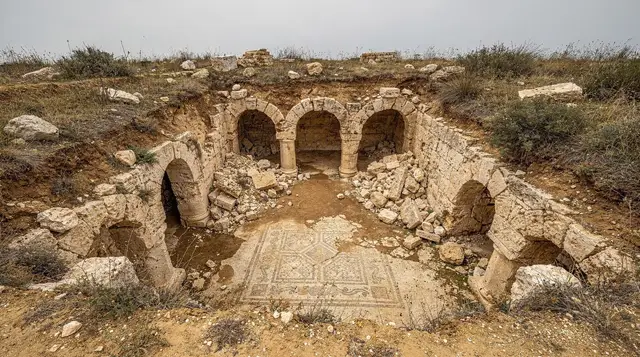
Dougga sits on a hilltop in the Tell, the fertile north-western interior of Tunisia, roughly two hours from Tunis near the small town of Teboursouk. UNESCO lists it as the best-preserved Roman town in North Africa, and unlike most Roman sites in the country it is not a scattering of isolated monuments but a genuine town, with streets, a theatre, temples, baths, a market and residential quarters still readable as a functioning place rather than fragments. It began as a Numidian settlement, absorbed Punic influence, and was rebuilt extensively under Rome from the second century AD onward, which is why the site layers three distinct cultures rather than presenting a single period.
| Where | Hilltop site near Teboursouk, north-western Tunisia |
| Cost | Entry around 12 TND |
| Time needed | Two to three hours on site, more for a slow, thorough visit |
| Getting there | Car or organised tour from Tunis (around 2 hours) |
| Best time | Morning, before the midday sun hits the exposed hilltop |
The theatre
Dougga’s theatre is the single most photographed structure on site and among the best-preserved Roman theatres anywhere in North Africa, with much of its original seating and stage backdrop still standing. It was funded by a private citizen, Publius Marcius Quadratus, rather than the imperial state, an inscription that survives on site and is a useful reminder that Roman North Africa’s wealth was genuinely local rather than solely imported from Rome. The theatre still hosts occasional performances during cultural festivals, and even without an event, standing at the top tier looking down over the stage and out to the surrounding hills is one of the better viewpoints among Tunisia’s Roman sites.
The capitol and the Temple of Saturn
The capitol, dedicated to Jupiter, Juno and Minerva, stands at the highest point of the site and is remarkably intact, with columns and pediment still largely in place — a rarity for this type of structure anywhere in the former Roman world. Nearby, the Temple of Saturn was built over an earlier Punic temple to Baal Hammon, one of several points on site where you can trace the same sacred ground being reused across different religious traditions rather than each culture starting from nothing. Together these two structures give Dougga a skyline that most Roman sites in Tunisia, including parts of Carthage, simply cannot match.
Baths, market and residential streets
The Licinian Baths are extensive and well preserved enough to make sense of how a Roman bathing complex actually functioned, room by room, rather than requiring imagination to fill enormous gaps. The old market square and the residential streets that spread down the hillside below the main monuments are less visited but genuinely worth the walk, giving a sense of Dougga as a lived-in town rather than a ceremonial centre. A Libyco-Punic mausoleum on the western edge of the site, one of the few surviving examples of pre-Roman Numidian funerary architecture in Tunisia, is easy to miss if you stick only to the central monuments, so budget time to walk the full site rather than the highlights alone.
| Structure | What to expect |
|---|---|
| Theatre | Near-complete seating and stage, the site’s best photo point |
| Capitol | Intact columns and pediment, the highest point on site |
| Temple of Saturn | Built over an earlier Punic temple, layered religious history |
| Licinian Baths | Extensive rooms, one of the best-preserved bath complexes in Tunisia |
| Libyco-Punic mausoleum | Rare pre-Roman funerary monument, on the site’s western edge |
Walking the site in a sensible order
Because Dougga is built on a slope, the order in which you walk it changes how the visit feels. Most people arrive at the upper end of the site, so a good approach is to head first for the theatre while the light is soft, continue up to the capitol and the Temple of Saturn, and only then work your way down through the market square and the residential streets towards the baths and the mausoleum. Doing it this way means the steepest climbing happens early, and the second half of the visit is a gentle descent through the quieter parts of the town, where you are most likely to have the ruins to yourself.
Take your time at the places where the stonework carries inscriptions. Dougga is unusually rich in carved dedications, and a few minutes spent reading them, or simply noticing how many there are, says a good deal about how proud and how prosperous this provincial community was. If you want the wider story of how a Numidian hill settlement became a Roman town, the Dougga complete guide goes through the monuments one by one, and the Dougga day trip guide is the better companion if your priority is logistics rather than history.
What makes the setting special
Part of Dougga’s appeal has nothing to do with the stones themselves. The town looks out over rolling farmland, olive groves and wheat fields, and on a clear day the views from the upper terraces make it obvious why a settlement was founded here in the first place: the position is defensible, the land below is fertile, and the town commands the surrounding countryside. Visiting in spring, when the fields are green, or in autumn, when the light turns golden, gives a very different impression from a dry high-summer visit. The seasons are worth thinking about before you commit to a date, and the best time to visit Tunis guide gives a broader picture of what the weather does across the year.
It is also a quiet place. Compared with the coastal sites, Dougga rarely feels crowded, and the hillside swallows visitors easily. That calm is part of what lets you imagine the place as a working town: you can stand in the market square or on the theatre steps and hear very little beyond the wind and the occasional bird.
Who will enjoy Dougga most
Dougga suits travellers who like to understand a place rather than tick it off. If you enjoy reading a landscape, tracing how streets connect and how public buildings relate to private homes, you will get far more from it than someone who only wants a single dramatic photograph. Families with older children who are interested in history can do well here, although the lack of shade and the uneven ground mean it is less comfortable with very young children; the Tunis with kids guide covers what works better for small ones. Travellers who care mostly about mosaics and museum-quality artefacts should plan to pair the visit with the Bardo Museum mosaics highlights, since the two complement each other well.
Choosing between a tour and a self-drive
Both approaches work, and the right choice depends on how you like to travel. A guided day removes the stress of the winding final stretch of road and usually includes someone who can explain what you are looking at, which is valuable on a site with relatively little signage. Driving yourself gives you freedom over timing, letting you arrive early and leave before the heat builds, but it means taking responsibility for navigation and parking. If you are weighing the two, the guides to car hire in Tunisia and to private versus group tours in Tunisia set out the trade-offs without pushing you either way.
Getting to Dougga
Dougga is roughly two hours from Tunis by car, on roads that are generally in reasonable condition but wind through hill country for the final stretch. There is no direct public transport that makes sense for a day visitor, which is why almost every non-driving visitor sees Dougga as part of an organised tour. Kairouan, Makthar and Dougga: 12-hour Roman and Islamic tour is a long but comprehensive option that pairs Dougga with the lesser-visited Roman site at Makthar and the holy city of Kairouan in a single, full day.
More commonly, visitors combine Dougga with the nearby sites of Testour and Bulla Regia, all reachable on the same loop through the north-west. Three separate operators run essentially the same route: Testour, Dougga and Bulla Regia: private guided day trip, Private day trip to Testour, Dougga and Bulla Regia, and Testour, Dougga and Bulla Regia private day trip.
All three cover broadly the same ground; the differences tend to be group size, exact timing and pickup flexibility rather than the itinerary itself, so compare on those details rather than expecting a meaningfully different day.
If you are based nearer the Sahel coast rather than Tunis, it is worth knowing that El Djem’s amphitheatre is a more convenient half-day Roman option: see Sousse: El Jem Roman Amphitheatre and Museum Half-Day Tour for that alternative rather than adding a long drive north-west to an already packed coastal trip.
Dougga versus the other Roman sites
Travellers trying to decide which Roman sites are worth their limited time often ask how Dougga compares to Carthage or El Djem specifically. The honest answer is that they show different things: Carthage’s Roman-era remains are impressive but fragmented across a modern city, El Djem’s amphitheatre is a single spectacular structure with little else around it, and Dougga is the only one that reads as a complete town. For a direct comparison, see Carthage or Dougga?, and for a wider ranking across every major site, Roman sites near Tunis, ranked by what you actually see.
Fitting Dougga into a longer trip
Dougga works best as one stop in a wider plan rather than an isolated excursion. If you are building a route around Roman Tunisia, the Roman Tunisia itinerary shows how it sits alongside the other major ancient sites, and the north Tunisia road trip gives a slower, more rural way of covering the same part of the country. For travellers with only a short stay in the capital, the best day trips from Tunis guide helps you decide whether a full day out in the north-west is the right use of your limited time. Those who enjoy the Roman theme can also read the writer’s account in Dougga at eight in the morning, which captures what the site feels like early, before anyone else arrives.
Practical notes
Dougga’s hilltop position means minimal shade and exposure to wind and sun in roughly equal measure, so a hat, sunscreen and water are genuinely necessary rather than optional extras, particularly if you plan the two to three hours a proper visit deserves. The uneven ground across the site, particularly around the theatre steps and residential streets, makes flat sandals a poor choice; solid, closed shoes make the visit considerably more comfortable.
Frequently asked questions about visiting Dougga
How long does a proper visit to Dougga take?
Budget two to three hours to see the main monuments and walk the residential streets properly; a rushed visit of under an hour will miss most of what makes the site distinctive as a complete town rather than a single structure.
Is Dougga better than Carthage for Roman ruins?
For understanding a complete Roman town, yes; Dougga’s structures are far more intact and less interrupted by the modern city that surrounds much of Carthage. Carthage still wins for sheer historical significance and its Punic-era layers, so the two sites answer different questions rather than one simply beating the other.
Can I visit Dougga without a car?
Not comfortably as an independent day trip; there is no practical direct public transport route, so almost all non-driving visitors join an organised tour that includes transport.
Is Dougga suitable for a day trip combined with other sites?
Yes, and this is how most visitors do it. Testour and Bulla Regia are the standard pairing on the same north-western loop, while Kairouan and Makthar form a longer, more comprehensive alternative route.
What should I wear to visit Dougga?
Closed, solid shoes rather than sandals, given the uneven paths and theatre steps, plus a hat and sunscreen given the almost total lack of shade across the hilltop site.
Is there a museum at Dougga itself?
The site has some on-site interpretation, but many of the more significant finds are held at the Bardo Museum in Tunis rather than displayed at Dougga itself; see the Bardo museum guide if artefacts specifically interest you.
How does Dougga compare to Bulla Regia, which is on the same route?
Bulla Regia is known specifically for its underground villas, built partly below ground to cope with the summer heat, which is a genuinely different kind of Roman architecture to Dougga’s above-ground town. The two complement rather than duplicate each other, which is exactly why they are usually visited together.
Is Dougga worth visiting in summer given the heat and lack of shade?
It is manageable with an early start and proper preparation, but the exposed hilltop makes a midday summer visit genuinely uncomfortable; spring and autumn are meaningfully more pleasant if your travel dates allow the choice.