Ksar Ghilane sits where the flat, stony pre-desert gives way to the Grand Erg Oriental, the great dune sea that stretches on into Algeria and Libya, and it is one of the few places in Tunisia where the desert looks like the one in most people’s imagination: high, wind-rippled sand rather than gravel plain. It’s also, unusually, a place you can swim: a natural warm spring rises at the edge of the dunes into a shallow pool that’s been used by travellers and caravans for centuries, long before anyone came for a photograph of it.
There’s no permanent town here, just the spring, a scatter of desert camps, a handful of hotels, and a ruined Roman fort watching over the whole thing from a low rise nearby. Most visitors reach it as part of a wider loop through southern Tunisia, based out of Tozeur or Douz.
| Where | Southern Tunisia, at the northern edge of the Grand Erg Oriental |
| Cost | Day excursions typically 100-250 TND per person; overnight desert camps from around 150-300 TND including meals |
| Time needed | 1 day round trip from Tozeur or Douz; 1-2 nights for a proper camp stay |
| Getting there | 4x4 required for the final stretch, whether self-driven or as part of an organised tour |
| Best time | November to March; avoid the midday sun even outside summer |
The spring that makes the desert liveable
The hot spring at Ksar Ghilane is the reason this spot became a stopping point at all, long before it appeared on any tourist route. It’s a natural warm pool, fed by an underground source, sitting right at the point where the flat ground rises into the first dunes — you can be neck-deep in warm water with a wall of sand ten metres away. Water temperature sits comfortably warm rather than hot, closer to a mild bath than a thermal spa, and it’s shallow enough that non-swimmers can wade in without concern. Facilities are basic: changing areas rather than resort-style infrastructure, which suits the setting better than anything more polished would.
Bathing here at sunset, once the day-trip coach groups have left and the light goes gold on the dunes behind the pool, is the single most-photographed moment in southern Tunisia, and it earns the reputation. Mornings are quieter still, before the heat builds, and are the better choice for anyone staying overnight in one of the nearby camps. Anyone interested in the wider network of oases and springs across the region should also look at Chott el Jerid, the vast salt lake that sits further north on the way in from Tozeur, for a sense of how dramatically the desert landscape here can change within a couple of hours’ drive.
The spring also pairs well with what you read about elsewhere in the south. The hot spring guide goes into the bathing side in more detail, and travellers who like the idea of warm water after a long drive may also enjoy the thermal springs at Korbous on the opposite side of the country, a very different setting for the same simple pleasure.
Into the dunes
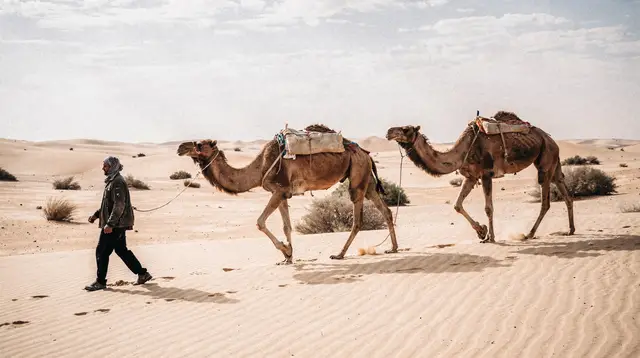
Beyond the spring, the Grand Erg Oriental begins in earnest, and this is where most organised excursions spend the bulk of their time. A 4x4 tour through the Sahara desert with a camel ride and time at the oasis is the standard way to see the dunes properly: the 4x4 covers ground quickly over difficult terrain, while a camel section, usually an hour or so, gives a slower, quieter sense of the scale of the dunes that a vehicle can’t. Sunset and sunrise are, unsurprisingly, the times the dunes look their best, with long shadows picking out every ripple in the sand that flattens out to nothing under a midday sun.
For visitors already based near Douz rather than approaching from Tozeur, a sunset or sunrise Sahara camel ride from Douz covers similar dune terrain on a shorter, more focused excursion that doesn’t require committing to the full drive out to Ksar Ghilane itself.
The Roman fort and why it’s there
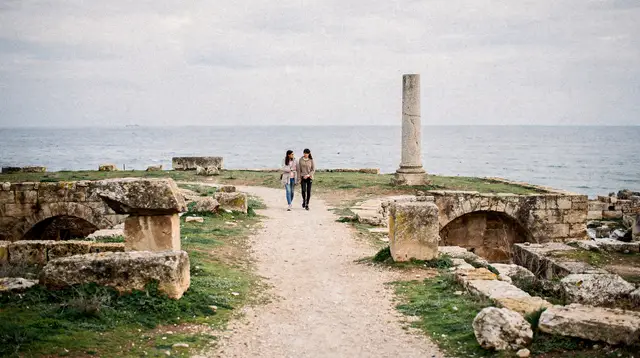
On a low ridge above the spring stand the remains of Tisavar, a Roman fort that once anchored the edge of imperial control in this direction — the Limes Tripolitanus, a chain of forts and watchtowers built to monitor movement between the settled north and the desert beyond. What survives today is modest: wall foundations, the outline of a rectangular structure, no standing arches or grand facades.
It’s worth the short walk up mainly for the context it gives the whole site — this was a genuine frontier, marked and garrisoned two thousand years ago, not just an attractive stretch of sand that tourism discovered recently. Readers curious about the wider network of Roman sites across the country can find more in this ranking of Roman sites near Tunis, though Tisavar itself sits well outside that cluster, out on the true desert frontier rather than the fertile north.
| Getting to Ksar Ghilane | Route | Notes |
|---|---|---|
| From Douz | Around 90 minutes via a mix of paved road and track | Most common approach; some road sections require care |
| From Tozeur | Around 2.5-3 hours, via Kebili and Douz | Usually combined with a Chott el Jerid crossing |
| From Tataouine | Longer desert-track route | Used on southern loop itineraries combining ksour and desert |
| Self-drive | Possible with a capable 4x4 and local knowledge | Most visitors join an organised tour instead |
Staying overnight
A night in one of the desert camps near Ksar Ghilane is a genuinely different experience from the day-trip version, and if the schedule allows, it’s worth the extra planning. Camps range from simple tents with shared facilities to more comfortable set-ups with proper beds and en-suite arrangements, but even the better ones lean into the setting rather than away from it — no electricity beyond a few hours of generator power, meals cooked over a fire, and a night sky largely free of light pollution.
A Tunisian Sahara villages and oasis overnight tour pairs a night at Ksar Ghilane with stops at smaller desert settlements along the way, which suits travellers who want more than a straight there-and-back trip. Anyone bringing children should also read taking children into the Tunisian Sahara before committing to an overnight camp stay, since the basic facilities and long transit suit some families better than others.
Multi-day options from further afield also exist. A 2-day tour from Tunis and Hammamet taking in Ksar Ghilane and Tataouine is built for visitors who don’t want to arrange transport to the south independently.
Longer loops covering four days or more give Ksar Ghilane one stop among several, alongside Matmata, the ksour near Tataouine and the mountain oases further along the route. For a sense of how these longer loops compare, this guide to Sahara tour options from Tunis is worth reading before booking, alongside this comparison of private and group tours.
Fitting Ksar Ghilane into a wider trip
Ksar Ghilane rarely works as a stand-alone destination; it rewards a little planning around it. Travellers coming from the capital usually treat it as the far point of a southern loop, and the one-week itinerary combining Tunis and the Sahara shows how the desert fits alongside the city without feeling rushed. If time is short, how many days in Tunis helps decide how much of a trip can honestly be given to the south, and the general trip planning guide covers the order in which to stack the pieces.
It also helps to understand the neighbours. Douz, the gateway to the Sahara is the usual base, and Douz versus Tozeur is worth a read if you have not yet decided where to sleep before the drive. Anyone drawn to the strange landscapes of the region can add the troglodyte houses of Matmata on the way, and film fans may enjoy the Star Wars locations in Tunisia, several of which lie on the same southern roads.
For a personal account of what a night out in the sand feels like, a night in the Sahara is a good companion read, and the long road to Douz gives a feel for the journey that precedes it. Practical questions about getting around by road are covered in driving in Tunisia and car hire in Tunisia, while the Sahara in summer explains why the hot months need a very different approach.
What a Ksar Ghilane excursion doesn’t include
It’s worth being clear-eyed about what a day trip here does and doesn’t offer. A single-day round trip from Tozeur or Douz spends a significant part of the day in transit, leaving perhaps two to three hours at the spring and dunes themselves — enough for a swim, a short camel ride and photographs, not much more.
Anyone weighing this against a longer stop should read this comparison of two-day versus three-day Sahara tours, since the extra night is what actually buys time in the dunes rather than time on the road. It’s also worth checking what to pack for a night in the Sahara if a camp stay is on the itinerary, since desert nights get cold even when the daytime heat is extreme.
Mistakes people make at Ksar Ghilane
Frequently asked questions about Ksar Ghilane
Can you actually swim in the Ksar Ghilane hot spring?
Yes, the pool is shallow and warm rather than hot, comfortable for a proper swim rather than a quick dip, and it’s open to anyone visiting the site.
Do I need a 4x4 to get to Ksar Ghilane?
The final approach runs on sand and gravel track that a standard rental car can’t handle reliably. Most visitors join an organised 4x4 tour rather than attempting the drive independently.
Is Ksar Ghilane worth an overnight stay, or is a day trip enough?
A day trip covers the spring, a short dune excursion and the fort, but leaves little time to linger given the transit involved. An overnight in a desert camp is the more rewarding option if the schedule allows it.
How far is Ksar Ghilane from Douz?
Around 90 minutes by a mix of paved road and track, making it the most common approach point for day trips and overnight excursions alike.
What’s the Roman fort at Ksar Ghilane?
The remains of Tisavar, a fort that once formed part of the Limes Tripolitanus, the Roman frontier system monitoring movement between settled North Africa and the desert. What survives is modest ruins rather than standing architecture.
Is Ksar Ghilane suitable for children?
The camel rides and the shallow spring pool work well for families with older children; very young children may struggle with the heat, the long transit and the basic camp facilities on an overnight stay.
What should I pack for a night at a Ksar Ghilane desert camp?
Warm layers for after dark, since desert nights get cold even after a hot day, along with sun protection, a torch and any personal items you’ll need, since camps have minimal on-site facilities.
How does Ksar Ghilane compare to the dunes near Douz?
Douz’s dunes are easier to reach and better suited to a short excursion; Ksar Ghilane’s are further into the true Grand Erg Oriental and paired with the hot spring, which most visitors consider worth the extra distance. Camel trekking around the dunes is usually included in a 4x4 excursion at either site but can also be arranged as a standalone activity.
Is Ksar Ghilane open year-round?
Yes, but midsummer heat (July and August) makes both the drive and any time in direct sun genuinely difficult. November to March is far more comfortable for both the crossing and time at the dunes.