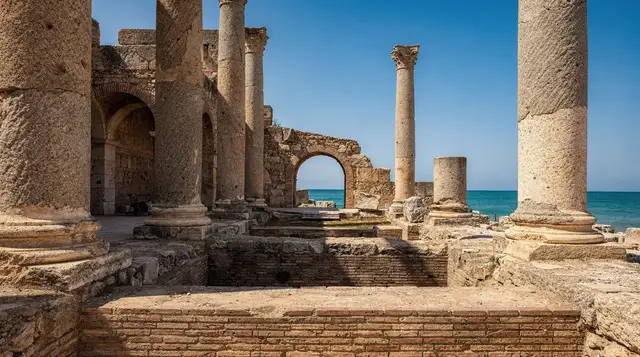
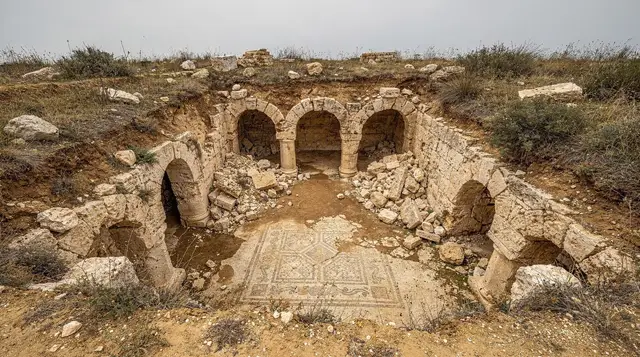
El Haouaria sits at the very tip of Cap Bon, the point where the peninsula narrows and the Mediterranean opens out on both sides. It is the end of the road in a fairly literal sense, and the town itself is small and unremarkable; what draws visitors is what lies just outside it, in the cliffs above the sea, where Roman quarry workers cut sandstone blocks out of the rock face, leaving behind a network of caves that are still the main reason anyone makes the drive this far north.
| Where | Northern tip of the Cap Bon peninsula |
| Cost | Cave entry a few dinars; a local guide (recommended) a small additional fee |
| Time needed | Half a day |
| Getting there | Car or organised tour from Kelibia (around 20 minutes) or Nabeul (around 1 hour) |
| Best time | Late spring, and June for the falconry festival if the timing works |
The Roman quarry caves
The caves above El Haouaria are not natural formations but the result of centuries of quarrying, mostly during the Roman period, when sandstone cut here was shipped by sea to build Carthage and other coastal towns. The result is a warren of chambers and passages cut directly into the cliff, with openings that give sudden views straight out over the sea.
Some passages run deep enough that a local guide, usually available at the entrance for a small fee, is worth having both for orientation and for the history they can point out that isn’t signposted. It is not a grand, curated archaeological site in the way Dougga or Carthage are; it is closer to an industrial site turned viewpoint, and it rewards visitors who appreciate that distinction rather than expecting temple ruins.
Falconry and the June festival
El Haouaria has a documented falconry tradition going back generations, tied to the migratory birds of prey that pass through Cap Bon during their seasonal movements. Each June, the town holds a falconry festival with demonstrations, trained birds and a genuinely local crowd rather than a tourist-oriented show. If your visit happens to fall during the festival, it is worth timing around; outside that window, falconry is a story you hear about rather than something you see demonstrated, so do not plan a trip specifically expecting a display unless you have confirmed the dates in advance.
Quail hunting and the autumn migration
Alongside falconry, El Haouaria has a long-standing tradition of quail hunting using large fixed nets set up along the cliffs to catch birds during their autumn migration south, a practice that predates any organised tourism here by centuries and is still carried out by local hunters each year. It is a livelihood rather than a spectacle staged for visitors, and while you may see the nets in place if you visit during the migration season, treat it as a glimpse of a genuinely local practice rather than an activity you can book or watch on demand.
The wider seasonal movement of birds of prey and migratory species through this narrow point of the peninsula is also the underlying reason falconry took hold here in the first place: El Haouaria sits on a natural bottleneck for birds crossing between Europe and Africa, which made it a practical place to develop both hunting and falconry traditions long before either became something a visitor might come to see.
The cliffs and the coast
Beyond the caves, the cliffs around El Haouaria offer some of the more dramatic coastal scenery on the peninsula, with the land dropping steeply to the sea and views that, on a clear day, stretch across the strait towards Sicily’s direction, though the island itself is well beyond visual range. Walking paths along the clifftop are informal rather than maintained trails, so sturdy shoes and reasonable care near the edges matter more here than at more developed viewpoints. The hiking guide to Cap Bon’s trails covers this stretch alongside other walkable sections of the peninsula.
Getting to El Haouaria
El Haouaria is genuinely at the end of the road, and public transport thins out considerably this far north. Louages run from Nabeul, but the journey is long for what amounts to a half-day stop, which is why most visitors reach it as part of a wider organised Cap Bon loop rather than as an independent trip.
VIP Cap Bon Tour: Kelibia, Haouaria, Kerkouane and Korbous covers this and the other northern stops in a single day, while Cap Bon Tour: Kerkouane, Kelibia and Hawaria takes a similar route with a different emphasis. For visitors starting from Tunis rather than Hammamet or Nabeul, Cap Bon Guided Private Day Tour with Lunch is a longer but more flexible private option that can be timed around your own schedule.
| From | Mode | Approximate time |
|---|---|---|
| Kelibia | Car or taxi | 20 to 25 minutes |
| Nabeul | Louage or car | 50 minutes to 1 hour |
| Tunis | Organised tour or car | around 1 hour 45 |
Artisans and local crafts
El Haouaria and the villages around it have a small, low-key tradition of stonework and rural crafts connected to the quarrying history of the area, distinct from the pottery tradition centred on Nabeul. Artisans and Ancient History: Full-Day Cap Bon Experience is built around this angle specifically, connecting the quarry caves to the wider craft and history of the peninsula rather than treating El Haouaria as an isolated stop.
Fitting El Haouaria into a Cap Bon day
The sensible way to think about El Haouaria is as the far end of a loop rather than a place to build a day around. Most people who come here are already working their way up the peninsula, so the question is less “should I go?” than “what do I pair it with?”. The Cap Bon loop day trip lays out how the northern stops connect, and the four-day Tunis and Cap Bon itinerary shows where a visit here sits in a longer stay. If you prefer to read about the drive before committing to it, the blog account of driving the Cap Bon loop gives a feel for how the landscape changes as the peninsula narrows.
Going north to south or south to north makes little difference to the caves themselves, but it does change how the day feels. Arriving early, before the clifftop has had a chance to warm up, tends to make the walk more pleasant, and leaves the afternoon free for a slower lunch elsewhere on the coast. Arriving late means rushing the one part of the trip that rewards lingering, so if your schedule is tight, shorten something else instead.
Choosing between a tour and your own wheels
A tour removes the logistics: someone else deals with parking, timing and the thin connections that make independent travel here slow. Driving yourself gives freedom to stop where the scenery pulls you in, which on this stretch of coast is often. Anyone weighing the two should read the guide to car hire in Tunisia and the notes on private versus group tours before deciding, since the right answer depends on how much you want to control the pace.
What to bring and how to pace the visit
Plan this stop like a short outdoor walk rather than a museum visit. Sturdy shoes, a hat and water matter more than a camera lens, and a light layer is useful because the exposed clifftop can feel much cooler than the town once the wind picks up. Give the caves unhurried time: the best moments tend to come when you stop moving and look out through one of the openings toward the sea, which is easy to miss if you treat the chambers as boxes to tick off.
If you are travelling with a mixed group, agree beforehand who wants to go deep into the passages and who would rather stay near the entrance and the viewpoints. Both options are perfectly reasonable, and the clifftop views do not depend on how far underground you go. For the wider picture of how this region fits with the rest of the peninsula’s coast, the guide to Kelibia and the Cap Bon beaches is a natural companion, and a quiet swim there makes a good way to finish the day after the cliffs.
Where to eat and where to stay
El Haouaria has a handful of simple restaurants near the town centre, serving straightforward grilled fish and standard Tunisian dishes; nothing here rivals the seafood in Kelibia, and most visitors treat a meal in El Haouaria as a practical stop rather than a highlight. Bring water for the cave and cliff walk regardless of season, since shade is limited along the clifftop paths.
Accommodation options are minimal, limited to a small number of guesthouses rather than proper hotels, which is another reason most visitors treat El Haouaria as a half-day stop on a wider loop rather than an overnight base; Kelibia, twenty minutes back down the coast, has a slightly wider choice if you want to stay closer to this end of the peninsula.
Practical notes for a comfortable visit
The site itself has minimal facilities beyond a ticket booth and the guides who work the entrance, so plan accordingly: bring cash in small denominations for both the entry fee and any guide fee, since card payment is unlikely to be available. Mobile signal is generally fine in the town itself but can drop out along parts of the cliff path, which is worth knowing if you are relying on a phone map to find your way back to a parked car.
The combination of quarry caves, cliffs and, depending on season, the sight of the fixed hunting nets along the clifftop makes El Haouaria feel more remote and less curated than almost anywhere else on Cap Bon, which is either exactly what a visitor is looking for or a reason to keep the stop brief and continue on to somewhere with more infrastructure.
Travellers drawn by the birdlife as much as the history will also find the birdwatching guide for northern Tunisia useful, since the same migration that shaped local traditions here is what makes the area interesting to watch.
Frequently asked questions about visiting El Haouaria
Are the El Haouaria caves natural or man-made?
Man-made. They were cut by quarry workers, largely during the Roman period, to extract sandstone blocks that were shipped by sea to build Carthage and other coastal towns; the caves are the leftover excavation, not a natural cave system.
Do I need a guide to visit the quarry caves?
Not strictly, but a local guide, usually available at the entrance for a small fee, is genuinely useful given the lack of on-site signage and the slightly maze-like layout of some passages.
When exactly is the El Haouaria falconry festival?
It is held each June, with exact dates varying year to year; check current dates locally or with a tour operator before planning a trip around it, since outside the festival window there are no scheduled falconry demonstrations.
Is El Haouaria worth visiting without a car?
It is possible via an organised tour, which is the more practical option given how thin public transport becomes this far north on the peninsula. Independent travel by louage is workable but slow for what is ultimately a half-day stop.
How does El Haouaria compare to Kerkouane as a historical site?
They cover different periods and types of history entirely: Kerkouane is a Punic city site with excavated house foundations, while El Haouaria’s caves are a Roman-era quarry. Visiting both on the same northern Cap Bon loop gives a reasonable spread across eras.
Is the cliff walk at El Haouaria suitable for children?
Older, sure-footed children generally manage it fine with supervision, but the paths are informal and the drops in places are steep, so it is not the easiest stop with very young children compared with somewhere like Friguia Park.
Can I see Sicily from the cliffs at El Haouaria?
On an exceptionally clear day some visitors report distant visibility in that general direction, but it is not a reliable feature of the visit and should not be a reason to plan a trip; treat the cliffs as impressive coastal scenery in their own right rather than a Sicily viewpoint.
What should I combine with El Haouaria on the same day?
Kelibia’s fortress and harbour are the closest and most natural pairing given the drive, with Kerkouane and Korbous both reasonable additions if you have a full day and transport sorted in advance.