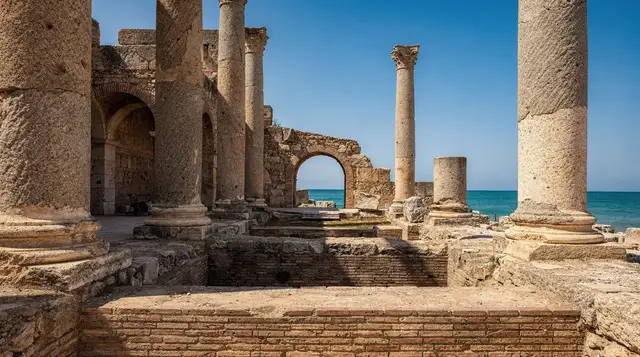
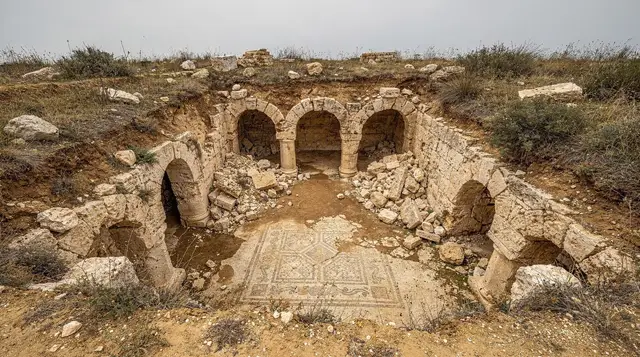
Kelibia sits at the northern tip of Cap Bon, on the point where the Mediterranean and the Gulf of Hammamet meet, and it is one of the more honest stops on the peninsula: a working fishing port with a genuine fleet, a Byzantine-era fortress on the hill above the harbour, and a run of beaches that are quietly better than most of what you find closer to Hammamet. It is also the town where much of Tunisia’s Muscat de Kelibia wine grapes are grown, on the hillsides just inland. It has none of the resort infrastructure of Hammamet or Sousse, which is either the appeal or the drawback depending on what you came for.
| Where | Northern tip of the Cap Bon peninsula |
| Cost | Fortress entry around 8 to 12 TND; a seafood lunch around 20 to 40 TND per person |
| Time needed | A full day; an overnight if you want the fortress at sunset without rushing |
| Getting there | Louage from Nabeul (around 45 minutes) or from Tunis (around 2 hours) |
| Best time | Late spring or early autumn; the port is at its most active in the early morning |
A fishing town with a fortress, not a resort
Where Hammamet and Yasmine Hammamet were built for tourism, Kelibia grew around its port, and that is still true today: the working harbour, where boats come in through the morning and the fish auction runs most days, is a bigger part of daily life here than any hotel strip. The fortress above town, built on Byzantine foundations and expanded by the Ottomans, was a genuine coastal defence rather than a folly, and it still functions that way visually — from the ramparts you can see exactly why this headland mattered for anyone trying to control access to the gulf. If you are coming from Nabeul or Hammamet, Kelibia reads as a different kind of place almost immediately.
The Kelibia fortress
The fortress sits on a low hill directly above the harbour and is one of the better-preserved coastal forts on this stretch of coast, open most days with a modest entry fee. The walk up is short but has no shade, so early morning or the couple of hours before sunset are the better times to go, both for the light and for the temperature. Inside, there is not a great deal of interpretive signage, which some visitors find thin and others find refreshing after the more curated sites further south; either way, the real draw is the view rather than the exhibits — the harbour below, the open gulf, and on a clear day the outline of the Cap Bon coastline curving away towards Kerkouane.
The port and the fish market
Kelibia’s fishing fleet is one of the larger ones on this coast, and the harbour is at its most interesting early, when boats return and the catch is sorted and auctioned before it goes to restaurants and markets across the region. It is not staged for visitors, which is precisely why it is worth seeing: nobody is performing for a camera, and if you turn up at seven rather than midday you get an honest look at how the town actually runs. Seafood restaurants along the port serve what came in that morning, and the quality here tends to be a notch above what you find in more tourist-facing towns further south, simply because the supply chain is shorter.
Beaches
Kelibia’s beaches are, in the view of a lot of Tunisians who holiday domestically, among the best on the Cap Bon coast: wide, clean, backed by dunes rather than a continuous hotel wall, and considerably less crowded than Hammamet or Nabeul in peak season. The main town beach is fine, but the better stretches are a short drive north and south of the centre, where development thins to almost nothing. For a wider comparison across the peninsula, see the guide to Kelibia and the beaches of Cap Bon.
| Beach | Distance from centre | Character |
|---|---|---|
| Kelibia town beach | Walking distance | Convenient, moderately busy in summer |
| Mansourah beach | 3 to 4 km north | Wide, quieter, popular with local families |
| Beaches towards El Haouaria | 10 to 15 km north | Wilder, minimal facilities, best with a car |
Getting there and around
Kelibia is not as well connected as the resort towns, and that is one of the reasons it stays quieter. Louages run from Nabeul and Menzel Temime with reasonable frequency, but direct connections from Tunis are less frequent and often route through Nabeul anyway, which makes an organised day trip a genuinely practical option rather than just a convenience. Tunis: Houaria Cliffs, Kelibia and UNESCO Kerkouane Private Tour covers the awkward northern loop in a single day with a driver, which is difficult to replicate cheaply using public transport alone.
Within Kelibia itself, the harbour, fortress and town centre are all within easy walking distance of each other; a car or taxi only becomes necessary for the outlying beaches or for continuing on to El Haouaria or Kerkouane.
Kelibia as a base for the northern Cap Bon loop
Kelibia’s position at the top of the peninsula makes it a sensible midpoint for a day that also takes in Kerkouane’s Punic ruins and El Haouaria’s cliffs and caves, rather than trying to reach all three from Hammamet and back in a single long day.
Cap Bon Tour: Kerkouane, Kelibia and Hawaria is built around exactly this route, and VIP Cap Bon Tour: Kelibia, Haouaria, Kerkouane and Korbous extends it to include the thermal springs at Korbous as well, for travellers who want the whole northern half of the peninsula in one outing. For the wider circuit including Nabeul and Hammamet, the Cap Bon loop in a day guide lays out the full route and realistic timings.
Wine and grapes
The hillsides inland from Kelibia grow Muscat grapes used in some of Tunisia’s better-regarded white and dessert wines, a detail that surprises visitors who assume wine production stopped after independence. Production is small-scale rather than a major tourist circuit, and there is no polished wine-tourism infrastructure here comparable to somewhere like Bordeaux; if wine specifically interests you, the Tunisian wine guide covers where and how to actually taste it, which is mostly in restaurants rather than at the vineyard gate.
Shaping a day in Kelibia
The simplest rhythm is the one the town itself suggests. Start at the harbour while the boats are still coming in, walk up to the fortress before the heat builds, then spend the middle of the day at a beach and eat fish at the port once the lunch crowd of locals has settled in. Nothing here needs booking in advance outside high summer, which is part of the pleasure: you can change your mind about the order of things without losing anything.
If you are staying in Hammamet and thinking about how Kelibia compares with the bigger resort strip, the Hammamet day trip guide and the Hammamet beaches guide help you decide how much of your time on the peninsula belongs here. Travellers who prefer a ready-made route can read the Tunis and Cap Bon in four days itinerary, which places the north of the peninsula inside a longer trip. For something slower, the account of driving the Cap Bon loop gives a feel for the roads and the pace.
Pairing Kelibia with other stops
Kelibia works best as one part of a northern Cap Bon day rather than as a standalone destination. Kerkouane adds an ancient layer to the coastline, El Haouaria adds the cliffs and the sense of the peninsula ending, and Korbous closes the loop on the western side. Walkers can look at the Cap Bon hiking trails, and anyone interested in the sea beyond the beach can read about Zembra Island marine reserve, which sits in the waters off this part of the coast.
Anyone who would rather not drive can compare private and group tours in Tunisia before choosing, and those weighing a rental car should read the car hire in Tunisia and driving in Tunisia guides first. A broader view of the region sits in the best day trips from Tunis.
Where to eat and stay
Seafood is the obvious choice, and the restaurants directly on the port serve grilled fish and seafood couscous that reflect the morning’s catch rather than a fixed menu. Accommodation in Kelibia is thinner than in Hammamet or Nabeul, mostly small guesthouses and a couple of mid-range hotels rather than large resorts, which again suits the town’s character as a place people pass through rather than settle into for a week. Booking ahead in July and August is sensible; outside peak summer, availability is rarely an issue.
Frequently asked questions about visiting Kelibia
Is Kelibia worth visiting if I only have one day on Cap Bon?
If you can only pick one town on the peninsula beyond Nabeul, Kelibia is a strong choice because it combines the fortress, the port and genuinely good beaches in one place, rather than requiring you to choose between them at separate stops.
How does the Kelibia fortress compare to sites like Carthage or Dougga?
It is far smaller in scale and has less on-site interpretation than the major Roman and Punic sites; its value is the setting and the view over the harbour rather than an extensive ruin to explore. Visitors expecting something on the scale of the Carthage archaeological sites or Dougga should recalibrate accordingly.
Are Kelibia’s beaches actually better than Hammamet’s?
For sand quality and how quiet they are, generally yes, particularly the stretches a short drive from the centre. Hammamet’s beaches have far more infrastructure, sunbeds and beach clubs, so the better comparison is convenience versus atmosphere rather than one being straightforwardly better.
Can I get from Kelibia to Kerkouane and El Haouaria without a car?
It is possible with local louages but connections are infrequent and not well timetabled for visitors trying to see all three sites in a day; most people without their own transport join an organised tour that covers the loop.
Is there anywhere good to stay overnight in Kelibia?
Yes, though the choice is narrower than in Hammamet: a handful of small guesthouses and mid-range hotels, mostly near the centre or close to the beach. An overnight is worthwhile mainly if you want the fortress at sunset without a return drive afterwards.
What is the Muscat de Kelibia wine actually like?
It is a light, aromatic white made from Muscat grapes grown on the hills inland, drunk mostly as a table or aperitif wine rather than exported widely. It is worth trying with a seafood lunch in town rather than seeking out a specific producer, since visitor-facing wine tourism here is minimal.
Is Kelibia safe to walk around, including the harbour area, in the evening?
Yes, in general. The harbour and town centre are well used by locals in the evening and the atmosphere is low-key rather than a nightlife scene; ordinary caution around the working port machinery and boat moorings is sensible more than any concern about safety.
How early should I go to see the fish market properly?
Aim to be at the harbour by around seven or eight in the morning, when boats are returning and the catch is being sorted; by midday the working part of the port has largely wound down for the day.