Kelibia and the beaches of Cap Bon
Are the beaches around Kelibia worth the trip from Tunis or Hammamet?
Yes, if open, less-developed coastline appeals more than resort infrastructure — Kelibia's beaches are wider and quieter than anything near Hammamet, backed by a working fishing port rather than hotel blocks. The trade-off is fewer facilities and a longer drive, roughly two hours from Tunis or ninety minutes from Hammamet.
Cap Bon, the peninsula reaching north-east from the mainland between Tunis and the Sahel coast, holds Tunisia’s most genuinely undeveloped stretch of Mediterranean beach within a reasonable day’s reach of either the capital or Hammamet. Kelibia, its main town, is built around a working fishing port rather than a resort strip, and the beaches around it — along with quieter spots further along the peninsula near Kerkouane and El Haouaria — trade the polish and facilities of Hammamet or Yasmine Hammamet for open coastline and considerably fewer people. This guide covers what the peninsula actually offers, how it compares to Tunisia’s more developed beach towns, and whether it’s worth doing as a day trip or a longer stay. For the places themselves, the destination pages for Kelibia, Kerkouane and El Haouaria go deeper than this beach-focused overview.
| Where | Kelibia, Kerkouane and El Haouaria, on the Cap Bon peninsula |
| Cost | Free public beach access; minimal paid beach club infrastructure compared to Hammamet |
| Time needed | A full day trip, or two to three days for a proper stay on the peninsula |
| Getting there | Roughly two hours from Tunis, ninety minutes from Hammamet, by car or organised tour |
| Best time | June to September for swimming; spring and autumn for a quieter, cooler visit |
Kelibia: a fishing port, not a resort town
Kelibia is best understood as a working town that happens to have excellent beaches, rather than a beach resort that happens to have a town attached, which is the reverse of how Hammamet or Yasmine Hammamet function. The port remains genuinely active, with fishing boats — including a distinctive local sailing design still used by some local fishermen — coming and going daily, and the town’s economy isn’t primarily built around tourism the way the Sahel coast further south is.
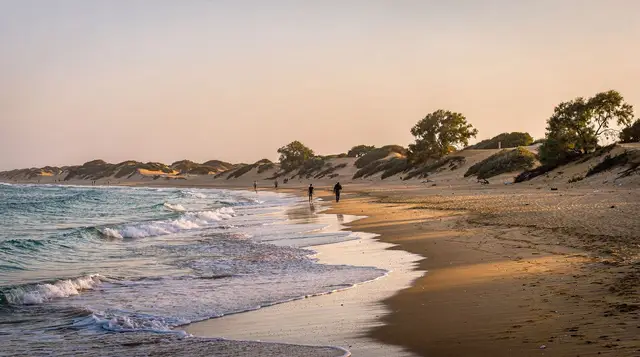
The beaches themselves are wide, sandy, and considerably less crowded than anywhere near Hammamet, even in peak summer, though that comes with a real trade-off: fewer beach clubs, fewer loungers for rent, and less English spoken in the shops and cafés around the harbour.
The beaches: what to actually expect
The main town beach at Kelibia is broad and sandy, backed by a Spanish-built fortress on a headland above the town that adds a genuine sense of place most resort beaches lack entirely. Further along the coast towards Kerkouane, smaller and even quieter coves appear, some reachable only by a short walk or a local’s directions rather than a signposted access road, which is either an adventure or a frustration depending on how much you value stumbling onto an empty stretch of sand versus knowing exactly where you’re going.
None of these beaches has the developed infrastructure of Hammamet — don’t expect rows of loungers or beachfront bars — but for travellers who prioritise the coastline itself over the amenities around it, that’s precisely the appeal.
| Kelibia / Cap Bon | Hammamet / Yasmine Hammamet | |
|---|---|---|
| Development level | Low — a working town, not a resort | High — purpose-built resort infrastructure |
| Crowd levels | Low, even in summer | High, especially July–August |
| Facilities | Minimal — a handful of cafés, few beach clubs | Extensive — loungers, water sports, beach bars |
| Distance from Tunis | About 2 hours | About 1 hour |
| Best suited to | Travellers prioritising open coastline over amenities | Travellers wanting a full resort beach day |
If you are travelling with children, family beaches in Tunisia compares the options on the wider coast, which helps you decide whether Kelibia’s lack of facilities suits your group.
Kerkouane: a Punic city on the coast
A short distance from Kelibia sits Kerkouane, the best-preserved Punic city in Tunisia and one of the few archaeological sites in the country that predates Roman rule almost entirely — it was abandoned after the Punic Wars and never significantly rebuilt, which is exactly why its street plan and house foundations survive as clearly as they do.
It sits directly on the coast, meaning a visit can be combined naturally with beach time rather than requiring a separate inland trip, and it’s a genuinely different kind of archaeological site from the Roman ruins that dominate most of Tunisia’s ancient history offering. A Cap Bon tour covering Kerkouane, Kelibia and Hawaria bundles the site with the coastal towns on this page in a single organised day, which is a practical option for travellers without their own transport.
El Haouaria: caves, birds, and the peninsula’s northern tip
At the very tip of Cap Bon, El Haouaria is known for a set of ancient Roman-era stone quarry caves cut into the cliffs, along with a falconry tradition that’s still practised locally and celebrated with an annual festival. It’s a further drive beyond Kelibia and Kerkouane, and most visitors see it as part of a longer loop around the peninsula rather than a standalone destination, but it rounds out a Cap Bon day with something genuinely different from beach time and Punic ruins.
A VIP Cap Bon tour covering Kelibia, Haouaria, Kerkouane and Korbous covers this fuller loop, including Korbous’s thermal springs on the peninsula’s western side, for travellers who want the complete circuit in a single organised day rather than piecing it together independently.
If you would rather plan the circuit yourself, the Cap Bon loop day trip lays out the route stop by stop, and the blog account of driving the Cap Bon loop gives a feel for what it is like on the road. Walkers who want to get off the coast road can look at the Cap Bon hiking trails.
The golden triangle loop from Hammamet
For travellers based in Hammamet rather than Tunis, Cap Bon is considerably closer and easier to reach as a day trip. A Hammamet tour of the Golden Triangle of Cap Bon, covering Kelibia, Kerkouane and Korbous is built specifically around this shorter distance, and it’s a reasonable way to see the peninsula’s highlights in a single day without needing to arrange your own transport or plan the route yourself. This is generally the more efficient option for Hammamet-based travellers than a Tunis-departure tour, simply because of the shorter drive each way. If Hammamet is your base, the Hammamet day trip guide and the Hammamet destination page cover what else the area offers, and best day trips from Tunis puts Cap Bon next to the other options from the capital.
| Departure point | Approximate one-way drive | Best tour option |
|---|---|---|
| Tunis | About 2 hours | Kerkouane and Kelibia-focused day tour |
| Hammamet | About 90 minutes | Golden Triangle loop covering Kelibia, Kerkouane and Korbous |
| Nabeul | About 45–60 minutes | Combined with artisan and pottery stops |
Nabeul and Cap Bon’s craft traditions
Nabeul, at the base of the peninsula, is Cap Bon’s other well-known stop, best known for pottery workshops and ceramics rather than beaches, though it has its own quieter coastline too. A full-day Cap Bon experience covering artisans and ancient history combines Nabeul’s craft traditions with some of the peninsula’s historical sites, making it a useful option for travellers who want to pair Cap Bon’s coastline with its artisan culture rather than treating beach time as the sole focus of the day. See Nabeul pottery: workshops, markets and what to buy for what the town’s ceramics scene involves in more detail.
Day trip or longer stay: which makes more sense
Whether Cap Bon works better as a single organised day trip or a longer independent stay depends on how much you want to see and how comfortable you are without resort-level infrastructure. A single day, whether departing from Tunis or Hammamet, covers the highlights — Kelibia’s beach and fortress, Kerkouane’s ruins, possibly El Haouaria or Korbous — at a reasonable pace without lingering long anywhere.
A longer stay of two or three nights based in Kelibia itself allows for genuinely exploring the quieter coves further along the coast, more time at Kerkouane without a tour schedule dictating the pace, and simply experiencing a working Tunisian coastal town rather than passing through it. The trade-off for a longer stay is accommodation and dining options that are noticeably more limited than Hammamet’s, since tourism infrastructure here is genuinely thinner.
For anyone building Cap Bon into a longer trip, the Tunis and Cap Bon four-day itinerary shows one way to sequence the capital and the peninsula without rushing either.
The local fishing boats and why they’re worth noticing
Kelibia’s harbour is home to a distinctive type of traditional sailing boat still used by some local fishermen, with a design that’s been passed down through generations of the town’s fishing families rather than replaced entirely by modern trawlers. Watching the boats come in with the day’s catch, usually in the late morning or early afternoon, is a small but genuine window into the town’s actual economy rather than a staged tourist activity, and it’s the kind of detail that separates Kelibia from a resort town built primarily to host visitors.
It’s worth timing a walk along the harbour to coincide with this if you’re in town at the right hour, and the fish sold at the small market near the port is about as fresh as it gets anywhere on this coast — several of the simple grill restaurants nearby serve whatever came in that morning rather than anything shipped in from elsewhere.
Korbous: thermal springs as a Cap Bon detour
On the western side of the peninsula, facing back towards the Gulf of Tunis rather than the open Mediterranean, Korbous offers a genuinely different kind of stop from the beaches covered elsewhere on this page: natural thermal springs that have drawn visitors for bathing since Roman times.
It’s not a beach destination in the conventional sense, but it’s commonly folded into the fuller Cap Bon loop tours mentioned above, and it adds a distinct change of pace — warm mineral water rather than open sea swimming — for travellers doing the peninsula as a longer circuit rather than a single-beach visit. See the thermal springs of Korbous for more on what a visit there actually involves and how it fits alongside the coastal stops on this page.
Comparing Cap Bon to the rest of Tunisia’s coastline
It’s worth placing Cap Bon in context against the other coastal options covered across this site, since travellers weighing where to spend limited beach time have several genuinely different choices. Tunis’s own suburbs, covered in the best beaches near Tunis, are the most convenient but least dramatic option for anyone based in the capital.
Hammamet, covered in the beaches of Hammamet, offers the most developed resort infrastructure on this entire coast. Cap Bon sits at the opposite end of that spectrum — the least developed, the quietest, and the one most likely to feel like a genuine discovery rather than a well-trodden beach day, at the cost of convenience and amenities. Choosing between them isn’t really about which is “best” in the abstract; it’s about which trade-off, development versus openness, suits the specific trip you’re on.
Practical notes: getting there and what to bring
Public transport to Kelibia from Tunis exists via louage or bus but takes considerably longer than driving and requires more planning around schedules; see louages: how Tunisia’s shared taxis work for how that system functions if you’re travelling independently without a rental car.
Travellers who prefer their own wheels will find the practicalities in car hire in Tunisia and driving in Tunisia, which matter more here than on the resort coast because the quieter coves are not served by signposted access roads. The Nabeul destination page is also useful if you are starting from the base of the peninsula.
Given the limited beach club infrastructure, bring your own umbrella, towel and sun protection rather than expecting to rent equipment on arrival, particularly outside Kelibia’s own town beach. Food options are more limited than in Hammamet, concentrated around the port and town centre rather than spread along the coastline, so plan meal stops accordingly rather than assuming beachfront restaurants will be readily available at every cove.
Mistakes to avoid
Frequently asked questions about Kelibia and Cap Bon beaches
How far is Kelibia from Tunis?
Roughly two hours by car. From Hammamet, it’s closer, at around ninety minutes, which makes Hammamet the more efficient departure point for a day trip.
Are Kelibia’s beaches better than Hammamet’s?
They’re different rather than strictly better — wider and considerably quieter, with far less development, but with fewer facilities like loungers, water sports and beachfront dining than Hammamet offers.
What is Kerkouane, and is it worth visiting?
Kerkouane is the best-preserved Punic city in Tunisia, predating Roman rule and offering a genuinely different archaeological experience from the country’s many Roman sites. It sits directly on the Cap Bon coast and pairs naturally with beach time.
Can I visit Cap Bon as a day trip without a car?
Yes, via an organised tour departing from Tunis, Hammamet or Nabeul, which is generally easier than arranging independent transport by louage or bus given the distances involved.
Is there anywhere to stay in Kelibia itself?
Accommodation options exist but are more limited and less resort-oriented than in Hammamet. It suits travellers prioritising an authentic coastal town experience over hotel amenities.
What is El Haouaria known for?
Ancient stone quarry caves cut into the cliffs at the peninsula’s northern tip, along with a local falconry tradition celebrated with an annual festival. It’s usually visited as part of a wider Cap Bon loop.
Is Cap Bon crowded in summer?
Considerably less so than Hammamet or the Tunis-area beaches, even during the peak July and August season, which is one of its main appeals for travellers seeking quieter coastline.
Should I combine Cap Bon with Nabeul’s pottery workshops?
It’s a natural pairing — several tours combine Cap Bon’s coastal and historical sites with Nabeul’s ceramics tradition, giving the day a mix of beach, history and craft rather than just coastline.
Is a two-day trip to Kelibia worth it over a single day tour?
If you want to properly explore the quieter coves and see Kerkouane at your own pace rather than a tour schedule, yes. A single day trip covers the highlights efficiently but doesn’t allow much unhurried time on the coast.
Beach & coast tours on GetYourGuide
Verified deep-linked GetYourGuide tours. Book through these links and we earn a small commission at no cost to you.
These are our own photographs of Tunisia, not the operator's pictures of this tour — open the tour page to see those.