The archaeological museum of El Djem
Is the El Djem archaeological museum worth visiting alongside the amphitheatre?
Yes — it's a short walk or drive from the amphitheatre, holds mosaics recovered from Roman villas at ancient Thysdrus, and takes under an hour, yet most day-trippers skip it entirely because their tour schedule is built around the amphitheatre alone. If your itinerary has 45 spare minutes, it's worth asking for.
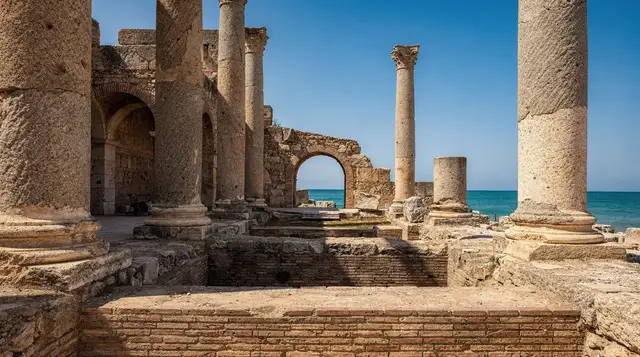
El Djem’s amphitheatre gets nearly all the attention, and reasonably so — it’s the third-largest Roman amphitheatre ever built and dominates the modern town’s skyline in a way that makes it hard to look at anything else. But a few hundred metres away sits the town’s archaeological museum, a smaller and much quieter building holding mosaics recovered from Roman villas that once stood around ancient Thysdrus, the city the amphitheatre served.
Most tour groups don’t stop here at all, which is a shame, because the museum’s mosaic collection is genuinely strong for its size and gives a sense of the wealth Thysdrus generated from olive oil, the same trade that funded the amphitheatre itself. This guide covers what’s inside, how it differs from the collections at the Bardo and in Sousse, and how to fit it into a day built around the amphitheatre.
| Where | A short walk or drive from the El Djem amphitheatre, on the edge of the modern town |
| Cost | A separate, modest ticket from the amphitheatre; roughly 8–10 TND (about €2.50–3) |
| Time needed | 30–45 minutes |
| Getting there | Walkable from the amphitheatre in about ten minutes, or a short taxi ride |
| Best time | Immediately after the amphitheatre, before the midday heat sets in |
If you’d rather see El Djem as part of a wider plan, the El Djem destination page gives the town in context, and the El Djem day trip guide covers how to organise the day around it. Travellers building a longer route through the country’s Roman heritage will also find the UNESCO Tunisia itinerary and the Roman Tunisia itinerary useful for deciding where this museum fits.
Thysdrus: the city that funded a colosseum
Ancient Thysdrus grew wealthy on olive oil production, and by the third century AD it was prosperous enough to fund an amphitheatre on the scale of the one still standing today — a scale that’s genuinely surprising for a provincial town rather than a major imperial capital. That wealth also built substantial private villas, and it’s the mosaic floors from those villas, excavated from sites around the modern town over the past century, that make up the bulk of the museum’s collection.
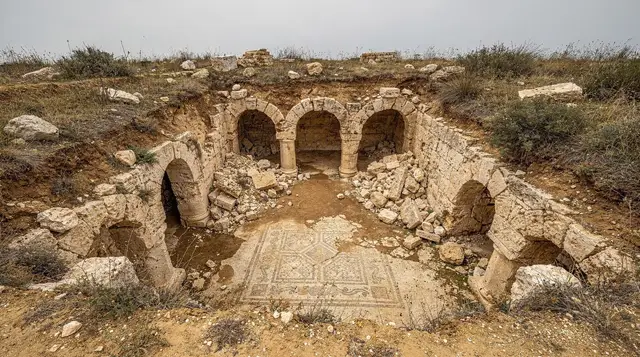
Some of the excavation is still visible in situ a short distance from the museum building itself, where a partially exposed villa site lets visitors see mosaics roughly where they were originally laid rather than only in a gallery setting — a detail that’s easy to miss if you don’t know to look for it.
What’s inside: mosaics from the villas of Thysdrus
The collection centres on floor mosaics depicting mythological scenes, hunting compositions, and the geometric patterns typical of high-status Roman villa flooring across North Africa. A well-known piece depicting the god Dionysus is usually highlighted as one of the museum’s strongest works, alongside several large hunting scenes that give a sense of the scale these floors covered in their original villa settings. The museum is considerably smaller than either the Bardo in Tunis or the archaeological museum in Sousse, and that’s actually part of its appeal for a lot of visitors — there’s no sense of needing to triage which rooms to prioritise, since the whole building can be seen properly in well under an hour.
| El Djem archaeological museum | Sousse archaeological museum | Bardo national museum | |
|---|---|---|---|
| Ancient city | Thysdrus | Hadrumetum | Multiple sites across Tunisia |
| Typical visit | 30–45 minutes | 60–90 minutes | Half a day |
| Setting | Modern building near a partially excavated villa site | Inside the Kasbah fortress | Former beylical palace |
| Crowd levels | Low — most amphitheatre visitors skip it | Moderate | High, especially with tour groups |
If the mosaics are what draw you, the Bardo museum mosaics highlights show the same tradition on a far grander scale, and the Bardo versus Carthage museum comparison helps you decide how to spread your museum time. For a broader view, the museums of Tunis, ranked puts the capital’s collections side by side, and the Tunisian history timeline places Thysdrus within the longer story of Roman Africa.
Why most visitors skip it — and why that’s a mistake
The practical reason so few visitors make it to the museum is scheduling: most day trips to El Djem are built around a fixed block of time at the amphitheatre, often as one stop among several on a wider itinerary, and the museum simply isn’t on the standard tour script unless a driver or guide specifically knows to include it.
A half-day El Jem Coliseum and museum visit from Sousse is one of the few tour formats that explicitly names the museum in its title, which is worth looking for specifically if seeing it matters to you — many other El Djem day trips mention only the amphitheatre, even when the museum is a short walk away and technically included or easily added with advance notice.
If you’re travelling independently rather than on a scheduled tour, there’s no reason to skip it: it adds well under an hour to a day that’s already built around a single-purpose destination, and the mosaics genuinely reward the extra stop rather than feeling like a diminished version of what you’ve already seen at the amphitheatre.
How it compares to Sousse’s museum
Travellers who are also visiting the Sousse archaeological museum sometimes wonder whether seeing both is redundant, since both collections are built around Roman-era floor mosaics from the same general region and period. They’re not redundant — the pieces come from different cities, Thysdrus and Hadrumetum respectively, excavated from different villas with different subjects and compositional styles, so seeing both adds real breadth rather than repeating the same experience twice. See the archaeological museum of Sousse for the fuller picture of that collection, and treat the two as complementary stops on a Sahel-coast itinerary rather than a choice between duplicates.
Combining the museum with the amphitheatre and the archaeological site
The most efficient way to see everything El Djem has to offer is to treat the day as three linked stops rather than one: the amphitheatre itself, the museum a short walk or drive away, and the partially excavated villa site near the museum where some mosaics remain closer to their original context. Budget roughly two to two and a half hours for all three if you want to see them properly rather than rushing. For the amphitheatre itself, see the El Djem amphitheatre: a complete guide, which covers the site in full and is the natural first stop before the museum.
| Stop | Time needed | Notes |
|---|---|---|
| Amphitheatre | 60–90 minutes | The main event; climb to the upper tiers if mobility allows |
| Archaeological museum | 30–45 minutes | A short walk or taxi from the amphitheatre |
| Excavated villa site near the museum | 15–20 minutes | Easy to miss; ask locally if it isn’t obviously signposted |
If you’re pairing El Djem with other stops on the coast, the Sousse and Monastir day trip and the ribats and fortresses of the Sahel fit naturally into the same region, while the Sousse destination page is a good base for planning. Independent travellers relying on public transport should read louages explained and trains in Tunisia before setting out.
What the excavated villa site adds that the gallery can’t
The partially exposed villa remains near the museum building are easy to miss, since they’re not always clearly signposted from the main entrance, but they’re worth actively asking about if you don’t spot them on your own. Seeing a mosaic floor still roughly in the position it was laid, with the outline of the room it once decorated still traceable in the surrounding foundations, gives a different sense of scale than the same mosaic lifted and mounted on a gallery wall.
It’s a small site, nowhere near the scale of Bulla Regia’s underground villas or Dougga’s town plan, but it’s a useful reminder that the museum’s collection didn’t originate in a museum at all — it came out of the ground a short walk from where you’re standing, from houses that once belonged to real families whose wealth is now measured mostly in the floors they left behind.
Getting to El Djem from Tunis, Sousse or elsewhere
El Djem sits roughly midway between Sousse and Sfax, making it a natural stop for travellers moving along the eastern coast rather than a dedicated destination from Tunis, though it’s done as a long day trip from the capital by some visitors with limited time.
From Tunis, the drive is around two and a half to three hours each way, which makes El Djem a better fit for a broader itinerary that also covers Roman sites further north — a Bulla Regia and Dougga archaeological tour with lunch from Tunis covers a different but comparably significant set of Roman sites without the longer drive south, and is worth considering as an alternative or complement if your itinerary has room for only one major Roman excursion from the capital.
For travellers focused on Carthage and closer sites, a Carthage walking tour of the archaeological sites and ruins stays within the greater Tunis area entirely.
Travellers combining a northern coastal route with El Djem sometimes also consider Utica and Bizerte on a separate day; a tour of the archaeological site of Utica, Ras Angela and Bizerte covers that entirely different stretch of coast and isn’t a substitute for El Djem, but rounds out a longer Roman-Tunisia itinerary for travellers with more than a week to spend. For a wider comparison of how the country’s Roman sites stack up against each other, Roman sites near Tunis, ranked by what you actually see is a useful reference before committing to which combination fits your schedule.
Why olive oil built an amphitheatre this size
It’s worth pausing on why a provincial town like Thysdrus, rather than a major administrative capital, ended up with an amphitheatre on the scale of El Djem’s — one that could seat tens of thousands and rivals structures in Rome itself. The answer is almost entirely economic: North Africa’s olive oil trade was enormously profitable under Roman rule, and Thysdrus sat at the centre of one of the richest oil-producing regions in the empire, with estate owners and merchants who accumulated the kind of private wealth that funded both grand public architecture and the lavish villa floors now on display in the museum.
The amphitheatre wasn’t built by imperial decree in the way some of Rome’s own structures were — it was, in large part, a statement of local prosperity, and the museum’s mosaics are the domestic counterpart to that same wealth, showing what individual households could afford to commission for their own homes rather than for public display. Understanding that connection changes how the museum reads: it isn’t a minor annex to the amphitheatre, but evidence of the same economic story from a different angle.
For a first-hand account of the amphitheatre’s upper rows, read El Djem from the top tier, a good companion to a museum visit. And if you’re deciding between ancient sites, Carthage versus Dougga and the Dougga complete guide show how a larger Roman town compares with the more compact picture you get at Thysdrus.
Practical details: tickets, hours, and what to expect
The museum sells a separate ticket from the amphitheatre — the two aren’t bundled — so budget for both if you’re visiting independently. Hours generally track the amphitheatre’s own daytime schedule, though it’s worth confirming locally since regional museum hours in Tunisia shift by season more than visitors from other countries tend to expect. The building itself is modern and air-conditioned, which makes it a welcome break from the heat of the open-air amphitheatre, particularly in the warmer months when the exposed stone terraces can be genuinely uncomfortable by midday. Labelling is in French and Arabic, with minimal English, consistent with regional museums outside the Bardo.
Mistakes to avoid
Frequently asked questions about the El Djem archaeological museum
Is the museum ticket included with the amphitheatre entry?
No, they’re sold separately. Budget a small additional ticket price if you want to visit both, and expect to pay at a separate counter near the museum building.
How long does a visit take?
Thirty to forty-five minutes is typical for the museum itself, plus another fifteen to twenty minutes if you also visit the partially excavated villa site nearby.
What’s the standout piece in the collection?
A well-preserved mosaic depicting Dionysus is usually singled out as the museum’s strongest single work, alongside several large hunting-scene compositions from local villa floors.
Do day tours to El Djem usually include the museum?
Not always — many itineraries focus solely on the amphitheatre. Look specifically for tours that name the museum in their description, such as a half-day El Jem coliseum and museum visit, or ask your guide whether it can be added.
How does this museum compare to the one in Sousse?
They’re complementary rather than duplicates. This collection comes from ancient Thysdrus, while Sousse’s comes from Hadrumetum — different villas, different subjects, both worth seeing if you’re touring the Sahel coast. See the archaeological museum of Sousse for details.
Is there anything to see beyond the museum building itself?
Yes — a partially excavated villa site sits near the museum where some mosaics remain closer to their original in-situ context, rather than only displayed in gallery rooms. It’s easy to miss if you don’t know to look for it.
Is El Djem a reasonable day trip from Tunis?
It’s a long one — around two and a half to three hours each way — and works better as part of a broader itinerary or a stop between Sousse and Sfax than as a dedicated day trip purely from the capital.
Is the museum air-conditioned?
Yes, which makes it a useful midday break from the heat of the open-air amphitheatre, particularly outside the cooler months.
Are the labels in English?
Mostly not — expect French and Arabic labelling with limited English signage, consistent with most regional Tunisian museums outside the Bardo in Tunis.
Roman & Punic site tours on GetYourGuide
Verified deep-linked GetYourGuide tours. Book through these links and we earn a small commission at no cost to you.
These are our own photographs of Tunisia, not the operator's pictures of this tour — open the tour page to see those.