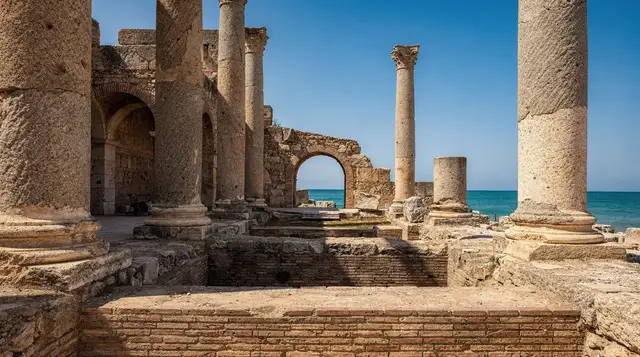
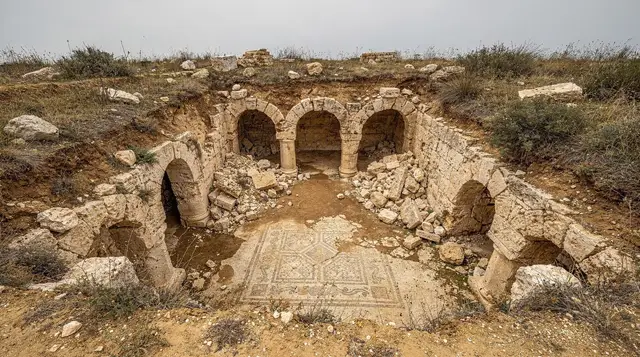
The Carthage national museum
What will I actually see inside the Carthage national museum?
Mostly Punic-era material: funerary stelae from the tophet sanctuary, carved sarcophagi including the well-known priestess and priest figures, ceramics, jewellery and trade amphorae, plus a smaller Roman-period room of mosaic fragments, statuary and glassware. It's compact, honestly, and strongest on Punic material rather than the large-scale mosaics the Bardo is known for.
The Carthage national museum sits inside the former seminary of the White Fathers on Byrsa hill, a building that predates the museum’s formal role by decades and still feels more like a repurposed institutional structure than a purpose-built gallery. That’s not a criticism so much as a description: this is a compact, site-specific collection built around what’s been dug out of Carthage’s soil rather than a national survey the way the Bardo is. This guide goes gallery by gallery through what’s actually on display, since the site’s history and Byrsa hill’s own Punic ruins are covered separately in Byrsa hill and the Carthage national museum.
| Where | Byrsa hill, Carthage, inside the former White Fathers seminary |
| Cost | Included in the Carthage multi-site ticket, roughly 12 TND (about €3.50) |
| Time needed | 45 minutes to an hour for the galleries themselves |
| Getting there | TGM train to Carthage-Hannibal, then a 15-minute uphill walk |
| Best time | Morning, before the hilltop’s exposed terraces get hot |
The prehistoric and earliest Punic rooms
The first galleries cover material that predates Carthage’s peak as a Mediterranean power, small finds from the earliest Phoenician settlement on this coast, ninth and eighth century BC pottery imported from the eastern Mediterranean, and simple domestic objects that establish just how early trading contact with Carthage’s Phoenician homeland began. It’s a modest opening section, easy to move through quickly, but worth a slower look for anyone interested in how a colony founded, according to tradition, by settlers under Elissa (Dido) grew from a small coastal trading post into the dominant power of the western Mediterranean within a few centuries.
The tophet stelae: Carthage’s most debated artefacts
The museum’s Punic funerary stelae, recovered from Carthage’s tophet sanctuary, are among the most discussed objects in the whole collection, and for reasons that go beyond their craftsmanship. The tophet was a burial ground associated with urn burials of infants and young animals, and for decades the site fuelled a genuinely contested debate among historians and archaeologists over whether it represents evidence of ritual child sacrifice, a practice ancient Greek and Roman writers accused Carthage of, or whether it was primarily a burial ground for children who died of natural causes, interpreted through later, hostile Roman propaganda.
The stelae themselves, carved with symbols including the “sign of Tanit,” a stylised figure associated with the chief Carthaginian goddess, are displayed with limited interpretive text, so it’s worth knowing before you arrive that the objects in front of you sit at the centre of a real, unresolved scholarly argument rather than a settled historical fact.
The sarcophagi: Carthage’s best-known single objects
If the museum has a signature exhibit, it’s the pair of marble sarcophagi carved with reclining human figures in long, finely worked robes, generally described as a priestess and a priest, discovered in Punic-era tombs and dated to the fourth century BC. The level of detail in the drapery and facial features is genuinely striking for material this old, and the pair is usually given the most prominent single display space in the museum. They’re a useful anchor point if you’re moving through the galleries quickly and want one unmissable stop rather than trying to absorb everything evenly.
The priestess figure in particular draws attention for the care given to her headdress and the folds of drapery across her shoulders, details that survive remarkably well given the sarcophagus spent centuries underground before excavation. Scholars generally read the pair as belonging to a wealthy Punic family who could commission funerary sculpture of a quality otherwise associated with much larger Mediterranean workshops, a reminder that Carthage’s elite maintained real artistic patronage even in the final century before Rome’s conquest.
| Gallery | Period | Highlight objects |
|---|---|---|
| Earliest Punic rooms | 9th–8th century BC | Imported eastern Mediterranean pottery |
| Tophet gallery | Punic era | Funerary stelae, sign of Tanit carvings |
| Sarcophagi hall | 4th century BC | Priestess and priest marble sarcophagi |
| Trade and daily life | Punic era | Amphorae, jewellery, ceramics |
| Roman rooms | 2nd century BC onward | Mosaic fragments, statuary, glassware |
A collection built by missionaries, later reorganised
The museum’s origins are worth knowing before you walk in, since they explain some of its slightly institutional, non-purpose-built feel. The collection grew out of the work of the White Fathers, a Catholic missionary order founded by Cardinal Charles Lavigerie, who established the seminary on Byrsa hill in the 1890s and, alongside their religious work, took a serious interest in the Punic and Roman finds emerging from excavations around them.
What began as an informal collection housed within the seminary was gradually organised into a proper museum through the early twentieth century, and reorganised again after Tunisian independence in 1956, when the state took over management of the collection and the site more broadly. That history is why the building still reads as a converted institutional structure rather than a museum designed from the ground up: it genuinely was one, repurposed rather than built for its current role.
A suggested order for a first visit
Given the museum’s modest size, a sensible route is to start with the earliest Punic rooms near the entrance, move through the tophet gallery and sarcophagi hall while attention is still fresh, since these are the collection’s strongest material, and finish with the trade and daily-life rooms and the smaller Roman-period galleries, which reward a slower look precisely because most visitors rush past them at the end of a visit. Doing it in reverse order isn’t wrong, but visitors who start with the quieter trade rooms sometimes run out of patience before reaching the sarcophagi, which would be a genuine shame given they’re the single most distinctive objects in the building.
Fitting the museum into a wider Carthage day
The museum works best as one stop among several rather than a destination on its own. The ticket that opens its doors also opens the other ancient sites, so the Carthage multi-site ticket guide is worth reading before you decide how to split your time. On the ground, the Antonine baths, the Roman theatre and villas and the Punic ports all sit within reach of the hill, and the museum gives useful background for each of them. For the full picture of what the ancient city offers, the guide to Carthage’s archaeological sites lays out the options, and the Carthage destination page covers the neighbourhood as a whole.
Many visitors finish the afternoon in the village nearby: the Sidi Bou Said complete guide and the Carthage and Sidi Bou Said day trip both show how the two fit together without a rushed schedule. If you are building a longer stay, the Tunis in one day itinerary and the Tunis in two days itinerary place the museum within a realistic plan, and how to get around Tunis explains the transport side.
Trade, jewellery and the everyday objects that funded Carthage’s power
A less dramatic but genuinely informative set of rooms covers the trade goods and daily-life objects that built Carthage’s wealth in the first place: amphorae used for shipping wine and olive oil across the Mediterranean, jewellery in gold and semi-precious stone, small votive figures left at shrines, and ceramics both locally produced and imported from as far as Greece and the Levant. These rooms give a more domestic, less monumental sense of Punic Carthage than the stelae and sarcophagi do, and they’re consistently the quietest galleries in the museum, worth a slower look precisely because most visitors move past them quickly toward the more famous pieces.
The Roman-period rooms: smaller in scale than you’d expect
A second, smaller set of galleries covers material from Carthage after Rome rebuilt it as Colonia Julia Carthago in the late first century BC, mosaic fragments, statuary, glassware and everyday Roman-period objects from the rebuilt city. It’s genuinely thinner in scale than what the Bardo holds, and worth knowing that in advance so it doesn’t feel like an anticlimax after the Punic galleries.
This museum’s strength is Punic material specifically; if room-sized Roman floor mosaics are what you came for, that’s a Bardo trip, not a Carthage national museum one. The Bardo or the Carthage museum? breaks this comparison down directly if you’re deciding how to split limited time between the two.
A skip-the-line guided tour of the Bardo is worth booking as a complement to a Carthage museum visit if you want the Roman mosaic side of the story properly covered rather than relying on this museum’s smaller Roman rooms alone.
Labelling, language and where a guide helps
Labelling across the galleries is inconsistent, some rooms carry detailed French and Arabic panels, others very little in English, and the tophet gallery in particular benefits from context a caption alone won’t provide given the genuine scholarly debate around it. A private tour covering the Bardo, Carthage, Sidi Bou Said and the medina pairs a guided walk through this collection with the Bardo’s Roman-era galleries the same day, useful if you want the Punic and Roman stories explained side by side rather than pieced together from two separate, unguided visits.
How this compares to other Tunisian archaeological museums
Tunisia has several smaller site museums built around a similar model, a compact collection tied to one specific archaeological site rather than a national survey. A half-day tour to the El Jem coliseum and museum from Sousse covers a comparable regional museum built around a single Roman town’s finds, worth considering if the site-museum format here at Carthage appeals to you and you have time to see how a different Roman-Tunisian town’s collection compares. The museums of Tunis, ranked places the Carthage national museum in context against the Bardo, Dar Ben Abdallah and the rest of the city’s collections.
Practical details: what to bring, what to expect
Bring water; there’s no reliable vendor inside the museum itself, and the hilltop above it has none either. Photography is generally permitted throughout, though flash is discouraged near the more fragile stelae and painted surfaces. The building itself involves stairs between some floor levels, worth knowing if mobility is a concern, since it wasn’t designed as a purpose-built accessible museum. Visits typically run 45 minutes to an hour for the galleries alone; add time if you’re combining the museum with Byrsa hill’s Punic quarter and the cathedral terrace immediately outside, covered separately in Byrsa hill and the Carthage national museum.
If you want more background before or after the visit, the Tunisian history timeline puts the Punic and Roman periods in sequence, and the Bardo mosaics highlights shows what to look for on the Roman side. Readers comparing sites across the country can also turn to the Roman sites near Tunis, ranked.
Mistakes to avoid
Frequently asked questions about the Carthage national museum
What period does the museum’s collection mostly cover?
Primarily Punic-era material, funerary stelae, sarcophagi, jewellery, trade goods, alongside a smaller Roman-period collection of mosaic fragments, statuary and glassware from the rebuilt city.
Is the tophet a proven child sacrifice site?
It’s genuinely disputed among historians and archaeologists — some interpret the urn burials as evidence of ritual sacrifice, others as a natural-death infant burial ground shaped by hostile Roman-era propaganda. The museum’s own labelling doesn’t fully resolve this, so treat the objects as evidence in an ongoing debate rather than a settled fact.
How does this museum compare to the Bardo?
It’s smaller, more site-specific, and stronger on Punic material; the Bardo holds a vastly larger and more famous Roman mosaic collection. See the Bardo or the Carthage museum? for a direct comparison.
Do I need a separate ticket for the museum?
No, entry is included in Carthage’s combined multi-site ticket, roughly 12 TND, which also covers the Antonine baths, the Punic ports and the other Carthage sites.
What’s the single most important object to see?
The priestess and priest sarcophagi, fourth-century BC marble figures with unusually fine carved detail for their age, are generally considered the museum’s signature pieces.
Is the museum wheelchair accessible?
Only partially — the building involves stairs between some levels, since it was originally a seminary rather than a purpose-built accessible museum. Check current access arrangements if this matters for your visit.
How long should I budget for the museum itself?
Forty-five minutes to an hour for the galleries alone. Add another 30 to 45 minutes if you’re combining it with Byrsa hill’s excavated Punic quarter and the cathedral terrace immediately outside.
Should I visit this before or after the Bardo?
Either order works, but visiting the Carthage museum first gives useful Punic-era context before seeing the Bardo’s larger, later Roman collection; visiting the Bardo first gives a strong baseline for how much bigger a national-survey museum can be compared with this compact, site-specific one.
Roman & Punic site tours on GetYourGuide
Verified deep-linked GetYourGuide tours. Book through these links and we earn a small commission at no cost to you.
These are our own photographs of Tunisia, not the operator's pictures of this tour — open the tour page to see those.