Thuburbo Majus: the quiet Roman city near Tunis
Is Thuburbo Majus worth visiting if I've already seen Dougga?
Yes, if you have half a day and an interest in Roman sites, mainly because it's uncrowded and can be combined with Zaghouan or Oudhna without a long drive. It's a smaller, quieter site rather than a must-see on its own.
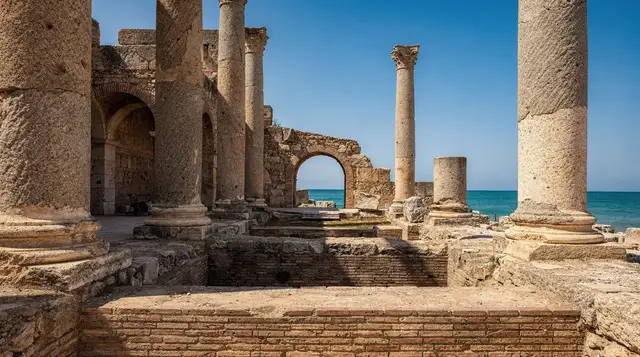
Thuburbo Majus doesn’t get anywhere near the visitor numbers of Carthage or Dougga, and that’s precisely its appeal for a certain kind of traveller. Founded as a Roman colony in the 1st century AD on the site of an earlier Numidian settlement, the city grew wealthy from the surrounding wheat and olive land and left behind a forum, a capitol on a raised platform, and a set of public baths with mosaic floors still partly in place. You can walk the whole site in under an hour without seeing another visitor, which is either a relief or a slightly eerie experience depending on your temperament.
It sits roughly 60 km south-west of Tunis, close enough that it’s often bundled with Zaghouan or Oudhna as part of a half-day loop rather than visited alone. Nothing here rivals Dougga’s theatre or Carthage’s Antonine baths for scale, but the winter baths mosaics and the capitol’s six standing columns are genuinely worth the stop if you’re already in the area.
| Where | Near Fahs, Zaghouan governorate, about 60 km south-west of Tunis |
| Cost | Around 8 TND (roughly €2.30) entry |
| Time needed | 45 minutes to 1.5 hours |
| Getting there | Car or tour from Tunis, about 1 hour each way |
| Best time | Late morning to early afternoon, any season |
What survives on site
The capitol, dedicated to Jupiter, Juno and Minerva, sits on an elevated platform reached by a broad flight of steps, with six of its original columns still standing — a striking silhouette against the hills toward Zaghouan, and the single most photographed feature at the site. Below it, the forum retains its paving and the outline of surrounding porticoes, giving a reasonably clear sense of the city’s civic centre even without much vertical structure remaining.
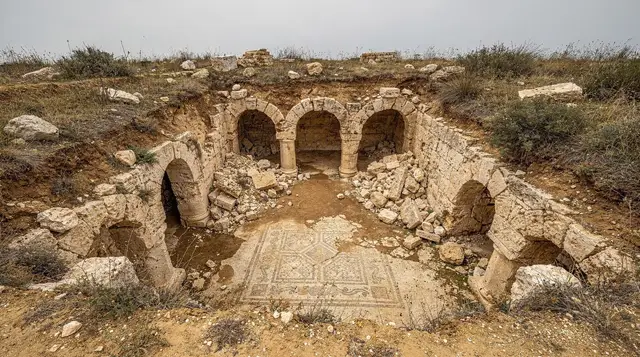
The winter baths are the other highlight, with several rooms retaining geometric mosaic floors in situ, similar in spirit to what you’ll see at Bulla Regia though on a smaller scale. There’s also a partially excavated market building (the palaestra of the Petronii) and traces of a temple to Mercury on the edge of the site. None of it is dramatically restored — this is very much a working excavation rather than a polished heritage park — which some visitors find refreshingly authentic and others find underwhelming compared with the more manicured presentation at Carthage’s main sites.
Getting there from Tunis
By car, Thuburbo Majus is around an hour from central Tunis via the A1 motorway toward Zaghouan, then a short stretch of secondary road near Fahs. There’s no direct public transport option that gets you to the site itself; louages run toward Zaghouan and Fahs, but you’d still need a taxi for the final approach, which makes this a car-or-tour destination for practical purposes.
Because the site sits roughly between Tunis and Zaghouan, it pairs naturally with a visit to the Zaghouan water temple and aqueduct, and often with Oudhna’s Roman amphitheatre as well, since all three sit within a compact triangle south of the capital. A private Roman tour covering Oudhna, Zaghouan and Thuburbo Majus is the most efficient way to see all three without retracing your route, and keeps the day to a manageable half-day rather than stretching into a full one.
If you’d prefer a slightly different combination or a group rather than private setting, a day tour from Tunis taking in Oudhna, Zaghouan and Thuburbo Majus covers the same three sites with a shared vehicle, generally at a lower price point than the private version.
Combining with Zaghouan and Oudhna
The logic of grouping these three sites is straightforward: Oudhna (ancient Uthina) sits closest to Tunis with its Roman amphitheatre partly cut into a hillside, Thuburbo Majus is roughly forty minutes further south-west, and Zaghouan’s water temple and aqueduct trailhead sit a similar distance again toward the mountain that gives the town its name. Done as a loop, the whole circuit takes around six to seven hours including driving, site time, and a lunch stop, which is why it’s typically sold as a half-day-plus rather than a strict half-day tour.
If your interest runs more toward rural Tunisian life than ruins specifically, a beginner pottery workshop on a farm near Tunis in the same general direction can be added to a Thuburbo Majus day for travellers wanting a change of pace from archaeology, since several farms and workshops operate in the Zaghouan-Fahs corridor. For those who’d rather see the region as part of a broader single day covering more ground, a full-day tour of the Tunis governorate is worth checking against your specific interests, since it covers a wider net than the Roman-sites loop.
For a fuller picture of the loop, the Zaghouan and Thuburbo Majus day trip lays out the route stop by stop, while the Oudhna guide and the Zaghouan water temple guide cover the other two halves of the triangle. The town itself has its own page under Zaghouan, worth a look if you want a sense of where you’ll stop for lunch.
Choosing between a tour and doing it yourself
Because public transport stops short of the site, the real decision is between a hired car and an organised day. If you’re weighing the two, private vs group tours in Tunisia explains the trade-offs in general terms, and car hire in Tunisia and driving in Tunisia cover what to expect behind the wheel. If you’d rather go without a car, louages explained, taxis in Tunis and the wider getting around Tunis guide will help you plan the awkward last leg.
What the visit actually feels like
Because Thuburbo Majus receives so few visitors relative to Dougga or Carthage, you’ll likely have long stretches of the site to yourself, which changes the character of the visit — there’s no jostling for a photo angle at the capitol steps, and the winter baths mosaics are usually visible without anyone else in frame. The trade-off is that there’s minimal on-site infrastructure: no café, limited shade, and signage that’s present but sparse, mostly in French and Arabic.
The ground is uneven in places, particularly around the baths complex where excavation trenches and partially reconstructed walls sit close together. Sturdy shoes matter more here than the short overall walking distance would suggest. There’s a small parking area near the entrance and a ticket booth that’s reliably staffed during opening hours, though don’t expect much beyond that — bring water, as there’s no reliable vendor on site.
Is it worth it if you’ve already seen Dougga?
This is the question most people weighing a visit actually have, and the honest answer depends on what you’re after. Dougga is unambiguously the more complete and impressive Roman site in the region, with a genuinely well-preserved theatre and a capitol you can walk into rather than just view from below. Thuburbo Majus doesn’t compete with that. What it offers instead is quiet, a shorter drive from Tunis than Dougga, and a natural pairing with Zaghouan that makes for an efficient half-day rather than committing a full day the way Dougga typically requires.
If you have limited time in Tunis and must choose one Roman site beyond Carthage, choose Dougga. If you have a second or third day for ruins, or if Zaghouan’s water temple is already on your list, Thuburbo Majus earns its place as an add-on rather than a destination in its own right.
Where Thuburbo Majus fits among the Roman sites
If you’re still deciding how to spend your ruins days, Roman sites near Tunis, ranked puts this site in context, and Carthage vs Dougga helps if you haven’t yet chosen your main site. The Dougga complete guide and the Dougga destination page describe the better-preserved option, and Bulla Regia’s underground villas are the other mosaic-rich stop to consider. Closer to the capital, Carthage and the Bardo Museum, where many mosaics from sites like this one are displayed, make natural companions. Anyone building a longer route can start from the Roman Tunisia itinerary or browse best day trips from Tunis.
Practical notes for the visit
Opening hours generally run from around 8:30am to 5:30pm in winter and slightly later into the evening in summer, though as with most Tunisian archaeological sites, it’s worth confirming the current hours locally rather than relying on posted times, since seasonal adjustments happen and aren’t always well signposted in advance. Entry is inexpensive relative to Carthage’s multi-site ticket, and there’s no equivalent combined pass here — it’s a standalone entry fee.
Photography is unrestricted and there’s no additional camera fee at the time of writing, unlike some other Tunisian sites. The capitol steps and platform give the best vantage point for an overview shot of the forum and surrounding countryside, particularly in the softer light of late afternoon.
A city built on wheat and olives
Thuburbo Majus began as an indigenous Numidian settlement before becoming a Roman colony under Augustus and then reaching full municipal status under Hadrian in the 2nd century AD. Its wealth, like most towns in this fertile stretch of the Medjerda basin, came from grain and olive oil production, exported north through Carthage to feed Rome itself — a reminder of just how central this region was to the Roman empire’s food supply. The capitol and forum you see today date largely from this period of prosperity, roughly the 2nd and early 3rd centuries, when the town’s leading families competed to fund public buildings as a form of civic status, a common pattern across Roman North Africa known as euergetism.
The town’s decline followed the broader pattern seen across inland Tunisia: economic pressure, reduced agricultural investment, and eventually the Vandal and then Byzantine periods brought reduced maintenance of public buildings, though there’s evidence of continued occupation on a smaller scale well into the Byzantine era, with some structures repurposed for defensive or religious use. By the early Islamic period the site had been largely abandoned, leaving it to be gradually built over by soil and vegetation until 19th and 20th century excavation began uncovering it again.
The market building and other lesser-visited features
Beyond the capitol, forum and winter baths, the site includes the palaestra of the Petronii, a large open exercise and market area named for an inscription referencing a prominent local family, the Petronii, who appear to have funded its construction. It’s less visually striking than the capitol but gives a useful sense of the town’s civic and commercial life beyond religion and bathing. Nearby, traces of a temple dedicated to Mercury — god of trade and commerce, fittingly positioned near the market building — round out the picture of a town organised, as most Roman towns were, around an interlocking set of civic, religious and commercial functions clustered near the forum.
These secondary features receive far fewer visitors than the capitol steps, and if you have the extra twenty or thirty minutes, walking out to them gives a fuller sense of the site’s original scale, which is easy to underestimate if you only see the two headline features.
Mistakes to avoid
Frequently asked questions about visiting Thuburbo Majus
How does Thuburbo Majus compare to Dougga?
Dougga is significantly larger and better preserved, with a complete theatre and a capitol you can enter. Thuburbo Majus is smaller, less restored, and much quieter, making it a good second Roman site rather than a substitute for Dougga on a first visit to the region.
Can I get to Thuburbo Majus without a car or tour?
Not easily. Louages run toward Fahs and Zaghouan, but there’s no direct route to the site itself, so you’d need a taxi for the final leg. Most visitors go by rental car or as part of an organised tour that also covers Zaghouan and Oudhna.
How much time should I budget for the site itself?
Most visitors spend 45 minutes to an hour and a half walking the forum, capitol and winter baths. It’s a compact site compared with Dougga, so it fits comfortably into a half-day that also includes Zaghouan or Oudhna.
Is there shade or anywhere to buy water on site?
Shade is limited, and there’s no reliable food or drink vendor at the site. Bring water, particularly if visiting between May and September when the exposed forum area gets hot by midday.
What’s the single best thing to see if I only have thirty minutes?
The capitol platform with its six standing columns is the site’s defining image and the quickest payoff for a short visit. If you have a few extra minutes, the winter baths mosaics are worth the short walk beyond the forum.
Is Thuburbo Majus suitable for visiting with children?
The uneven terrain and lack of shade make it less comfortable for young children than more developed sites, though the compact size means the visit itself is short. It works better as part of a varied day that includes a farm or workshop stop than as a standalone stretch of ruins for younger visitors.
Does the site charge extra for photography?
No additional camera fee applies at Thuburbo Majus at the time of writing, unlike some other Tunisian archaeological sites where a separate photography ticket is sometimes required.
What’s nearby if I want to extend the day beyond Roman ruins?
The Zaghouan-Fahs area has several farms offering activities like pottery workshops, which make a good contrast to a morning of ruins. Zaghouan town itself, with its mountain backdrop and the water temple trailhead, is the natural next stop on the same route.
Who built the capitol and why does it stand on a raised platform?
The capitol was funded, like most major public buildings at Thuburbo Majus, by wealthy local families competing for civic prestige — a common pattern across Roman North Africa. Raising it on an elevated platform reached by a broad staircase followed standard Roman religious architecture, giving the temple to Jupiter, Juno and Minerva visual dominance over the surrounding forum and civic buildings below.
Roman & Punic site tours on GetYourGuide
Verified deep-linked GetYourGuide tours. Book through these links and we earn a small commission at no cost to you.
These are our own photographs of Tunisia, not the operator's pictures of this tour — open the tour page to see those.