Uthina (Oudhna) and its Roman amphitheatre
Is Oudhna's amphitheatre similar to El Djem's?
No. Oudhna's amphitheatre is smaller, partly built into a natural hillside, and far less complete than El Djem's freestanding colosseum. It's a worthwhile half-day stop close to Tunis, not a substitute for El Djem.
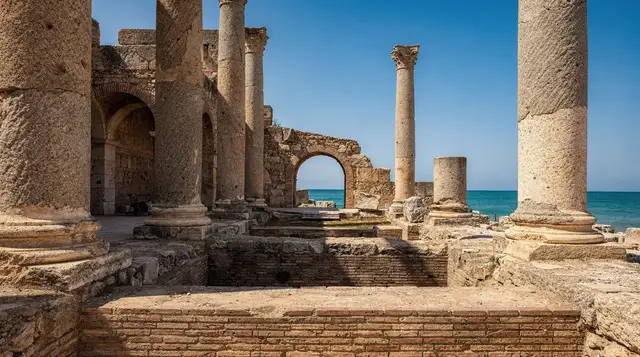
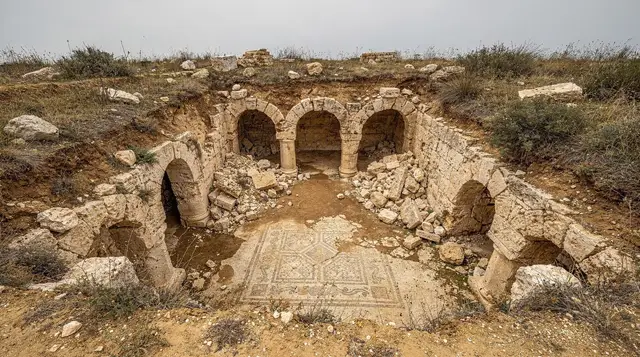
Of all the Roman sites within easy reach of Tunis, Oudhna is the closest and the least visited, which makes it an odd but genuine curiosity: a Roman amphitheatre roughly thirty minutes from the capital that most travellers, and even a lot of Tunis residents, have never been to. The ancient city was called Uthina, founded as a veterans’ colony under Augustus, and it grew into a modestly prosperous town whose amphitheatre — cut partly into the natural slope of a hill rather than built entirely freestanding — still stands, along with a capitol, cisterns, and the remains of a large residential quarter with mosaic floors.
It isn’t a rival to El Djem, and nobody claims it should be. What it offers is proximity — genuinely close enough to combine with a morning in Tunis and still be back by mid-afternoon — plus a specific bit of Roman engineering (the hillside-cut cavea) that’s worth understanding even if the visit itself takes under an hour.
| Where | Oudhna village, about 30 km south of Tunis |
| Cost | Around 8 TND (roughly €2.30) entry |
| Time needed | 45 minutes to 1 hour |
| Getting there | Car or tour from Tunis, about 30-40 minutes each way |
| Best time | Morning, combined with Zaghouan or Thuburbo Majus |
The amphitheatre and what makes it different
Most Roman amphitheatres, El Djem included, are freestanding structures built entirely from cut stone, rising as independent buildings regardless of the surrounding terrain. Uthina’s amphitheatre takes a different, cheaper approach: its builders cut part of the seating tiers directly into a natural hillside, using masonry construction only where the slope didn’t already provide the necessary rake. It’s a smart, economical piece of engineering, though it also means less of the structure survives as freestanding stonework compared with El Djem, since erosion and stone-robbing over the centuries have taken a heavier toll on the built sections.
What remains is still recognisably an amphitheatre — you can walk the arena floor and trace the tiers rising on the hill side — but it requires more imagination to picture it complete than El Djem does. For visitors who’ve already seen El Djem and want to understand Roman amphitheatre construction more broadly, seeing this hillside variant is genuinely informative. For a first and only amphitheatre visit in Tunisia, El Djem gives a far more dramatic and complete picture.
Beyond the amphitheatre
The rest of the site includes a capitol on raised ground, a set of cisterns that once supplied the town’s water, and a large residential complex known for a mosaic depicting a chariot race, though much of that has been moved to the Bardo museum rather than left in situ. The overall footprint of Uthina is large — this was a real town, not just an amphitheatre — but much of it remains unexcavated or only partially cleared, so the visitable core is smaller than the ancient city’s actual extent.
Signage is sparse, similar to Thuburbo Majus, and there’s minimal on-site infrastructure. The setting itself, on a hill with views over the surrounding agricultural land, is pleasant enough to justify a slow walk even where the ruins themselves don’t demand much time.
Getting there from Tunis
Oudhna is genuinely close — about 30 km south of Tunis, roughly a thirty-to-forty-minute drive depending on traffic leaving the city. This makes it one of the more accessible Roman sites for travellers without a full day to spare, and it’s often the first stop on longer loops heading toward Zaghouan and Thuburbo Majus, or occasionally combined with Dougga for a more ambitious single day.
A private Roman tour covering Oudhna, Zaghouan and Thuburbo Majus is the most common way to see the site, using it as the first, quickest stop before continuing to the more substantial ruins further south. For travellers wanting to pair Oudhna with a longer day covering Dougga as well, a full-day private tour combining Uthina and Dougga is a reasonable option, though be aware this makes for a fuller day given the additional distance to Dougga beyond Oudhna.
Choosing between a car, a taxi and a tour
How you get to Oudhna shapes the rest of the day. Anyone comfortable behind the wheel will find that car hire in Tunisia gives the most freedom, especially if you plan to stop at several sites; the driving in Tunisia guide covers what to expect on the road. If you would rather not drive, taxis in Tunis and the wider overview in getting around Tunis explain how to agree a fare before setting off. Travellers weighing a guided option can read private vs group tours in Tunisia to decide which format suits a small site like this one.
Where Oudhna fits in a Roman-sites loop
Oudhna works best as the opening stop of a longer circuit. Heading on to Zaghouan, you can see the Zaghouan water temple, the monument that marks the source of the Roman aqueduct, and then continue to Thuburbo Majus, whose larger and better-cleared ruins make a natural counterpart to Oudhna’s quieter hillside. The Zaghouan and Thuburbo day trip lays out that loop in more detail, and the Zaghouan mountain hike is an option for anyone who wants to add some walking.
For a wider view, the Roman sites near Tunis ranked puts Oudhna in context beside its neighbours, while the Roman Tunisia itinerary strings several of these places into a longer trip. If you are still deciding how to fill your days, best day trips from Tunis compares the options side by side.
How it compares to El Djem
This is the comparison most people are actually curious about, and it’s worth being direct: El Djem’s amphitheatre is one of the best-preserved Roman amphitheatres anywhere in the world, a freestanding colosseum you can walk through at multiple levels, including underground service passages. Oudhna’s amphitheatre is a fraction of that scale and completeness. If your trip includes time near Sousse or El Djem itself, that’s where to see a proper Roman amphitheatre; Oudhna is a convenience stop for travellers based in Tunis who won’t make it further south.
That said, the two aren’t really competing for the same visit. A tour discovering the El Djem amphitheatre or a half-day trip to the El Djem amphitheatre and museum from Sousse makes sense as a separate excursion if your itinerary reaches that far south; Oudhna simply isn’t a substitute if El Djem is reachable during your trip.
For anyone who does reach the south, the El Djem amphitheatre guide and the El Djem day trip guide explain what a fully preserved colosseum looks like, and the El Djem destination page covers the town around it. Seeing Oudhna first and El Djem later is a good way to appreciate how differently Roman builders handled the same building type.
Practical notes
The site opens roughly 8:30am to 5:30pm in winter with slightly extended summer hours, though as with the smaller sites in this region, confirming current hours locally is sensible rather than relying on posted times. There’s minimal shade, a small ticket booth, and no food or drink available on site, so plan accordingly if it’s part of a longer day.
Because Oudhna sees relatively few visitors, it’s rarely crowded even when tour buses do pass through, and photography is unrestricted with no separate camera fee at the time of writing. The best overview shot of the amphitheatre comes from the top of the hillside seating, looking down across the arena toward the capitol ruins in the middle distance.
The wider ancient city
It’s worth remembering that Uthina was a real town of several thousand residents at its height, not just an amphitheatre. Aerial surveys and partial excavations over the past century suggest the ancient street grid extended well beyond what’s currently cleared and open to visitors, with residential quarters, workshops and at least one additional bath complex still largely under the surrounding farmland. Only a fraction of that footprint has been properly excavated, partly because much of the ancient city now lies beneath active agricultural fields, and partly because archaeological funding in Tunisia has understandably prioritised the larger, more visitor-ready sites like Dougga and Carthage over a smaller provincial town.
This partial-excavation status is worth knowing before you visit, because it explains why Oudhna can feel oddly incomplete compared with its historical importance — you’re seeing perhaps a third of what actually survives underground, rather than the full ancient city. For visitors with a genuine interest in how Roman archaeology in Tunisia actually works, rather than just the finished, roped-off version presented at the major sites, Oudhna’s rougher, partially-excavated character is arguably more honest about the ongoing nature of the work.
Much of what Uthina once held now lives in Tunis. The Bardo museum complete guide and the Bardo mosaics highlights show where the finds from sites like this one are displayed, which makes a Bardo visit a sensible companion to a trip out to Oudhna. For the bigger picture of how the veterans’ colony fits into the region’s past, the Tunisian history timeline gives the sequence, and the Carthage archaeological sites guide covers the great Roman and Punic city that sat at the centre of the province.
Uthina under Augustus and its later history
The town’s founding as a colony for army veterans under Augustus in the late 1st century BC placed it among the earliest wave of formal Roman settlements in the province of Africa Proconsularis, predating much of the development at Dougga and Thuburbo Majus by decades. Veteran colonies like Uthina were typically laid out on a standardised grid plan, with land parcelled out to former soldiers as a form of retirement settlement — a practice Rome used across its provinces to reward long service while extending agricultural production and Roman cultural presence into newly incorporated territory.
Over the following two centuries Uthina grew wealthy on the same olive and grain economy that enriched most of the region’s towns, funding the amphitheatre, capitol and bath complexes whose remains you see today. Like most inland Tunisian towns, its fortunes declined through late antiquity, and by the early medieval period the site had been largely abandoned in favour of other regional centres, leaving the ruins to be gradually reclaimed by the surrounding farmland until modern excavation began uncovering them again in the 20th century.
Comparing a visit here to a morning in central Tunis
Given how close Oudhna sits to Tunis, it’s a reasonable candidate for travellers weighing whether to spend a morning on a Roman site versus a morning in the city itself — the Bardo museum, the medina, or Sidi Bou Said. If you’ve already covered those central Tunis highlights and have a spare morning before an afternoon commitment elsewhere, Oudhna fills that slot efficiently without eating into a full day. If you haven’t yet done the Bardo or the medina, prioritise those first; they offer considerably more per hour spent than Oudhna does on its own. The Tunis in two days itinerary shows one way to sequence those highlights, and the larger site of Dougga, described in the Dougga complete guide, is the natural next step for anyone who wants a fuller Roman day out.
Mistakes to avoid
Cisterns and the water system
One of the less-visited but genuinely interesting parts of the site is the set of cisterns that once stored water for the town, cut into the ground and lined with the waterproof Roman concrete (opus signinum) that shows up at Roman sites across North Africa. Uthina’s location, on a hill rather than beside a spring or river, meant its water supply depended more heavily on captured rainwater and cisterns than towns like Zaghouan that sat right beside a natural source. Walking among the cistern remains gives a practical sense of how a Roman provincial town actually functioned day to day, beyond the more photogenic amphitheatre and capitol — the unglamorous infrastructure that made everyday life possible.
These cisterns sit slightly off the main path most visitors take between the amphitheatre and the capitol, and it’s easy to walk past them without realising what you’re looking at, since signage doesn’t call them out clearly. If practical Roman engineering interests you as much as the monumental architecture, it’s worth the short detour to seek them out specifically.
Frequently asked questions about visiting Oudhna
Is Oudhna the same place as Uthina?
Yes. Uthina was the Roman name for the city; Oudhna is the modern Tunisian village and archaeological site occupying the same location. Both names are used interchangeably in tour listings and guidebooks.
How does the drive time compare to other Roman sites near Tunis?
Oudhna is the closest of the region’s Roman sites to Tunis, at around thirty to forty minutes each way, noticeably shorter than the drive to Dougga (roughly an hour and a half) or Bulla Regia (around two and a half hours).
Is the amphitheatre freestanding like El Djem’s?
No. Part of the seating structure is cut into a natural hillside, with masonry construction filling in where the slope didn’t provide enough rake on its own — a different and cheaper building technique than El Djem’s fully freestanding colosseum.
Can I visit Oudhna by public transport?
There’s no direct route by louage or train to the site itself. A car, taxi, or organised tour is the practical way to get there, though the short distance from Tunis makes a taxi a more viable one-off option here than for the more distant sites.
Is there anything for children at the site?
The open arena floor and the hillside seating are easy and safe to walk for most ages, and the compact size means a visit doesn’t demand long attention spans. There’s no dedicated children’s programming or facilities, though.
What should I see if I only have thirty minutes?
Walk the arena floor and climb partway up the hillside seating for the overview shot, then take a short look at the capitol ruins nearby. That covers the site’s main points of interest within a brief stop.
Does Oudhna have a museum on site?
No dedicated site museum; the best mosaic finds from Uthina, including the well-known chariot-race mosaic, are displayed at the Bardo museum in Tunis rather than kept on site.
Is Oudhna worth visiting if I’m short on time in Tunis?
If you have limited time, prioritise Carthage, the medina, and the Bardo museum first. Oudhna is a reasonable half-day add-on once those priorities are covered, particularly if you’re already heading toward Zaghouan or Thuburbo Majus.
How much of ancient Uthina has actually been excavated?
Only a portion. Surveys suggest the ancient street grid and residential quarters extend well beyond the currently cleared area, with much of the town still lying under surrounding farmland. What’s open to visitors today — the amphitheatre, capitol, cisterns and part of the residential quarter — represents a fraction of the full ancient city footprint.
Is Oudhna suitable for a quick stop if I’m driving between Tunis and Zaghouan anyway?
Yes, this is one of the most efficient ways to see it. Since Oudhna sits directly on the route most travellers take toward Zaghouan and Thuburbo Majus, adding a thirty-to-forty-five-minute stop costs very little extra time compared with driving straight past.
Roman & Punic site tours on GetYourGuide
Verified deep-linked GetYourGuide tours. Book through these links and we earn a small commission at no cost to you.
These are our own photographs of Tunisia, not the operator's pictures of this tour — open the tour page to see those.